
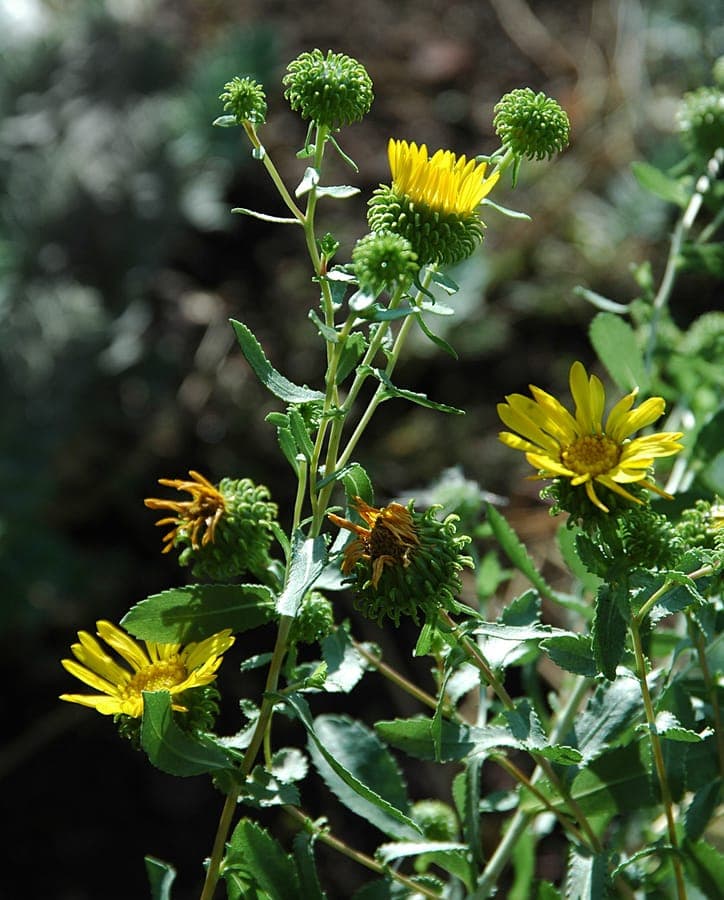
Wikimedia Commons / CC BY-SA 3.0, via Wikimedia Commons
Grindelia squarrosa: A Hardy Bloom for Dry Gardens
Grindelia squarrosa
¿Quieres ver Grindelia squarrosa: A Hardy Bloom for Dry Gardens en tu jardín?
1 minuto, sin tarjeta de crédito
Overview
Grindelia squarrosa, commonly known as curly cup gumweed, is an annual or short-lived perennial herbaceous plant belonging to the Asteraceae family. Native to central and western North America, it thrives in arid, open environments such as prairies, disturbed soils, roadsides, and dry slopes. In horticulture, Grindelia squarrosa is valued not only for its architectural beauty and consistent flowering but also for its ecological role in supporting pollinators and thriving in low-water landscapes.
This species can grow up to 2 feet (60 cm) tall with an upright, branching structure. The most distinctive feature is its prominent, golden-yellow flower heads surrounded by stiff, reflexed phyllaries - bracts that curl backward to form a cup-like shape, giving the plant its common name. The leaves are lance-shaped, coarsely toothed, and slightly sticky due to the presence of resin. Historically, Native American tribes utilized extracts from the plant, particularly the resinous flower buds, for medicinal purposes such as treating respiratory conditions and skin irritations.
Grindelia squarrosa has seen renewed interest in xeriscaping and naturalistic garden designs, where its low maintenance and high visual impact make it a standout choice. It's especially suited for meadow plantings, pollinator gardens, and habitat restoration projects.
Appearance & bloom cycle
Grindelia squarrosa produces bright golden-yellow composite flowers from mid-summer to early fall, typically July through September. Each flower head measures about 1 to 1.5 inches (2.5–3.8 cm) in diameter and features an outer ring of yellow ray florets encircling a dense center of darker yellow to reddish disc florets.
The defining trait is the involucre - the whorl of bracts beneath the flower head. These bracts are green, rigid, and strongly reflexed, curving backward to create a dramatic, cup-shaped silhouette. This characteristic not only makes the plant highly recognizable but also provides a protective enclosure for the developing buds, reducing moisture loss and deterring herbivores.
The foliage is a medium green, often with a grayish tinge, and arranged alternately along the stems. Leaves are lanceolate to oblanceolate, with serrated margins and a slightly rough texture due to fine hairs. When crushed, they emit a mild, resinous aroma. The plant grows in a clumping habit and may reseed readily in favorable conditions, forming small naturalized colonies.
After flowering, seeds mature in late summer and are dispersed by wind or small animals. While the plant is typically annual in colder zones, it can behave as a short-lived perennial in milder climates when provided with winter protection.
Ideal location
Full sun is essential for optimal growth and flowering. Grindelia squarrosa requires at least 6 to 8 hours of direct sunlight daily. In shaded conditions, the plant becomes leggy, loses structural integrity, and produces fewer flowers. For gardeners, this makes it ideal for use in xeriscapes, rock gardens, gravel beds, and native plant borders.
It performs exceptionally well in exposed, windy sites, mimicking its natural prairie habitat. However, in very high-wind areas, tall stems may benefit from neighboring plants for light support. Avoid overcrowding, as good air circulation helps prevent fungal diseases and promotes robust blooming.
Landscape uses include cottage-style wildflower meadows, habitat gardens, and educational plots focusing on native flora. It's also useful in erosion control on dry slopes due to its fibrous root system.
Diseño gratis
¿Quieres ver Grindelia squarrosa: A Hardy Bloom for Dry Gardens en tu jardín? Crea un diseño gratis ahora.
Soil requirements
The plant excels in lean, well-drained soils. Sandy, gravelly, or loamy soils are ideal. Heavy clay soils should be avoided unless amended with coarse sand or organic matter to improve drainage. The soil pH range for Grindelia squarrosa is between 6.0 and 7.5 - neutral to slightly alkaline conditions are preferred.
Rich, fertile soils should be avoided, as they can lead to excessive vegetative growth, weak stems, and reduced flowering. The plant's natural adaptation to poor soils makes it ideal for low-input gardening. In container settings, use a cactus or succulent mix with added perlite or pumice for optimal drainage.
Watering
Grindelia squarrosa is highly drought tolerant. Once established, it requires minimal irrigation and can survive entirely on natural rainfall in most temperate climates. During the first few weeks after planting, moderate watering helps root establishment. Afterward, reduce watering frequency significantly.
Overwatering is the primary risk; it can lead to root rot, crown rot, and fungal issues. Water only during prolonged drought periods (3+ weeks without rain), and ensure deep but infrequent soakings to encourage deep root development. Avoid frequent light watering, which promotes shallow roots and weak growth.
Pruning
Pruning is not required for plant health but can improve aesthetics and control self-seeding. Deadheading spent blooms extends flowering and prevents excessive volunteer seedlings. Cut back stems in late fall or early spring to maintain a clean appearance and make room for new growth.
If encouraging natural propagation, leave some seed heads intact over winter to provide food for birds and support self-sowing. Cut stems should be composted only if disease-free.
Maintenance calendar
- January: Monitor for winter damage. Remove heavy snow from plants if necessary.
- February: Start seeds indoors under grow lights for early germination.
- March: Sow seeds directly outdoors in warming soils. Prepare garden beds.
- April: Transplant seedlings after last frost. Weed around young plants.
- May: Monitor growth. Apply light mulch for moisture retention.
- June: Water during dry spells. Watch for aphids or spider mites.
- July: Flowering begins. Start deadheading to prolong bloom.
- August: Peak bloom. Attracts bees, butterflies, and beneficial insects.
- September: Reduce watering. Allow some flower heads to set seed.
- October: Cut back dead stems. Collect and store seeds if desired.
- November: Improve heavy soils with sand or grit. Apply light mulch in colder zones.
- December: Dormant period. Avoid fertilizing or disturbing soil.
Winter hardiness
Grindelia squarrosa is hardy in USDA zones 4 to 8. In colder zones, it behaves as an annual. In milder areas, it may survive as a short-lived perennial with proper mulching. Apply a dry mulch like straw or pine needles in late fall to insulate the crown without trapping moisture.
Even if the plant dies back, self-seeding ensures its return in spring. Overwintering success improves in well-drained sites with minimal winter saturation.
Companion plants
Pair Grindelia squarrosa with other drought-tolerant natives such as Echinacea purpurea, Rudbeckia hirta, Asclepias tuberosa, and various sedums. These combinations offer extended bloom times and increase pollinator diversity.
Avoid moisture-loving plants like hostas or astilbes. Instead, combine with yarrow, blanket flower, or ornamental grasses such as Bouteloua gracilis for a cohesive, low-water planting scheme.
Closing
Grindelia squarrosa is a standout choice for gardeners seeking beauty with minimal input. Its vibrant blooms, ease of care, and ecological value make it a powerful addition to sustainable landscapes. Whether restoring native prairie or designing a water-wise garden, this resilient wildflower brings color, form, and function. By respecting its simple needs - full sun, lean soil, and minimal water - you'll enjoy its reliable summer display year after year. As climate-conscious gardening gains traction, Grindelia squarrosa proves that hardy, low-maintenance plants can lead the way in creating resilient and beautiful outdoor spaces.
¿Quieres ver Grindelia squarrosa: A Hardy Bloom for Dry Gardens en tu jardín? Crea un diseño gratis ahora.
Sube una foto, elige un estilo y obtén un diseño fotorrealista con lista de plantas en menos de un minuto.
Sin tarjeta de crédito


Plantas similares
Calendula stellata: complete guide
Calendula stellata
Complete guide to Calendula stellata, the star-flowered marigold from Sicily: location, soil, watering and companion planting tips.
Korean chrysanthemum: complete guide
Chrysanthemum x rubellum
Chrysanthemum x rubellum is a hardy autumn perennial with single pink to copper flowers from August to November. Care and combinations.
Helianthus divaricatus: complete guide
Helianthus divaricatus
Helianthus divaricatus is a North American woodland sunflower with yellow summer blooms, ideal for naturalistic borders and shady edges.