
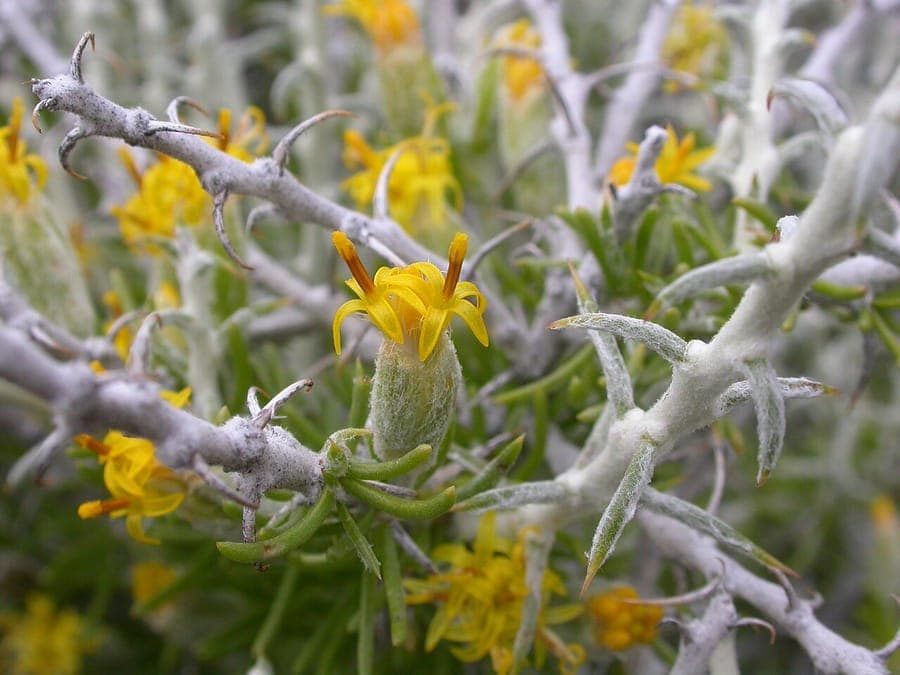
Matt Lavin / CC BY-SA 2.0, via Wikimedia Commons
Tetradymia spinosa: complete guide
Tetradymia spinosa
¿Quieres ver Tetradymia spinosa: complete guide en tu jardín?
1 minuto, sin tarjeta de crédito
Overview
Tetradymia spinosa, commonly called spiny horsebrush or cat-claw horsebrush, is a remarkable spiny subshrub native to the arid, alkaline landscapes of western North America. Its natural range encompasses the Great Basin, Nevada, Utah, and the desert regions of California. A member of the Asteraceae family, this plant has evolved over millennia to survive conditions that most garden plants would find lethal: extreme winter cold, scorching summer heat, minimal rainfall, and soils laden with mineral salts that most species cannot tolerate. Growing slowly to a height of 30 to 90 centimetres, Tetradymia spinosa forms a compact, densely branched mound with genuinely impressive survival adaptations that have made it a key species in desert revegetation projects. The genus name Tetradymia refers to the clustered nature of the flower heads, while "spinosa" is simply Latin for spiny. Gardeners interested in water-wise planting and minimal-maintenance front yard design can explore how this species fits into a cohesive composition at gardenworld.app, where drought-adapted shrubs take centre stage in professionally designed layouts.
Appearance and bloom
The shrub produces multiple upright stems directly from the base, giving it a bushy, mounded silhouette that reads as a grey-green dome from a distance. The branches are grey to light green and densely armed with short, sharp spines that resemble cat claws, which explains its evocative common name. The small, needle-like to lance-shaped foliage is grey-green in colour, coated in fine hairs that reduce water loss and reflect intense sunlight - a classic desert plant adaptation that also gives the plant its characteristic silvery appearance in bright sun. In spring and early summer, the plant produces composite flower heads in a conspicuous white to pale yellow colour that stands out vividly against the grey-green backdrop of stems and foliage. These flowers attract bees, hoverflies, and other pollinators, making the plant genuinely valuable for local biodiversity even in cultivated garden settings. After pollination, small fruits develop equipped with tufts of white or cream-coloured hairs that catch the wind and carry seeds across the landscape. Bloom time typically falls between April and July depending on elevation and local climate conditions, with higher-elevation plants blooming later.
Ideal location
Tetradymia spinosa demands a position in full sun without compromise. Partial shade reduces vigour and flowering significantly, while full shade is fatal. The plant tolerates hours of uninterrupted direct sunlight even at peak summer temperatures and does not require midday shelter the way some desert plants do. In temperate European gardens, the ideal position is a south-facing border, rock garden, or gravel bed where sun exposure is maximised throughout the day. A sheltered microclimate against a south-facing wall or fence significantly improves survival in cooler climates by raising local temperatures and reducing wind chill in winter. The plant is an excellent candidate for dry gravel gardens, xeriscape designs, and ornamental desert-themed plantings where water conservation is a priority. If you want to visualise exactly where this shrub would look best in your own front garden, gardenworld.app provides professional garden design tools that generate photorealistic layouts showing the possibilities before you commit to planting.
Soil
The soil requirements of Tetradymia spinosa differ markedly from those of most common garden plants. It is adapted to alkaline to mildly acid soils with a pH range of 6.5 to 8.2 and performs best at the higher, more alkaline end of that range. Unusually among ornamental shrubs, it also tolerates saline or slightly brackish soils, making it valuable for coastal gardens or locations affected by road salt. The single non-negotiable condition is outstanding drainage. Waterlogged, clay-heavy, or poorly drained soils invariably cause root rot and plant death, often within a single wet season. A planting mix of coarse sand, gravel, and lean topsoil in equal parts is ideal. Unlike most garden plants, Tetradymia spinosa should not receive additional fertiliser or compost amendments; rich soils trigger rapid, soft growth that is more susceptible to disease and reduces the natural hardiness that makes this species special. A surface mulch of coarse gravel 5 centimetres deep around the crown improves drainage and suppresses weeds without creating the moisture retention that organic mulches would produce.
Watering
Watering discipline is the single most important factor in successfully growing Tetradymia spinosa in a garden setting. In its native Great Basin habitat, annual precipitation totals just 150 to 300 millimetres, and the plant has evolved a deep tolerance for prolonged drought. In the garden, the recommended approach is the classic "drench and drought" method: water thoroughly once every two to three weeks and allow the soil to dry out completely before the next watering session. During the hottest weeks of summer, frequency can be increased marginally if temperatures are extreme and the soil dries out faster than usual. In autumn and winter, when the plant enters dormancy, watering can be suspended almost entirely. Overwatering is by far the most common cause of failure with this species in cultivation, and the symptoms - stem softening at the base, yellowing, and sudden collapse - often appear too late to reverse. Drip irrigation on a low-frequency schedule consistently outperforms frequent overhead watering because it mimics natural desert rainfall patterns. Collecting rainwater for irrigation helps avoid mineral salt build-up in the soil over time.
Diseño gratis
¿Quieres ver Tetradymia spinosa: complete guide en tu jardín? Crea un diseño gratis ahora.
Pruning
Tetradymia spinosa is naturally compact and self-shaping, requiring minimal intervention from the gardener. Its slow growth rate means established plants hold their form for years without pruning. In early spring, remove any branches killed by frost or physical damage, cutting cleanly back to live wood with a sharp, clean blade. Always wear thick leather gloves when working with this plant; the sharp spines can cause painful puncture wounds that are slow to heal. Hard pruning is not recommended because the plant responds poorly to drastic cutting and produces weak, irregular regrowth from cut stumps. If size management is needed, tip-prune only the longest stems after the blooming period ends, ideally in August when the worst summer heat has passed. This gives the plant adequate time to harden off new growth before winter arrives. Chemical growth regulators are entirely unsuitable for this species and may damage the root system.
Maintenance calendar
January to February: no action required, plant is in full dormancy. Check that no water is pooling around the base. March: inspect for frost damage and remove dead wood back to live tissue; growth will resume slowly as temperatures rise. April to May: bloom begins, apply a thin layer of gravel mulch around the base to conserve soil moisture and suppress weeds; water sparingly only if the soil is bone dry. June to July: peak flowering period, minimal watering, enjoy the pollinator activity and pale yellow flower display. August: light tip pruning after bloom if needed to maintain compact shape. September: final deep watering of the season, then transition to dry conditions. October to November: ensure drainage is optimal before winter frosts arrive; check that no standing water accumulates around the crown. December: full dormancy, no maintenance required, absolutely no watering.
Winter hardiness
Despite its desert origins, Tetradymia spinosa is impressively cold-hardy, a fact that surprises many gardeners who assume desert plants are frost-tender. In its native Great Basin range, winter temperatures regularly fall to -20 degrees Celsius or below, and the plant survives without damage provided drainage is excellent. In European gardens it is generally hardy to USDA zone 5, corresponding to minimum temperatures of -28 to -23 degrees Celsius, which covers the vast majority of the continent with ease. Frost damage to stems is rare when soil drainage is adequate; the main winter threat is waterlogging combined with cold, which rots the root system even when the stems appear healthy. A thick gravel mulch layer of 5 to 8 centimetres around the base helps keep the root zone dry and provides insulation against freeze-thaw cycling. In persistently wet European winters, a simple cold frame cover or transparent polytunnel shelter can be a worthwhile precaution. First-year plants benefit from additional protection; established specimens are considerably more resilient.
Companion plants
For an ecologically coherent and visually compelling dry border, Tetradymia spinosa pairs best with other Great Basin and desert steppe plants that share similar soil and water requirements. Artemisia tridentata, the big sagebrush, is a classic companion from the same region and creates an authentic Nevada desert atmosphere that is immediately recognisable. Penstemon species, with their tubular flowers in shades of red, purple, and blue, provide vivid colour accents through summer and are outstanding for pollinators. Yucca filamentosa or Yucca glauca contribute bold structural and vertical elements that give the planting backbone and year-round presence. Low-growing Sedum and Sempervivum varieties fill the ground-level role effectively without competing for deep soil moisture. Drought-tolerant ornamental grasses such as Festuca glauca or Helictochloa sempervirens add movement and textural contrast. Avoid mixing with Mediterranean plants such as lavender or rosemary unless pH levels are carefully managed, as these species tend to prefer less strongly alkaline conditions than Tetradymia spinosa demands.
Closing thoughts
Tetradymia spinosa is not a plant for gardeners seeking lush, low-effort colour. It is a plant for those who appreciate the raw beauty of extreme survival, understated form, and ecological authenticity. Planting this Great Basin subshrub in a dry alkaline garden is a commitment to biodiversity, genuinely minimal water use, and a distinctive aesthetic that sets the garden apart from conventional plantings. Its grey-green spiny mounds, delicate pale flowers, and windborne seeds tell the story of one of North America's most challenging landscapes in a way that no domesticated plant can replicate. Beyond ornamental use, this species plays a documented role in revegetation programmes on degraded desert soils, which speaks to its remarkable ecological value and adaptability. For ideas on how to incorporate Tetradymia spinosa and other exceptional drought-tolerant shrubs into a professionally designed garden layout that works for your specific climate and conditions, explore the possibilities at gardenworld.app.
¿Quieres ver Tetradymia spinosa: complete guide en tu jardín? Crea un diseño gratis ahora.
Sube una foto, elige un estilo y obtén un diseño fotorrealista con lista de plantas en menos de un minuto.
Más de 10.000 jardines diseñados
Sin tarjeta de crédito


Plantas similares
Calendula stellata: complete guide
Calendula stellata
Complete guide to Calendula stellata, the star-flowered marigold from Sicily: location, soil, watering and companion planting tips.
Korean chrysanthemum: complete guide
Chrysanthemum x rubellum
Chrysanthemum x rubellum is a hardy autumn perennial with single pink to copper flowers from August to November. Care and combinations.
Helianthus divaricatus: complete guide
Helianthus divaricatus
Helianthus divaricatus is a North American woodland sunflower with yellow summer blooms, ideal for naturalistic borders and shady edges.