
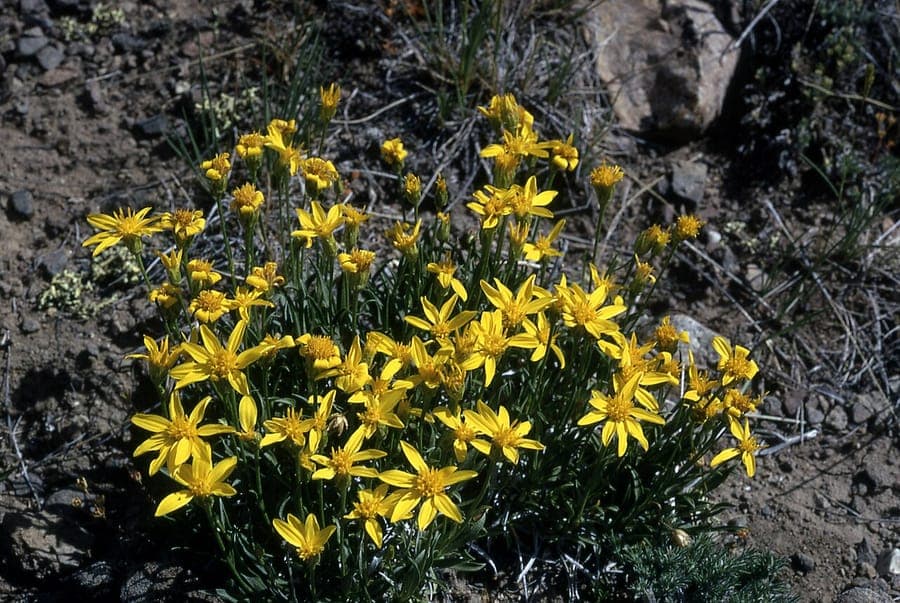
JW Stockert / Public domain, via Wikimedia Commons
Stenotus acaulis: complete guide
Stenotus acaulis
¿Quieres ver Stenotus acaulis: complete guide en tu jardín?
1 minuto, sin tarjeta de crédito
Overview
Stenotus acaulis is a remarkable low-growing subshrub belonging to the family Asteraceae, native to the western United States. Its natural range covers the Rocky Mountain region, with primary populations found in Wyoming, Colorado, Utah, Montana, and Idaho. In the wild, this plant colonises alpine and subalpine meadows, rocky slopes, and stony soils at considerable elevations. The species name 'acaulis' refers to its nearly stemless character: the plant hugs the ground so closely that the flowers appear to sit directly on the green cushion with almost no stems visible. Despite its modest stature of only 5 to 20 centimetres tall, Stenotus acaulis plays a vital ecological role as an early-season nectar source for butterflies, native bees, and other pollinators at a time when few other plants are in bloom at those high elevations. The rhizomatous growth habit allows the plant to spread steadily and quietly across rock surfaces and gravel, forming a progressively wider and denser mat over the years. Gardeners exploring rock garden ideas on gardenworld.app will find Stenotus acaulis a compelling and underused choice for creating vibrant, low-maintenance alpine displays.
Appearance and bloom
Stenotus acaulis forms dense, cushion-like mats of dark green, leathery narrow foliage. The individual blades are narrow, spatula-shaped to linear, only a few millimetres wide, smooth, and slightly glossy - all adaptations that reduce water loss in the plant's naturally harsh, dry environment. In late spring and early summer, which at high elevations may mean June or even July, the mat becomes studded with numerous bright yellow, daisy-like flower heads held on very short stems just above the foliage. Each flower head consists of a ring of vivid yellow ray petals surrounding a golden disc of tubular florets at the centre. The blooms are proportionally large relative to the plant itself, sometimes reaching 2 to 3 centimetres across, which makes the flowering display impressively showy for such a small plant. After flowering, fluffy seed heads appear, adding a subtle textural interest and providing food for small birds and insects. The plant spreads steadily via underground rhizomes, gradually extending its green carpet over surrounding rock and gravel surfaces year after year.
Ideal location
Full sun is non-negotiable for Stenotus acaulis. In nature this plant occupies open, unshaded slopes where sunlight is available throughout the day without interruption. In the garden, a minimum of six to eight hours of direct sunlight daily is required for healthy growth and good flowering. South-facing or south-west-facing positions in a rock garden, raised bed, dry-stone wall, or gravel garden are ideal. The plant is entirely unsuitable for shaded or partially shaded spots: without adequate sun it loses its compact cushion habit, produces fewer blossoms, and becomes susceptible to fungal issues. Sloping terrain that encourages water to drain away quickly after rain is particularly favourable. In flat, moisture-retaining areas the plant will struggle regardless of other conditions being met. For those planning a front garden or patio rock feature, gardenworld.app offers design tools and inspiration for integrating alpine plants like Stenotus acaulis into a cohesive and attractive layout.
Soil
One of the most remarkable characteristics of Stenotus acaulis is its exceptionally wide pH tolerance: the plant thrives in soils ranging from pH 3.7 to 8.5. This is an unusual trait that makes it compatible with almost any soil chemistry, from strongly acidic mountain soils to alkaline limestone and chalk. Despite this flexibility, the plant strongly prefers lean, sharply draining soil. Rich garden soil loaded with organic matter encourages lax, overly lush growth that destroys the neat cushion form and leaves the plant vulnerable to root rot and crown disease. An ideal planting medium consists of a mix of horticultural grit, coarse sand, and a small proportion of low-fertility topsoil or loam. When planting in heavier clay-based garden soil, incorporate generous amounts of gravel or perlite to improve drainage significantly before planting. Never add fertiliser-rich composts or farmyard manure to the planting hole.
Watering
Stenotus acaulis is a confirmed drought-tolerant plant, thoroughly adapted to extended dry periods in its Rocky Mountain homeland. Once established, typically after one full growing season, the plant requires little or no supplemental irrigation and is well suited to rainfall-only management in most temperate climates. During the first year after planting, watering once or twice a week in dry spells will help the root system establish itself and spread into the surrounding soil. After that, deep but infrequent watering during prolonged summer drought is sufficient to keep the plant healthy and flowering well. Overwatering is the most common cause of failure with this plant. Permanently moist soil, especially in winter when root activity slows, almost invariably leads to crown rot and plant death within a single season. Avoid drip irrigation systems that keep the root zone continuously damp; instead, water thoroughly and then allow the soil to dry out completely before watering again.
Diseño gratis
¿Quieres ver Stenotus acaulis: complete guide en tu jardín? Crea un diseño gratis ahora.
Pruning
Stenotus acaulis requires minimal pruning and is one of the great virtues of this plant for low-maintenance rock gardens. After flowering, the spent bloom stalks can be trimmed away for a tidier appearance, though this is entirely optional since the developing seed heads have their own quiet charm and ecological value. The leathery narrow foliage remains evergreen or semi-evergreen throughout the year and does not need cutting back. If an older plant develops a dead or woody centre, a natural process in cushion plants that can appear after several years of vigorous spread, modest renovation pruning in early spring will encourage fresh growth from the outer margins. Remove the most congested central sections carefully and allow the peripheral portions to continue spreading. Avoid hard pruning into old wood: Stenotus acaulis does not regenerate readily from bare stems and overly aggressive pruning can weaken or kill well-established plants.
Maintenance calendar
In March and April, inspect the plant after winter and remove any frost-damaged foliage or discoloured tips. This is also the best time to apply a light topdressing of fresh grit around the crown to improve drainage. A minimal amount of slow-release, low-nitrogen fertiliser can be applied at this stage if the soil is very poor, but err toward less rather than more. In May and June, enjoy the bloom period and observe the pollinators visiting the flowers; no maintenance is needed during this time. After blooming in late June or July, trim spent flower stalks if desired. August and September are largely maintenance-free months; monitor for any signs of crown moisture issues after heavy rain and ensure drainage channels remain unblocked. In October, check that drainage around the plant is unobstructed before winter sets in. November through February require no active maintenance; the plant is dormant and needs only to be kept free from standing water around the crown.
Winter hardiness
Stenotus acaulis is an exceptionally cold-hardy plant, which is entirely unsurprising given its origins in the high alpine zones of the Rocky Mountains where temperatures regularly plunge to -30 degrees Celsius or lower. The plant withstands such temperatures without any harm, provided the soil drains freely and no moisture accumulates around the crown. In most of northern and western Europe, cold temperature alone is never a threat to this plant; it is the combination of cold and persistent wet that poses the real danger. A layer of coarse gravel placed around the crown, often called a grit collar, helps moisture drain away from the most vulnerable part of the plant during wet winters. In severe winters, the foliage may look somewhat battered, but the plant recovers strongly and quickly once spring arrives. Container-grown specimens are somewhat less cold-hardy because the entire root ball is exposed to freezing air temperatures rather than being insulated by the surrounding ground.
Companion plants
Stenotus acaulis pairs beautifully with a wide range of other alpine and drought-tolerant plants in a rock garden or gravel planting. Phlox subulata, which blooms at a similar time in shades of pink, lilac, and white, provides a complementary and harmonious colour contrast. Aubrieta deltoidea offers cascading purple blooms that echo and complement the yellow of Stenotus from a slightly different angle. Sempervivum species contribute year-round rosette structure and strong textural contrast that remains interesting even out of the flowering season. Sedum acre, another yellow-flowering ground cover with different foliage texture, shares the same cultural requirements and creates a pleasing partnership. Armeria maritima introduces a refined pink note and gently upright form without dominating. For background structure in a larger rock garden, Festuca glauca and small ornamental Allium species are excellent companions. Avoid pairing Stenotus acaulis with moisture-loving or nutrient-demanding plants, as their cultural requirements are fundamentally incompatible.
Closing thoughts
Stenotus acaulis is a genuine gem for anyone building or improving a rock garden, alpine bed, or gravel garden. Its combination of vivid early-season yellow flowers, neat cushion habit, extraordinary cold hardiness, and remarkable soil pH flexibility makes it a plant that gives generously while asking very little in return. It suits gardeners who want a reliable, low-maintenance ground cover that also supports local pollinators during the critical early weeks of the season when very few other plants are available. Although less well known in European horticulture than many other alpine plants, its track record in the harsh conditions of the Rocky Mountains speaks convincingly for itself. For personalised planting advice and garden design ideas that incorporate plants like Stenotus acaulis into beautiful and practical front garden layouts, visit gardenworld.app.
¿Quieres ver Stenotus acaulis: complete guide en tu jardín? Crea un diseño gratis ahora.
Sube una foto, elige un estilo y obtén un diseño fotorrealista con lista de plantas en menos de un minuto.
Sin tarjeta de crédito


Plantas similares
Calendula stellata: complete guide
Calendula stellata
Complete guide to Calendula stellata, the star-flowered marigold from Sicily: location, soil, watering and companion planting tips.
Korean chrysanthemum: complete guide
Chrysanthemum x rubellum
Chrysanthemum x rubellum is a hardy autumn perennial with single pink to copper flowers from August to November. Care and combinations.
Helianthus divaricatus: complete guide
Helianthus divaricatus
Helianthus divaricatus is a North American woodland sunflower with yellow summer blooms, ideal for naturalistic borders and shady edges.