
Wikimedia Commons / Public domain, via Wikimedia Commons
Gilia achilleifolia: complete guide
Gilia achilleifolia
¿Quieres ver Gilia achilleifolia: complete guide en tu jardín?
1 minuto, sin tarjeta de crédito
Overview
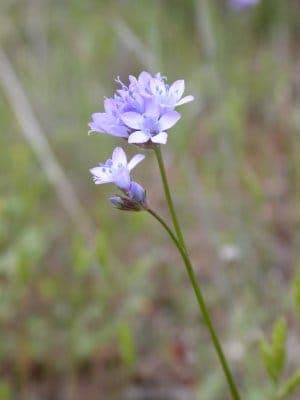
Gilia achilleifolia, known as California gilia or California gily-flower, is a North American annual plant with delicate, purple-blue flower clusters. This easy-to-grow wildflower grows natively in dry desert and grassland areas of California and Arizona. The plant is extremely adaptable and blooms abundantly throughout a long summer.
Appearance & Bloom
The plant grows 30-45 cm tall and 20-30 cm wide with fine, hair-like leaves distributed evenly along the stems. The flowers are small, 6-8 mm diameter, clustered in dense, ball-shaped heads with purple-blue or sometimes pink tints. The blooming period runs from April to October in warm climates. The plant has a wispy, elegant appearance.
Ideal Location
Gilia achilleifolia thrives best in full sun with at least 6 hours of direct sunlight daily. The plant is very sun-loving. Good air circulation prevents fungal problems. Plant in open, windy locations where the plant feels comfortable.
Soil
The plant thrives best on well-draining, sandy or loamy soil. Heavy clay soil must be improved with sand and gravel. Nutrient-rich soil is not essential - the plant grows well on poor soil. A pH of 6.5-7.5 is ideal.
Diseño gratis
¿Quieres ver Gilia achilleifolia: complete guide en tu jardín? Crea un diseño gratis ahora.
Watering
Gilia achilleifolia is extremely drought-tolerant. Water when planting and then only during very dry periods. Excessive watering leads to lush growth and fungal problems. The plant prefers it on the dry side once established.
Pruning
Minimal pruning is needed. You can deadhead faded flowers if desired, but this is not essential. The plant automatically produces new flowers. Deadheading, however, stimulates continued bloom throughout the summer.
Maintenance Calendar
March-April: Sow seeds in the ground or pots. May-June: Seedling growth, water until established. July-October: Bloom period, minimal watering. November-February: Winter dormancy, no watering.
Winter Hardiness
Gilia achilleifolia is an annual plant and cannot tolerate frost. The plant will die at the first frost. Resow seeds in spring. In warm climates, the plant may self-seed and reappear next season.
Companion Plants
Combine with other drought-tolerant desert plants such as Lupine, Salvia, Desert Sunflowers, and other native wildflowers. The purple-blue flowers contrast beautifully with yellow or orange flowers.
Closing
Gilia achilleifolia is an easy, attractive wildflower for dry locations and xeriscape gardens. The fine texture and long bloom period make it ideal for desert gardens. Seed is readily available. Learn more at gardenworld.app/en and gardenworld.app/nl.
¿Quieres ver Gilia achilleifolia: complete guide en tu jardín? Crea un diseño gratis ahora.
Sube una foto, elige un estilo y obtén un diseño fotorrealista con lista de plantas en menos de un minuto.
Más de 10.000 jardines diseñados
Sin tarjeta de crédito


Plantas similares
Phlox alyssifolia: complete guide to Alyssum-leaf Phlox
Phlox alyssifolia
Alyssum-leaf phlox is a compact alpine pink bloomer from North America. Discover care, location and all growing requirements.
Phlox richardsonii: complete guide to Richardson's Phlox
Phlox richardsonii
Richardson's phlox is an arctic bloomer exceptionally robust. Learn cultivation in extreme conditions and complete care guide.
Polemonium foliosissimum: complete guide
Polemonium foliosissimum
Polemonium foliosissimum is a vigorous Rocky Mountain perennial with blue-purple summer flowers that attract pollinators and thrive in borders.