
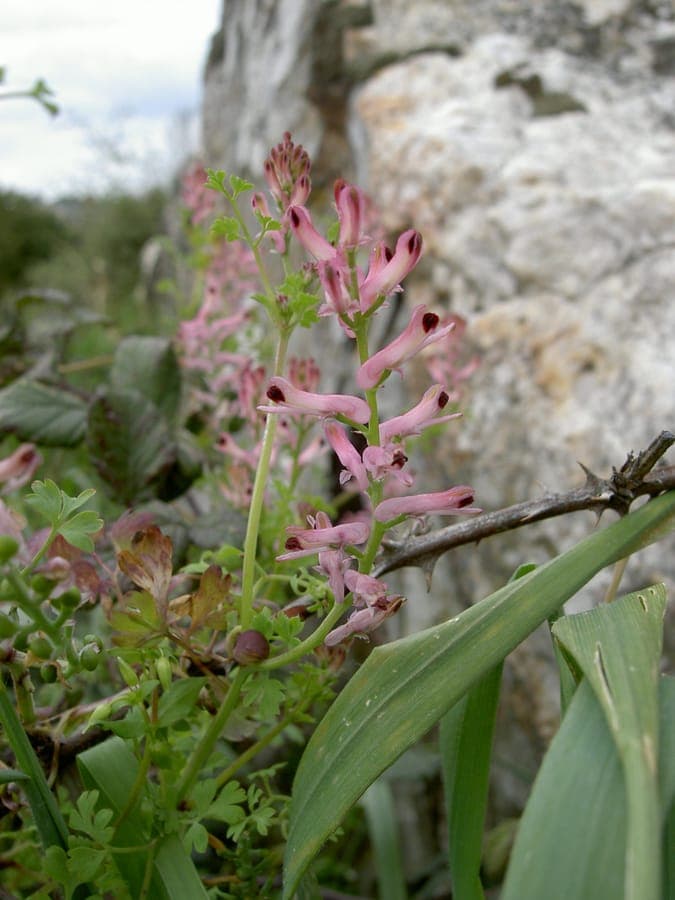
(c) aroche, some rights reserved (CC BY) / CC BY 4.0, via Wikimedia Commons
Fumaria bastardii: complete guide
Fumaria bastardii
¿Quieres ver Fumaria bastardii: complete guide en tu jardín?
1 minuto, sin tarjeta de crédito
Overview
Fumaria bastardii, commonly known as Bastard Fumitory or Tall Ramping-fumitory, is a delicate annual from the Mediterranean and Northwest European regions. The plant grows wild from North Africa to Britain, primarily along roadsides, in cultivated fields, and on disturbed sites.
This is a transient plant with fine, feathery foliage and small pink to purple flowers. While not dramatic, it has an attractive, airy growth. It is popular in naturalistic gardens and permaculture designs for bird seed and self-seeding habit.
Appearance and Bloom
Fumaria bastardii is recognizable by its fine, extremely feathered foliage that appears nearly hair-like. The plant reaches 20 to 40 centimeters in height. Flowers are small, approximately 5 to 8 millimeters long, and come in variations of pink to purple, sometimes nearly white.
The flowering period runs from April to August in northern Europe, but in milder climates it may bloom longer. Small flowers grow in loose spikes, giving the plant an airy, delicate appearance.
When seeds form, they change into small pod-shaped fruits. Seed dispersal happens via bird droppings, especially from finches and other seed-eaters.
Ideal Location
Fumaria bastardii grows best in sunny to half-shaded positions. The plant thrives in open, unstructured landscapes. It grows well along borders, in wild corners, and in permaculture designs.
The plant is not fussy about position. It grows equally well on south-facing slopes as on flat terrain. In heavily shaded areas, flowering is less abundant.
The plant is extremely tough and grows well between stones, in cracks, and in less perfect growing spots.
Soil
Fumaria bastardii grows in virtually all soil types. The plant prefers dry to moderately moist soils. It thrives excellently in less fertile, even stony soils.
The plant tolerates both acidic and alkaline soils. It prefers soils with pH between 6.0 and 7.5, but grows outside this range too.
Good drainage is important, especially for long-term survival. In very wet conditions, it can rot out quickly.
Diseño gratis
¿Quieres ver Fumaria bastardii: complete guide en tu jardín? Crea un diseño gratis ahora.
Watering
Fumaria bastardii is reasonably drought-tolerant, especially once established. The plant needs moderate water during the growing season. In drier periods, supplemental water helps extend flowering.
Waterlogged conditions can lead to rotting. Good drainage is therefore important. In temperate regions, rainfall usually suffices.
In containers, one must water more regularly than in open ground.
Pruning
Pruning is not really needed since this is an annual. Deadheading spent flowers can, however, extend the blooming period by preventing seed formation.
If you want the plant to self-seed, leave some flowers to set seed. These seeds drop in fall and germinate in early spring.
Maintenance Calendar
Fall: Sow seeds directly in soil in September to October. They can survive winter and germinate in early spring.
Spring: Young plants appear in March to April. Thin them to about 10 centimeters apart.
Summer: Flowering from April to September. Water regularly. Remove spent flowers if you want extended blooms.
Fall: Leave some flowers for seed production. Collect seeds for next year if desired.
Winter Hardiness
Fumaria bastardii is treated as a self-seeding annual in temperate regions. The plant can survive winter as seed, but flowering plants do not survive frost.
Annual seeds that naturally fall in September and October can survive winter and germinate in spring. This provides annual repetition.
Companion Plants
Fumaria bastardii pairs well with other soft-growing, naturalistic plants:
- Other Fumaria species
- Light-growing flowers
- Grasses and sedges
- Other self-seeding annuals
- Small Daisy family species
Sow these together for a naturalistic, unforced effect.
Closing Remarks
Fumaria bastardii is an undervalued plant for naturalistic and permaculture gardens. With its delicate beauty, bird food, and self-seeding tendency, it adds a low-energy dimension to gardens.
Sow seeds directly in soil in fall, ensure good drainage, and let the plant work. Self-seeding will usually provide what you need in subsequent seasons.
For more information visit gardenworld.app for guides and naturalistic design ideas. Enjoy growing this airy flower!
¿Quieres ver Fumaria bastardii: complete guide en tu jardín? Crea un diseño gratis ahora.
Sube una foto, elige un estilo y obtén un diseño fotorrealista con lista de plantas en menos de un minuto.
Más de 10.000 jardines diseñados
Sin tarjeta de crédito


Plantas similares
Papaver gorodkovii: complete guide
Papaver gorodkovii
Papaver gorodkovii, the arctic poppy, thrives from Alaska to Russia's Far East. Discover how to grow this rare, extremely cold-hardy rock garden treasure.
Papaver setiferum: complete guide
Papaver setiferum
Papaver setiferum is a hardy giant Caucasian poppy with fiery red blooms. Discover siting, soil, deadheading and winter hardiness.
Pale Poppy: complete guide
Papaver alboroseum
Discover pale poppy (Papaver alboroseum) - rare alpine poppy with white-pink flowers. Precious beauty from Kamchatka. Cultivation in alpine and rock gardens.