
Papaver setiferum: complete guide
Papaver setiferum
¿Quieres ver Papaver setiferum: complete guide en tu jardín?
1 minuto, sin tarjeta de crédito
Overview
Papaver setiferum, sometimes called the Caucasian giant poppy, is a hardy herbaceous perennial in the poppy family (Papaveraceae). The species occurs naturally from eastern Turkey through the Caucasus, and has since naturalized in parts of the Czech Republic, Denmark, Finland, France, Great Britain, Hungary and Sweden. That spread as far north as Scandinavia already hints at the plant's impressive winter hardiness.
The name setiferum, meaning bristle-bearing, refers to the coarse, hairy bristles covering stems and leaves, a trait it shares with its more famous cousin, the oriental poppy. On gardenworld.app, Papaver setiferum regularly appears in designs for cottage gardens and sunny borders where an early, vividly colored highlight is wanted.
In ornamental gardens, Papaver setiferum is often confused with its more famous cousin Papaver orientale, though the two species can be distinguished by the shape of the seed capsule and the precise pattern of the petal blotch. For enthusiasts of early-blooming, showstopping perennials, this is a surprisingly little-known gem that is rarely found in standard garden centers.
Appearance and bloom
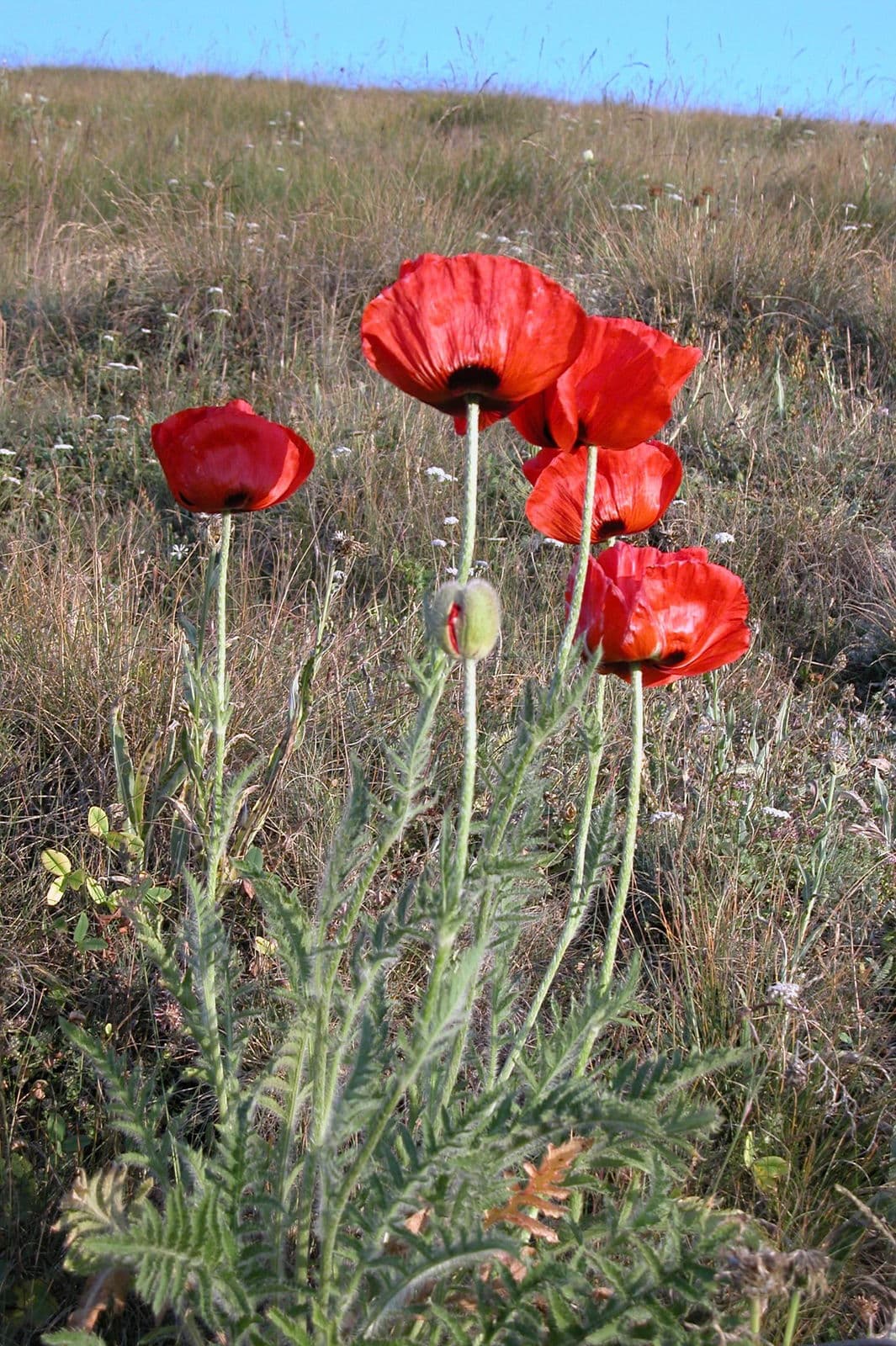
The plant forms a basal rosette of deeply cut, bristly leaves reaching up to 30 cm long. From this rosette, flower stems 60 to 100 cm tall shoot up in May, each crowned by a single, lush bud.
The flowers themselves are spectacular: up to 12 to 15 cm across, with thin, silky petals in fiery red to scarlet, often marked by a dark, near-black blotch at the base of each petal. Bloom falls in May and June and lasts roughly three to four weeks. After flowering, decorative seed capsules appear, followed by the typical summer dormancy: the foliage dies back and the plant disappears until autumn.
Ideal location
This poppy prefers a fully sunny spot, with at least 6 hours of direct sun daily. A little shelter from strong wind is welcome, since the large, tissue-paper-thin blooms can be damaged in storms.
The plant suits a classic cottage border, a gravel garden, or a sunny perennial bed beautifully. Because the foliage disappears after flowering, pair Papaver setiferum with neighbors that fill the bare gap later in the season.
Soil
Papaver setiferum grows best in well-drained, moderately fertile soil with a pH between 6.0 and 7.5. The plant develops a long taproot and, once established, tolerates dry spells well as a result.
Avoid heavy, wet clay in winter: stagnant water around the taproot is the leading cause of death. Improve heavy soil with grit or coarse sand before planting. In poor, sandy soil, the plant often flowers even more abundantly than in overly rich ground.
Watering
Water young plants regularly during their first season, especially during dry spells in April and May, to develop a strong root system. Once flowering ends and the foliage begins retreating, watering can be scaled back completely.
During summer dormancy, from July through September, the plant needs almost no water at all; the rootstock survives comfortably on residual soil moisture. Resume normal watering only once new foliage appears in autumn.
Pruning
Maintenance on Papaver setiferum is limited to removing spent flower stems after bloom, sometime in June. This prevents unwanted self-seeding if that is not desired, though many gardeners deliberately leave a few seed capsules standing for decorative value in the border.
Once the foliage fully yellows and dries in summer, simply cut it back to ground level. New foliage appears on its own in September or October and overwinters as a small rosette.
Diseño gratis
¿Quieres ver Papaver setiferum: complete guide en tu jardín? Crea un diseño gratis ahora.
Maintenance calendar
March-April: new rosettes develop; apply first light feeding.
May-June: main bloom; remove spent stems as desired.
July-August: summer dormancy, virtually no watering needed.
September-October: new foliage appears, resume light watering.
November-February: dormant period, rosette stays green and winters through practically unscathed.
Winter hardiness
Papaver setiferum is remarkably winter hardy, in part thanks to its natural range extending into Sweden and Finland. The plant is hardy to USDA zone 4, corresponding to temperatures down to -30C. In the Netherlands, Belgium, Germany and France, this poppy therefore overwinters without any protection whatsoever.
The real risk is not cold but wet soil in winter. Ensure adequate drainage around the rosette, and the plant returns flawlessly every spring. Even in the coldest regions of the Netherlands, such as Twente or the Achterhoek, and in the Belgian Ardennes, this poppy survives winter without extra protection, making it one of the hardiest ornamental poppies available for the northern European garden.
Companion plants
Because the foliage of Papaver setiferum disappears after bloom, the plant pairs excellently with later performers that fill the bare gap, such as catmint (Nepeta), lady's mantle (Alchemilla mollis) and ornamental grasses. Hardy geraniums (Geranium 'Rozanne') further fill out the border once the poppy retreats.
At Intratuin and Gamma garden centers, seed and young plants of related Papaver species are usually stocked in the perennial section; for the specific species setiferum, a specialty seed supplier is often the more reliable source.
Propagation
Papaver setiferum is propagated almost exclusively from seed, since the plant forms a long taproot that tolerates transplanting poorly. Sow directly in place in September-October or March-April, covered lightly with a thin layer of soil, where the plant is meant to remain permanently. Germination takes 2 to 4 weeks at 15 to 18 degrees Celsius. Thin seedlings to 30 to 40 cm apart once they reach a few centimeters tall. Division of the rootstock is technically possible on older plants, but success rates are low due to the sensitive taproot; sowing therefore remains by far the most reliable method for this species.
Pests and diseases
Papaver setiferum suffers from few persistent diseases. Powdery mildew can appear on foliage during humid, shaded summers, but rarely occurs on plants grown in full sun with good air circulation. Slugs pose the greatest threat to young seedlings in early spring; protect emerging plants with slug pellets or a physical barrier. Aphids sometimes cluster on flower buds just before opening, but rarely cause lasting damage and are usually cleared quickly by ladybugs. Root rot from persistently wet winter soil is the leading cause of death, and entirely preventable with good drainage.
Closing
With its fiery red, tissue-paper-thin blooms and impressive winter hardiness extending into Scandinavia, Papaver setiferum is a surprisingly tough addition to the sunny border. On gardenworld.app you can preview beforehand how this poppy, paired with its later-blooming neighbors, keeps a border interesting all season long. For anyone who loves a brief but intense flowering peak followed by a trouble-free rest period, this Caucasian beauty is well worth growing.
¿Quieres ver Papaver setiferum: complete guide en tu jardín? Crea un diseño gratis ahora.
Sube una foto, elige un estilo y obtén un diseño fotorrealista con lista de plantas en menos de un minuto.
Más de 10.000 jardines diseñados
Sin tarjeta de crédito


Plantas similares
Papaver gorodkovii: complete guide
Papaver gorodkovii
Papaver gorodkovii, the arctic poppy, thrives from Alaska to Russia's Far East. Discover how to grow this rare, extremely cold-hardy rock garden treasure.
Pale Poppy: complete guide
Papaver alboroseum
Discover pale poppy (Papaver alboroseum) - rare alpine poppy with white-pink flowers. Precious beauty from Kamchatka. Cultivation in alpine and rock gardens.
Sierra bleeding heart: complete guide
Dicentra nevadensis
Everything about Dicentra nevadensis - the Sierra bleeding heart: location, soil, watering and care for your garden.