
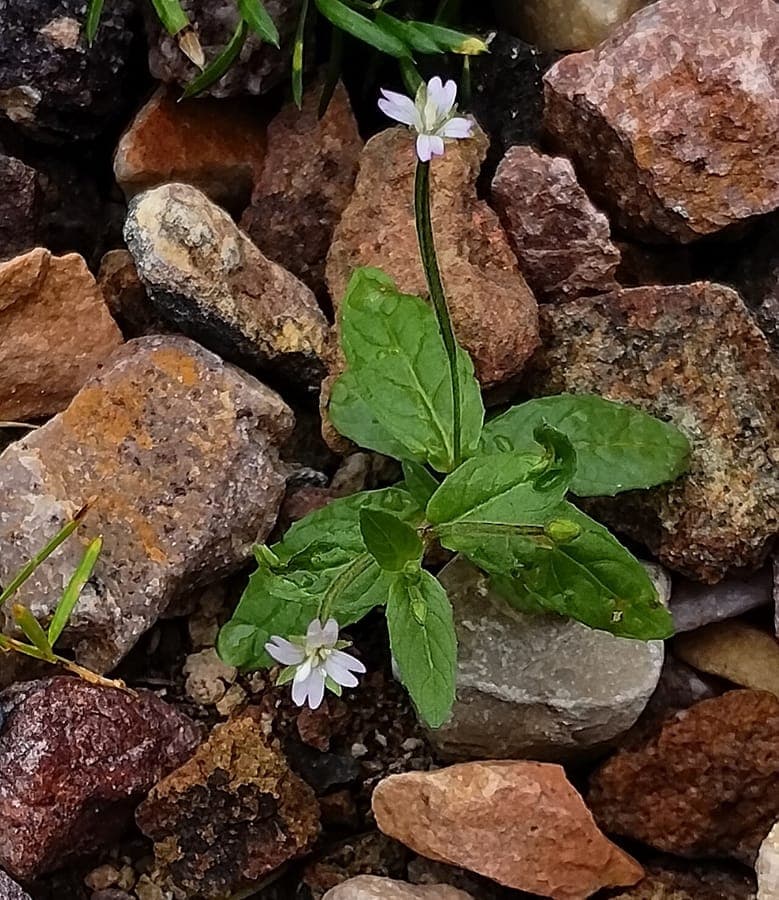
Plantman / CC BY-SA 4.0, via Wikimedia Commons
Pale willowherb: complete guide
Epilobium roseum
¿Quieres ver Pale willowherb: complete guide en tu jardín?
1 minuto, sin tarjeta de crédito
Overview
Pale willowherb (Epilobium roseum) is a charming wildflower native from Europe to Central Asia, thriving in moist to wet habitats. This delicate plant reaches 20-50 cm tall and produces countless small, delicate pink flowers from June through October. The epithet 'roseum' (pink) refers to the characteristic flower color, while 'pale' distinguishes it from more intensely colored relatives.
Epilobium roseum is perfect for gardeners seeking subtle yet fascinating plants for moist banks, ditches, and wetlands. This is not a typical cultivar plant, but rather a true wildflower with genuine ecological value. Through gardenworld.app, request a garden plan where wild water plants bloom at full potential together.
Appearance & Bloom
The plant features thin, reddish-brown tinged stems with narrow, elongated leaves that feel gray-green. Flowers are extremely small (about 4-6 mm diameter), in delicate pink to mauve shades. They grow in extensive clusters from leaf axils, covering the entire plant with blooms.
The seed plumes are extremely light and dance-like, allowing seed dispersal over considerable distances. This makes pale willowherb a 'nomadic' plant, establishing wherever space and moisture permit.
Ideal Location
Pale willowherb thrives in full sun to light partial shade, especially where moisture-loving species congregate. Stream banks, ditches, wet meadows, and pond margins are ideal. The plant spreads readily along water channels.
Soil & Nutrition
Well-suited to wet, nutrient-poor soils. Sandy to clay soil with high moisture retention is perfect. pH ranges from acidic (5.0) to neutral (7.0). Pale willowherb is extremely tolerant regarding soil nutrition.
Diseño gratis
¿Quieres ver Pale willowherb: complete guide en tu jardín? Crea un diseño gratis ahora.
Watering & Moisture Requirements
Constant to regular moisture is essential. In natural settings, the plant lives permanently in or very near water with sustained capillary moisture. In gardens, ensure soil remains regularly moist. Summer drought can suppress the plant, but it recovers quickly after watering.
Pruning & Maintenance
Minimal care required. After flowering, seed heads can be removed to prevent uncontrolled self-seeding. Dead stems are removed in March. The plant sometimes spreads aggressively via seed - which may be desirable (wild appearance) or require management.
Maintenance Calendar
- March-April: Clean up previous season; remove seed if needed
- April-May: Growth period; no special interventions
- June-October: Flowering and seed production
- October-November: Seed maturation
- November-February: Winter dormancy
Winter Hardiness
Epilobium roseum is hardy to USDA zone 4 (-30°C). In severe winters, the plant may die back to roots but regrows each spring.
Companion Plants
Pale willowherb combines beautifully with:
- Shield ferns (Polystichum) for textural contrast
- Marsh marigold (Caltha palustris) for yellow accents
- Water plantain (Alisma plantago-aquatica) for architectural forms
- Japanese iris (Iris laevigata) for purple-blue tones
Conclusion
Pale willowherb is a delicate, underrated wildflower that brings wetland meadows to life. Its affinity for moist sites makes it invaluable in ecologically conscious gardens. With gardenworld.app, create ecosystems where subtle species like epilobium roseum reveal their full beauty.
¿Quieres ver Pale willowherb: complete guide en tu jardín? Crea un diseño gratis ahora.
Sube una foto, elige un estilo y obtén un diseño fotorrealista con lista de plantas en menos de un minuto.
Más de 10.000 jardines diseñados
Sin tarjeta de crédito


Plantas similares
Marsh willowherb: complete guide
Epilobium palustre
Marsh willowherb (Epilobium palustre): graceful plant for wet areas. Growing tips, care, and habitat combinations for wetland gardens.
Myrtle: complete guide
Myrtus communis
Myrtle is a Mediterranean shrub with glossy leaves and white flowers. Ideal for sunny locations, grows 1-3 meters tall. Prefers dry to moderately moist soil with pH 6.0-8.0. Suitable for terrace containers in the Netherlands.