
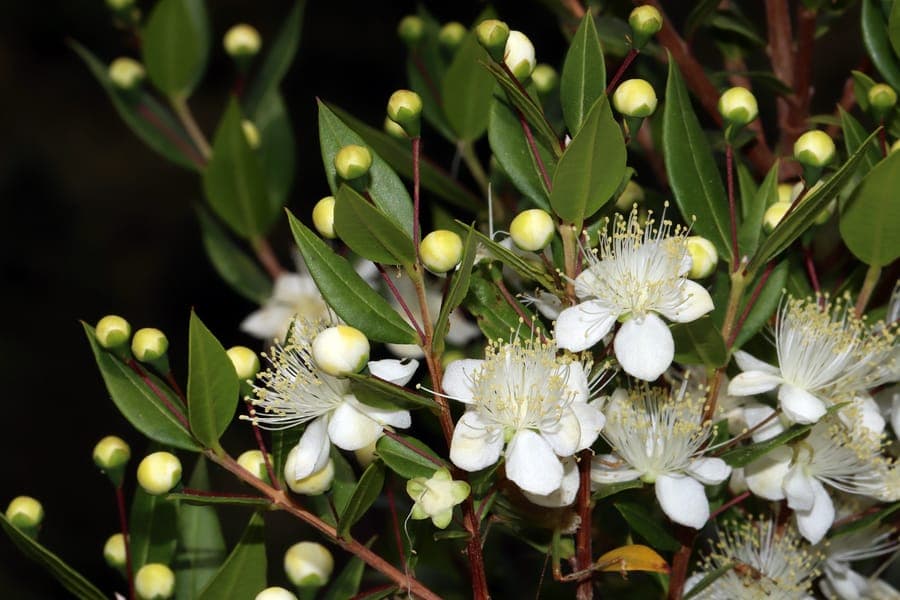
LIGURIAN VASCULAR FLORA / CC BY 2.0, via Wikimedia Commons
Myrtle: complete guide
Myrtus communis
¿Quieres ver Myrtle: complete guide en tu jardín?
1 minuto, sin tarjeta de crédito
Overview
Myrtle (Myrtus communis), also known as common myrtle, is a beautiful Mediterranean shrub from the myrtle family (Myrtaceae) that has been valued since antiquity for its fragrant foliage, delicate flowers, and aromatic fruits. This plant originates from the Mediterranean region where it occurs naturally in garrigue and macchia vegetation. Myrtle grows to 1-3 meters tall and forms a compact, densely foliaged shrub with glossy dark green foliage. What makes this plant unique is the fine aroma released when brushing past the small, oval leaves - a scent traditionally used in Mediterranean countries in bridal bouquets and spiritual rituals.
The plant produces beautiful small white flowers from July to August, followed by blue to black berry-like fruits that are highly decorative. Myrtle is particularly valuable in ecological gardens because it attracts flower-visiting insects and provides berries for birds. In northern climates, myrtle can be grown in containers and protected during winter, making it popular for terrace garden designs.
Appearance and bloom cycle
Myrtle grows to a height of 1-3 meters, depending on cultivar and growing conditions, but can remain more compact if regularly pruned. The leaves are small, narrow, 1-2 cm long, glossy dark green and very densely arranged along the stems. The leaf surfaces have a smooth, almost layered texture. The stems are green to reddish, smooth, and erect growing.
Flowers appear in July and August in small clusters at the end of twigs. Each flower is only 0.8-1 cm across but extremely fragrant and very attractive to bees. The flowers are white to cream-colored, with many yellow stamens that make the flower very lively. After flowering, fruits form that begin green, then turn blue-purple and finally black (nearly black). These fruits are 0.8-1 cm across and can remain on the plant for up to 6 weeks, which is very decorative.
Ideal location
Myrtle performs best in fully sunny locations with at least 6-8 hours of direct sunlight daily. This makes it ideal for south-facing walls of houses, against south-facing facades, or on sunny terrace spots. The plant also accepts partial shade (4-6 hours sun) but grows less compactly there and flowers less abundantly. In full shade the plant will not grow well.
The ideal location also offers protection from strong northwestern winds, especially in winter. In the Netherlands and Belgium, myrtle can survive outdoors only in very protected locations (for example against a south-facing wall with additional protection) in zones where temperatures rarely drop below -5 degrees Celsius. In most regions, protected container growing is preferable.
Soil requirements
Myrtle prefers dry to moderately moist, well-drained soils. The ideal pH ranges between 6.0 and 8.0 (neutral to moderately alkaline). In containers, use best quality potting soil mixed with sand or perlite (ratio 2:1) to ensure excellent drainage. The plant cannot tolerate waterlogging and will rot in constantly wet conditions.
In ground soil, add sand or gravel to heavy clay soils to improve drainage. The plant grows better in nutrient-poor to moderately fertile soils - do not use excessive fertilizer as this leads to succulent, poorly branched growth. An annual topdressing of coarse sand helps maintain drainage around the roots.
Diseño gratis
¿Quieres ver Myrtle: complete guide en tu jardín? Crea un diseño gratis ahora.
Watering and nutrition
Myrtle is highly drought-tolerant but grows better with regular, moderate watering. In ground, water only once every two weeks, especially during full growth (May-August). In containers, water more cautiously - check if substrate feels dry before watering again. Winter watering should be minimal, as growth then stops.
Feeding is not critical. An annual dose of slow-release fertilizer or lean fertilizer in spring is sufficient. Excessive nitrogen promotes soft foliage more susceptible to disease. In containers, diluted fertilizer solution can be applied once monthly during growing season.
Pruning and shaping
Myrtle tolerates pruning well and can be trained in many forms. For compact, bushy growth, prune annually in spring (March-April) by removing growth tips until the plant reaches desired width and shape. This stimulates side shoots and makes the plant denser. For standard form (single stem), remove all lower side shoots during growth and prune only the top bud regularly.
Remove dead or damaged branches when noticed. Unhealthy growth indicates problems with drainage or underwatering - ensure better water management.
Maintenance calendar
March to April: Begin the growing season. Give moderate water. Prune growth tips for compact form. Check for insects or diseases from previous season.
May to July: Growing period in full swing. Water regularly but not excessively. Enjoy flowering in July.
August to September: Flowering subsides. Fruits begin to color. Continue regular watering.
October to November: In northern climates, move containers to protected spot (for example against wall or in covered terrace). Reduce water gradually.
December to February: Minimal water (only if soil is very dry). Plant rests. Check monthly for problems. In very cold periods, provide extra protection (for example burlap cloth).
Winter hardiness
Myrtle is moderately winter hardy. While it can tolerate temperatures from -5 to -8 degrees Celsius (USDA zone 8), it is not suitable for unprotected outdoor cultivation in most Dutch and Belgian locations outside very southern coastal zones. However, in protected locations (for example against a south-facing wall with extra protection or in warm garden micro-climates) the plant can overwinter in zones down to -5 degrees.
Preference is for pot cultivation with relocation to protected locations in winter (garage, greenhouse, or against wall with burlap protection). Groups of potted plants can be placed against each other to maintain mutual heat.
Companion planting combinations
Myrtle works beautifully with other Mediterranean plants. Combine it with lavender (Lavandula angustifolia), rosemary (Rosmarinus officinalis), and sage (Salvia officinalis) for a classic Mediterranean garden complex. For smaller formats, pair with dwarf myrtle varieties and dwarf pittosporum.
In containers, combine myrtle with white-flowering petunias or verbena for contrast. For self-seeding tolerant combinations, add wild oregano (Origanum vulgare) and thyme (Thymus vulgaris). At gardenworld.app you will find inspiring Mediterranean garden designs.
Closing thoughts
Myrtle is a delightful addition to sunny gardens, especially for those who appreciate Mediterranean aesthetics. With its fragrant foliage, delicate flowers, and attractive fruits, it offers much seasonal beauty. In northern climates it can easily be grown in containers for mobile seasonal decoration. Search for healthy specimens at specialized garden centers or Mediterranean plant specialists. At Intratuin and Gamma in the Netherlands you will regularly find myrtle plants. At gardenworld.app you will discover more advice for Mediterranean garden design and container planting.
¿Quieres ver Myrtle: complete guide en tu jardín? Crea un diseño gratis ahora.
Sube una foto, elige un estilo y obtén un diseño fotorrealista con lista de plantas en menos de un minuto.
Más de 10.000 jardines diseñados
Sin tarjeta de crédito


Plantas similares
Flooded gum (Eucalyptus grandis): complete guide
Eucalyptus grandis
Everything about the flooded gum: fast growth, impressive stature and silvery bark. How to plant and care for this eucalyptus in your garden.
Yellow gum (Eucalyptus leucoxylon): complete guide
Eucalyptus leucoxylon
Everything about the yellow gum: showy flowers in winter, compact form and drought tolerance. How to grow and care for this eucalyptus in your garden.
Sydney blue gum (Eucalyptus saligna): complete guide
Eucalyptus saligna
Everything about the Sydney blue gum: extraordinary growth rate, beautiful grey-blue bark and impressive stature. How to plant and care for this eucalyptus.