
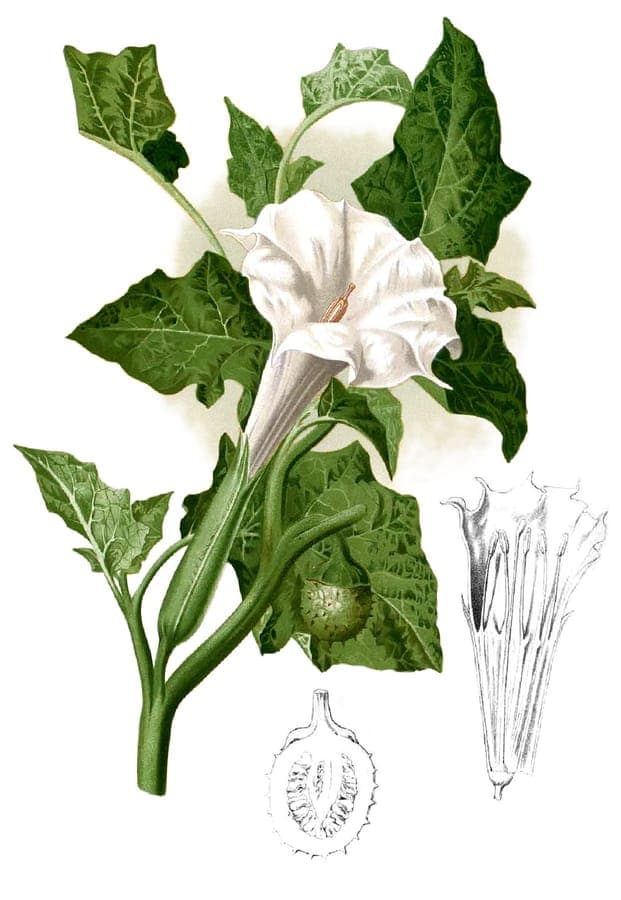
Francisco Manuel Blanco (O.S.A.) / Public domain, via Wikimedia Commons
Datura metel: complete guide
Datura metel
¿Quieres ver Datura metel: complete guide en tu jardín?
1 minuto, sin tarjeta de crédito
Overview
Datura metel, known as thorn apple or thorn-apple, is a striking plant from the Solanaceae family. This plant grows from Texas via Central America to Colombia. It is an annual or short-lived perennial plant known for its spectacular, large flowers.
The plant is toxic to humans and animals and contains tropane alkaloids. Despite this, it is a popular choice plant for gardens because of its exotic, beautiful flowers. However, it must be handled carefully.
Datura metel grows quickly and can become large in a single season. It is a plant for experienced gardeners who can handle toxic species carefully.
Appearance and bloom
Datura metel is a large, shrubby plant that can grow 1.5-2 meters tall. The stems are thick and sturdy with large, dark green leaves about 10-20 cm long. The leaves have irregular edges and rough texture.
The flowers are the highlight of this plant. They are large, funnel-shaped and can be white, yellow, purple or pink, depending on the cultivar. The flowers often have double petals and smell sweet, especially in the evening.
The seed pods are characteristic - round to oval shapes covered with strong thorns. They are about 5-8 cm in diameter. The seeds are black and numerous.
Ideal location
Datura metel thrives best in full sun. Plant it in locations with at least 6-8 hours of direct sunlight per day. The plant appreciates warm growing conditions and can tolerate very high temperatures.
The plant is wind-sensitive, so plant it in a slightly protected place, although it is not a major concern. It can be grown in pots on a terrace or balcony, or directly in the garden.
Ensure good air circulation around the plant to prevent fungal diseases. Avoid planting in very wet soils or low-lying areas.
Soil
Datura metel is not particularly fussy about soil. It grows in all soil types. The optimal pH is between 6.0 and 7.5. The plant prefers well-draining soil.
Add compost or well-rotted leaf matter to the planting hole. The plant is a strong grower and nutrient-hungry, so nutrient-rich soil promotes better flowering.
Water-holding capacity is important, but waterlogging must be avoided. A good balance is essential.
Watering
Datura metel needs regular watering, especially during growth and flowering periods. Keep the soil moist but not wet. Water deeply on a few days a week, depending on weather conditions.
In hot, dry periods, daily watering may be needed. Check the soil by inserting your finger - water if it is dry to about 2-3 cm depth.
Excessive water can cause root rot. In rainy seasons, supplemental watering may not be necessary.
Diseño gratis
¿Quieres ver Datura metel: complete guide en tu jardín? Crea un diseño gratis ahora.
Pruning
Pruning is optional for Datura metel. If you want a more compact plant, you can pinch the tops to stimulate branching. This leads to more flowers.
Remove dead flowers to stimulate more blooms. Also remove dead branches or diseased foliage.
Be careful when pruning - wear gloves and avoid skin contact. All parts of the plant are toxic.
Maintenance calendar
MAY-JUNE: Plant seedlings after last frost; water regularly. JULY-AUGUST: Full bloom; fertilize monthly. SEPTEMBER-OCTOBER: Seed pods ripen; reduce watering. NOVEMBER: End of season; collect seeds; pull up plant. DECEMBER-APRIL: Winter; no maintenance needed.
Winter hardiness
Datura metel is frost-sensitive and cannot tolerate temperatures below 5 degrees Celsius. In temperate climates, it is treated as an annual plant that dies after the first frost.
Seeds can be collected and resown the next season. In tropical and warm subtropical regions, it can be perennial and return each year.
In cold climates, the plant can be grown in containers that can be moved to a greenhouse for overwintering.
Companion plants
Datura metel is a striking focal point plant and gets most attention alone. Use it as a central point in a bed.
Combine it with other warm-loving plants with contrasting foliage. Gray foliage plants like Artemisia create beautiful contrast with Datura's dark green.
Low groundcover plants below can complement the structure.
Warning: Toxicity
Datura metel is highly toxic. All parts contain tropane alkaloids. Consumption can cause severe poisoning: rapid heartbeat, hallucinations, delirium, and in severe cases, death.
Although toxic, it is not a surface contact poison. Be careful with gloves and wash hands thoroughly after handling.
Keep the plant away from children and pets. Seeds are exceptionally toxic.
Closing thoughts
Datura metel is a spectacular plant for gardens where spectacular flowers are appreciated. But it requires respect for its toxic nature. With careful attention and cautious handling, you can safely enjoy this botanical marvel.
Visit OBI or Hornbach for seeds or cuttings. Read cautions on all labels. More information at gardenworld.app.
Gardenworld.app helps you create safe and beautiful gardens, even with challenging plants like datura metel.
¿Quieres ver Datura metel: complete guide en tu jardín? Crea un diseño gratis ahora.
Sube una foto, elige un estilo y obtén un diseño fotorrealista con lista de plantas en menos de un minuto.
Más de 10.000 jardines diseñados
Sin tarjeta de crédito


Plantas similares
Solanum dolichosepalum: complete guide
Solanum dolichosepalum
Discover Solanum dolichosepalum, an Andean nightshade with striking long sepals. Growing tips, hardiness, and companion planting for your patio.
Solanum ripense: complete guide
Solanum ripense
Discover Solanum ripense, a moisture-loving Andean nightshade for pond edges and conservatories. Growing tips, hardiness, and companions.
Solanum tomentosum: complete guide
Solanum tomentosum
Discover Solanum tomentosum, a thorny South African nightshade with felted leaves. Growing tips, hardiness, and companion planting ideas.