
Buendia22 / CC BY-SA 4.0, via Wikimedia Commons
Cobaea scandens: complete guide
Cobaea scandens
¿Quieres ver Cobaea scandens: complete guide en tu jardín?
1 minuto, sin tarjeta de crédito
Overview
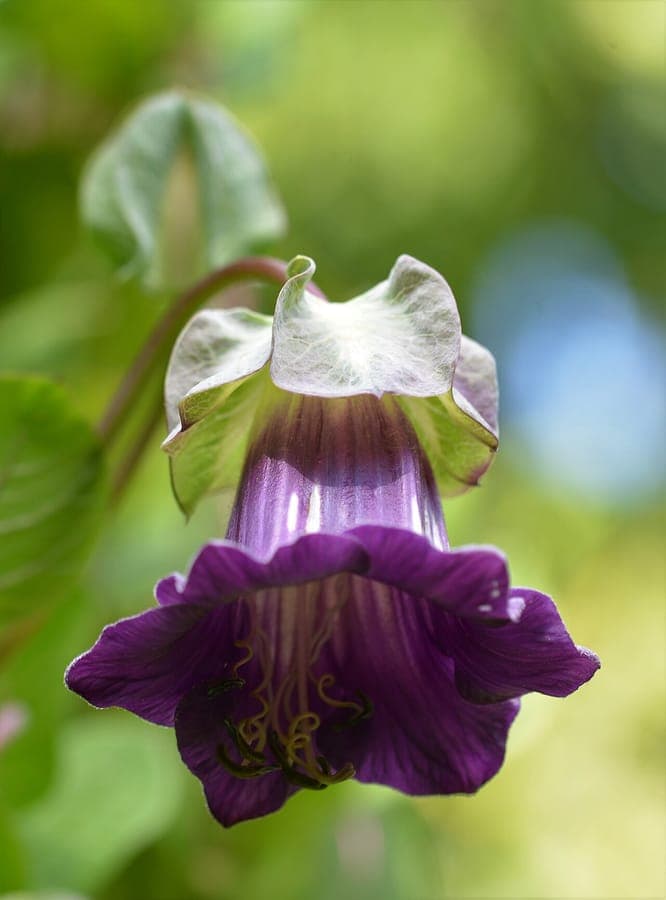
Cobaea scandens, commonly known as Cup-and-saucer vine or Cathedral bells, is a dramatic climber from Mexico. The plant gets its name from the large, bell-shaped flowers that enlarge as they mature, with a saucer-like base resembling a cup and saucer.
This is a fast-growing climber perfectly suited for pergolas, screens, and garden structures. The plant can grow several meters per season. In temperate climates it usually grows as an annual, while in warm areas it can be perennial.
Appearance and Bloom
Cobaea scandens is a twining climber with strong tendrils and large, green leaves. The plant reaches large sizes quickly with support. The main attraction, however, is the spectacular flowers.
Flowers start green-yellow and gradually deepen to violet-blue as they mature, taking two to three weeks. The individual flower is about 7-8 cm long, bell-shaped, and surrounded by a green calyx. A single plant can produce hundreds of flowers per season.
The flowers have a pleasant, lightly aromatic fragrance.
Ideal Location
Cobaea scandens grows best in a very sunny location with at least 6 hours of direct sunlight daily. In very hot climates, the plant accepts light afternoon shade. Full sun, however, promotes the most blooming.
The plant loves warmth and cannot tolerate frost. In temperate climates, protection from strong wind is important as the heavy growth can be damaged.
Soil Requirements
Cobaea scandens grows best in nutrient-rich, well-draining soil. Provide plenty of organic matter in the soil because the plant needs heavy feeding due to rapid growth. pH can be neutral to slightly acidic.
When using pots, use potting soil mixed with extra perlite for drainage.
Watering
Cobaea scandens needs lots of water due to rapid growth. Water regularly, especially during dry periods. The plant must not dry out. In pots, frequent watering is essential.
Mulching around the base helps support moisture retention.
Diseño gratis
¿Quieres ver Cobaea scandens: complete guide en tu jardín? Crea un diseño gratis ahora.
Pruning
Cobaea scandens grows very fast and can be pruned throughout the season for control. Pruning also stimulates denser growth and more flowers. Remove damaged parts and prune for shape.
The plant tolerates aggressive pruning well. After the season you can prune back heavily if you want to keep the plant for the next year.
Maintenance Calendar
Spring: Sow seed indoors or plant seedlings outside after last frost. Summer: Peak growth and blooming period. Water regularly, feed weekly. Prune for control. Support is essential. Fall: Blooming continues until frost. Gradually reduce feeding. Winter: In warm climate: plant goes dormant. In temperate climate: plant dies after frost.
Winter Hardiness
Cobaea scandens is absolutely not winter hardy and dies after the first frost in temperate climates. It's treated as an annual in most areas. In warm areas (USDA zones 9-11) it may grow as perennial if protected from hard winters.
The plant can be grown from seed each spring, or you can take cuttings in fall and overwinter them indoors.
Companion Plants
Cobaea scandens pairs beautifully with other summer-flowering climbers like Ipomoea (Morning Glory), Lathyrus (Sweet Pea), and Tropaelum (Nasturtium). The purple flowers work well with white, red, or yellow flowers.
Also works well with Hedera (Ivy) as background for contrast.
Closing
Cobaea scandens is a spectacular plant for those seeking a fast-growing, abundantly flowering climber. The unusual bell-shaped flowers are great conversation starters. With plenty of sunlight, nutrient-rich soil, and regular watering, you'll grow this plant effortlessly from seed. Perfect for filling empty pergolas in a single season.
Available at garden centres worldwide. Find more inspiration at gardenworld.app and gardenworld.app for additional plant collections.
¿Quieres ver Cobaea scandens: complete guide en tu jardín? Crea un diseño gratis ahora.
Sube una foto, elige un estilo y obtén un diseño fotorrealista con lista de plantas en menos de un minuto.
Más de 10.000 jardines diseñados
Sin tarjeta de crédito


Plantas similares
Phlox alyssifolia: complete guide to Alyssum-leaf Phlox
Phlox alyssifolia
Alyssum-leaf phlox is a compact alpine pink bloomer from North America. Discover care, location and all growing requirements.
Phlox richardsonii: complete guide to Richardson's Phlox
Phlox richardsonii
Richardson's phlox is an arctic bloomer exceptionally robust. Learn cultivation in extreme conditions and complete care guide.
Polemonium foliosissimum: complete guide
Polemonium foliosissimum
Polemonium foliosissimum is a vigorous Rocky Mountain perennial with blue-purple summer flowers that attract pollinators and thrive in borders.