
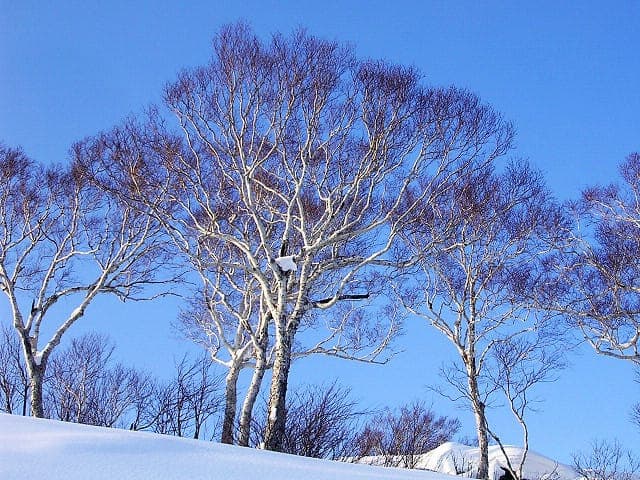
E-190 / CC BY-SA 3.0, via Wikimedia Commons
Russian rock birch: complete guide
Betula ermanii
¿Quieres ver Russian rock birch: complete guide en tu jardín?
1 minuto, sin tarjeta de crédito
Overview
The Russian rock birch (Betula ermanii), also called Erman's birch or stone birch, is an elegant birch species native to mountainous regions from Siberia to Japan. This tree is renowned for its striking white to pink-white peeling bark and spectacular golden-yellow autumn colour. It's an essential specimen for contemporary garden design.
Appearance & characteristics
The Russian rock birch grows into an upright, graceful silhouette reaching 12-18 metres tall and 6-10 metres wide. The stems display striking white-pink to orange-red bark that peels in papery flakes, providing year-round ornamental interest.
The foliage is small, oval, glossy green and finely textured. In May-June, inconspicuous catkins appear. Autumn colour is spectacular - bright golden-yellow to orange-yellow from August through October.
Growth is rapid (40-60 cm annually), reaching mature size in 20-30 years. The form remains naturally graceful without heavy pruning.
Ideal location
This tree performs best in full sun to light shade. Full sun produces the brightest stem colour. The Russian rock birch is remarkably flexible and even thrives in difficult locations. Plant it in your most visible spot - this tree deserves prominence.
Winter hardiness is exceptional - hardy to USDA zone 3 (-35°C) and considerably colder. Professional tree nurseries and major garden centres stock this species.
Soil requirements
The Russian rock birch grows in virtually all soil types. Sand, gravel, clay - all suitable. It tolerates acidic and neutral soils better than chalky soils. Add humus on very poor soils.
Good drainage is important - avoid permanently wet locations. On standard garden soil, this tree requires no soil amendments.
Diseño gratis
¿Quieres ver Russian rock birch: complete guide en tu jardín? Crea un diseño gratis ahora.
Watering
Water regularly after planting until the root system establishes (first growing season). Subsequently, this tree is extremely drought-efficient with its deep root system. During extreme summer drought, supplemental watering is beneficial but not essential.
Young trees may require staking for wind protection.
Pruning
This tree requires almost no pruning. Allow it to develop naturally. Remove only dead branches and very low vegetation. The white bark is itself decorative.
When young, minor formative pruning to remove lowest branches is beneficial.
Maintenance calendar
- March-April: Check for frost damage when young. Begin watering.
- May-June: Monitor for pests (very rare). Enjoy fine foliage and catkins.
- July-August: Water during extreme drought. Tree grows rapidly.
- September-October: Yellow foliage is spectacular. Photograph this moment!
- November-February: Winter dormancy. White stems stand out beautifully.
Winter hardiness
The Russian rock birch is extremely hardy - far hardier than USDA zone 3. This tree survives the severest winters without protection. Only heavy snow can break young branches, but recovery is rapid.
Companion planting
Perfect underplanting includes:
- Shade-tolerant perennials beneath the canopy (hostas, hellebores)
- Ground cover plants for wind protection
- Shrubs with contrasting foliage colour
- Spring-flowering bulbs
Standard trees make exceptional specimens. Essential on gardenworld.app for contemporary, minimalist garden designs.
Closing thoughts
The Russian rock birch is a masterpiece of form and colour. With its white stems and golden autumn hues, this tree offers value across all seasons. At maturity, an absolute showstopper providing decades of enjoyment.
¿Quieres ver Russian rock birch: complete guide en tu jardín? Crea un diseño gratis ahora.
Sube una foto, elige un estilo y obtén un diseño fotorrealista con lista de plantas en menos de un minuto.
Más de 10.000 jardines diseñados
Sin tarjeta de crédito


Plantas similares
Heart-leaf birch: complete guide
Betula cordifolia
Heart-leaf birch is an attractive North American birch tree for large gardens. Discover growth, white papery bark and winter hardiness.
Tropical hornbeam: complete guide
Carpinus tropicalis
Everything about Carpinus tropicalis, the tropical hornbeam from Central America. Growing tips, location, care, and garden use explained.
Japanese Alder (Alnus firma): complete guide
Alnus firma
Learn everything about Japanese Alder in our complete guide. Discover care, growth, and applications for larger gardens.