
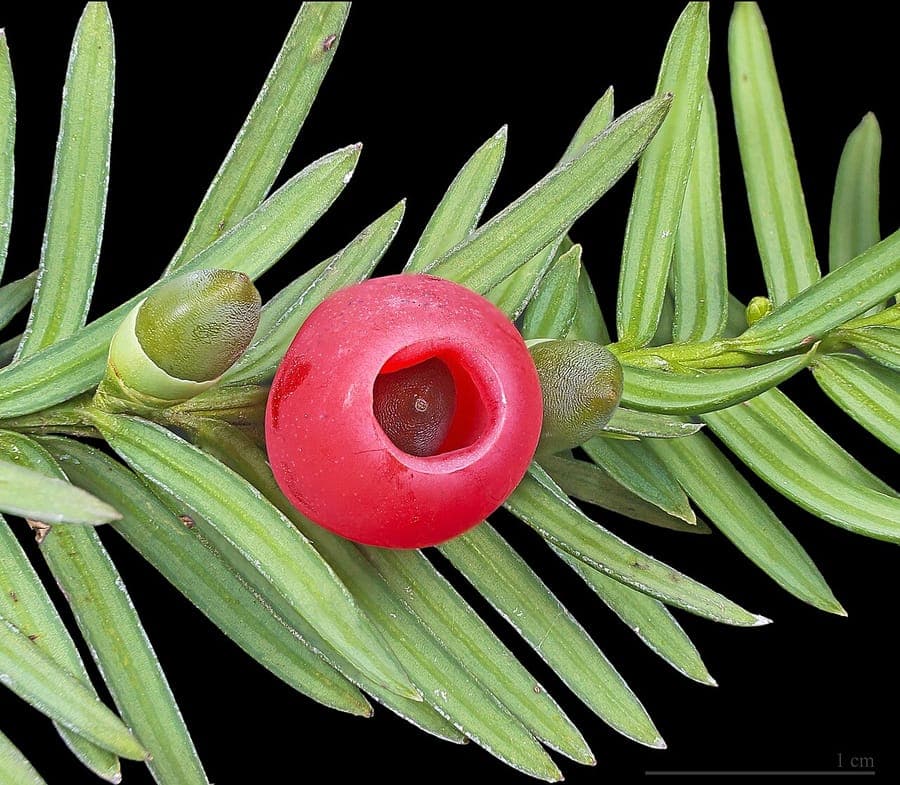
Didier Descouens / CC BY-SA 4.0, via Wikimedia Commons
English Yew: complete guide
Taxus baccata
Want to see English Yew: complete guide in your garden?
Full design in HD: €7.99
Overview
English Yew (Taxus baccata) is one of the most versatile and dependable evergreen plants for gardens in temperate climates. Whether you need a crisp, impenetrable hedge, an elegant topiary shape, or a stately specimen tree, yew delivers. This native European conifer has been used in garden architecture for centuries, from medieval cloister gardens to the great English landscape estates and the contemporary urban courtyard.
What makes yew so exceptional is the combination of qualities that no other hedging plant offers. Yew tolerates deep shade, regenerates after hard pruning, grows in virtually any soil, and outlives every other European tree - specimens exceeding two thousand years of age have been documented. On gardenworld.app you can create a garden design where yew forms the structural backbone: as a hedge, a cone, a sphere, or a backdrop for a flowering border. Unpruned, the tree reaches 10 to 20 metres, but it can be maintained effortlessly at any desired height.
Appearance and bloom
Yew has dark green, flattened needles 2 to 3 centimetres long, arranged in two rows along the twigs. The upper surface is glossy dark green, the underside slightly paler with two faint longitudinal bands. The foliage is retained year-round, making yew an outstanding evergreen hedge. New growth in spring is a striking fresh green that contrasts beautifully with the darker, older foliage.
Yew is dioecious: there are separate male and female plants. Male plants produce small, yellowish pollen cones on the underside of the twigs in February and March. Female plants, once pollinated, develop the characteristic red berries (arils) - bright scarlet, fleshy, with a single dark brown seed in the centre. The arils are the only non-toxic part of the yew; the flesh is sweet and is eaten by blackbirds and thrushes, which disperse the seeds. All other parts - needles, bark, wood, and seeds - are highly toxic to humans and most animals. This is a critical consideration when planting in gardens accessible to children and pets.
Ideal location
One of yew's greatest assets is its shade tolerance. Where most hedging plants languish in deep shade, yew thrives. From full sun to full shade - yew adapts. This makes it indispensable for north-facing gardens, for hedging beneath large trees, and for shaded urban plots where little light penetrates.
Yew also handles wind well, though it grows slightly faster in a sheltered position. The one condition yew truly cannot tolerate is prolonged waterlogging. For a yew hedge, a planting density of 4 to 5 plants per linear metre is standard for plants 60 to 80 centimetres tall. In the UK, yew hedges are a hallmark of cottage gardens and stately homes alike. In the USA, yew is equally at home in New England gardens, Pacific Northwest landscapes, and Mid-Atlantic borders. In Australia and South Africa, it performs best in cooler highland areas.
Soil requirements
Yew is exceptionally flexible regarding soil type. Heavy clay, light sand, chalky limestone, mildly acidic humus - yew roots and grows in all of them. The single firm requirement is that the ground must not be permanently waterlogged. Standing water leads to root rot, the primary cause of death in yew.
When planting in heavy clay, it is wise to dig the planting hole generously (at least twice the rootball width) and place a 10 centimetre layer of coarse gravel at the bottom for improved drainage. In poor sandy soil, work some compost into the top layer to improve moisture retention. The ideal soil pH ranges from 6.0 to 8.0, but yew grows outside this range too. Most garden centres and nurseries carry yew plants in sizes ranging from small pots to large rootballed specimens.
Watering
Newly planted yew requires regular watering during the first year. Give 5 to 10 litres per plant weekly, depending on weather and soil type. Allow the soil surface to dry slightly between waterings, but do not let the root zone dry out completely. After the first growing season, yew is reasonably drought resistant and manages without supplementary water in most years.
Pay particular attention during prolonged dry spells combined with frost in winter: evergreen plants continue to lose moisture through their needles in winter, while frozen ground cannot supply water. During mild winter spells (above freezing), give young yew plants an occasional thorough soak. Yew in containers needs attention year-round: check weekly and never let the rootball dry out entirely.
Free preview
Want to see English Yew: complete guide in your garden? Make a free preview of your design.
Pruning
Yew tolerates pruning like no other conifer. You can cut a yew back to bare old wood and it will resprout - a trait most conifers lack entirely. This makes yew ideal for topiary and for renovating neglected hedges that have grown out of shape.
Clip yew hedging one to two times per year. The best time for the main trim is late August to early September, when the principal growth flush has finished. A second light trim in June is optional but produces a crisper result. Use hedge shears for flat hedges and hand secateurs for topiary. Clip on an overcast day if possible, to prevent scorching of newly exposed foliage.
For topiary, yew is the undisputed number one. Spheres, cones, spirals, animal shapes - yew can be shaped into anything. Start with a simple form (sphere or cone) and build your skills. Wire frames to guide topiary cutting are available from specialist garden suppliers.
Maintenance calendar
March–April: Check for frost damage and winter desiccation (brown needles). Apply a 5 centimetre layer of mulch around the base, keeping the trunk itself clear.
May: New growth is clearly visible as bright green shoots. This is a good time to apply an organic fertiliser if needed.
June: Optional first clip for an extra-crisp result. Remove water shoots and strongly protruding growth.
July: Check for vine weevil (Otiorhynchus sulcatus) - adults notch the leaf edges, while larvae eat the roots.
August–September: Main clip. Shape the hedge or topiary form. Female plants begin to display red berries.
October–November: Planting season for yew hedging. Rootballed and bare-root plants can be planted now.
December–February: Dormancy. Water young plants and container plants during mild spells. Check for rabbit and hare damage to the bark of young specimens.
Winter hardiness
Taxus baccata is fully winter hardy across the UK, most of the USA (USDA zones 6–8), and comparable climates worldwide, withstanding temperatures to -20°C and below. As a native European species, yew is perfectly adapted to the variable winters of the Atlantic climate, with alternating frost and thaw.
The only winter issue that may arise is desiccation damage: during prolonged frost, the evergreen needles continue to transpire moisture that the frozen roots cannot replace. This manifests as browning of the foliage, typically on the windward side. Prevent this by watering during mild spells. Snow load is rarely a problem for clipped hedges, but free-growing yews with broad branches can split under heavy wet snow. Gently shake fresh snow from the branches during extreme falls.
Companion plants
Yew is the ultimate backdrop plant. Its dark green, uniform texture forms the perfect canvas for flowering borders. White and yellow flowers show up particularly well against it: think white roses, yellow yarrow (Achillea), and white foxglove (Digitalis purpurea 'Alba'). Hydrangeas (Hydrangea macrophylla) in white or pink in front of a yew hedge is a classic combination seen in gardens from the Cotswolds to Cape Town.
As structural hedging, yew combines excellently with box spheres (Buxus sempervirens) planted in front as a lower accent. Lavender (Lavandula angustifolia) as edging along a yew hedge gives a formal-romantic effect. For a contemporary garden, ornamental grasses such as Miscanthus or Stipa alongside a crisp yew hedge work brilliantly. In shaded situations, hostas, ferns, and astilbes make a beautiful foreground. The versatility of yew as a background is boundless - it is the green canvas on which you can compose any garden picture.
Closing
Yew is the most reliable and versatile evergreen hedging and topiary plant available to gardeners in temperate climates. Its shade tolerance, its ability to regenerate after pruning, its adaptability to virtually any soil type, and its extraordinary longevity make it without equal. Be mindful of the toxicity of all plant parts (except the red aril flesh) and plant thoughtfully where children and pets have access.
Purchase your yew plants from a reputable nursery for the best quality. On gardenworld.app you can create a garden design where yew forms the structural foundation - as a hedge, as topiary, or as the dark green backdrop that makes your flower borders sing. Give this ancient European conifer a place in your garden and enjoy its timeless elegance for generations to come.
Pruning
Want to see English Yew: complete guide in your garden? Make a free preview of your design.
Upload a photo, pick a style, and get a photorealistic design with plant list in under a minute.
Full design in HD: €7.99


Identify this plant in your own garden
Take a photo of a plant in your garden and see which one it is.
Similar plants
Common Boxwood: complete guide
Buxus sempervirens
Everything about Common Boxwood (Buxus sempervirens): planting, pruning, topiary and box moth control. Practical tips for healthy, green hedges and shapes.
English Lavender: complete guide
Lavandula angustifolia
Everything about English Lavender (Lavandula angustifolia): planting, pruning, care and overwintering. Practical tips for lush purple blooms.
Bigleaf Hydrangea: complete guide
Hydrangea macrophylla
Everything about the Bigleaf Hydrangea (Hydrangea macrophylla): planting, pruning, flower colour control and winter protection. Practical tips for lush blooms.