
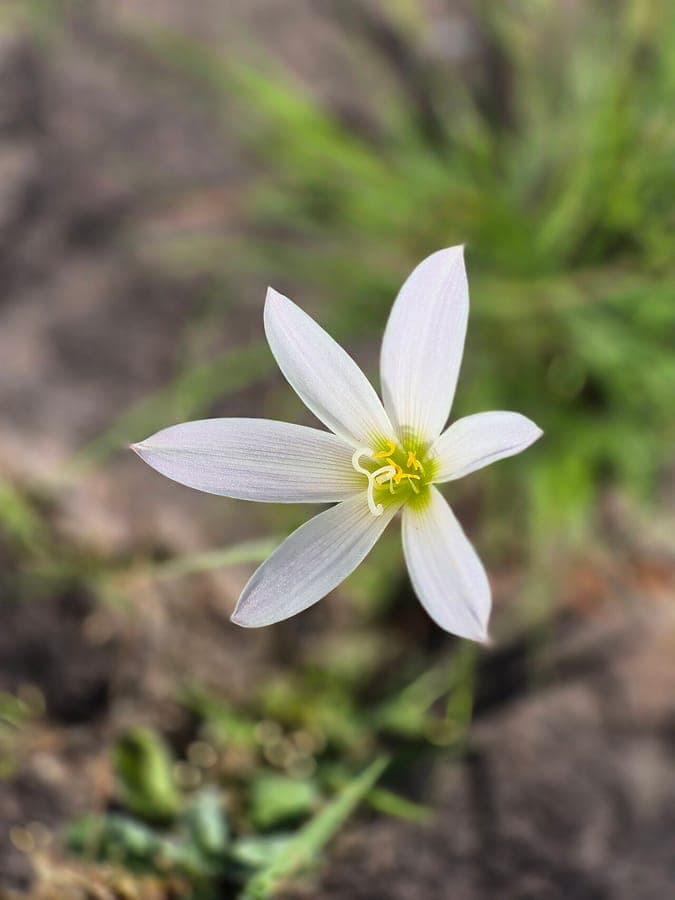
Bageense / CC BY 4.0, via Wikimedia Commons
Zephyranthes candida: complete guide
Zephyranthes candida
Want to see Zephyranthes candida: complete guide in your garden?
1 minute, no credit card
Overview
Zephyranthes candida, known as zephyr lily, fairy lily, or white rain lily, is a charming bulb plant originating from Brazil, Paraguay, Uruguay, and Argentina. This delicate plant grows in gardens worldwide thanks to its white, elegant flowers and easy temperament. With slender, grass-like foliage and abundant star-shaped flowers, it is perfect for borders, containers, and rock gardens.
The plant belongs to the Amaryllidaceae family, the same as amaryllis and daffodils. In its homeland, it grows in moist mountain slopes and grasslands, where it blooms in August and September (southern hemisphere) after rainy periods.
Appearance and Bloom
The zephyr lily grows from underground bulbs to approximately 20-30 cm tall. The leaves are thin, narrow, and grass-like, creating a graceful appearance. They grow in clumps forming soft emerald green tufts.
The flowers are the true charm - white, star-shaped flowers about 3-4 cm diameter with yellow or green center. They stand on slender stems above the foliage. Blooming period is August to October in the Northern hemisphere (May to July in southern hemisphere where native).
The flowers open in afternoon and close at evening, explaining their poetic name "flower of the western wind." Bees and butterflies love these flowers. After blooming come small seed pods.
Ideal Location
The zephyr lily grows best in full sun to partial shade. Minimum 6 hours direct sunlight daily is ideal for optimal blooming. In shady gardens it flowers less abundantly. A south or west-facing spot is perfect.
It works well in borders, rock gardens, containers, and even lawn edges. In colder climates they are grown in pots and brought indoors for winter. In milder regions they can overwinter outdoors.
The plant accepts diverse placements, but full sun produces the most flowers. Combine with other summer bloomers for maximum color.
Soil
The zephyr lily grows in well-draining soil - this is essential. Heavy, waterlogged soil leads to bulb rot. Work loamy or sandy potting soil, or add perlite to garden soil.
The pH can be neutral to slightly acidic (6.0-7.0). In nutrient-rich soil it grows faster and flowers more abundantly. In poor soil it grows slower but is equally healthy.
When planting work 3-4 cm compost into the planting hole. The bulbs themselves need little nutrition, so fertilizer is optional.
Free design
Want to see Zephyranthes candida: complete guide in your garden? Make a free design now.
Watering
This is where zephyr lily becomes interesting. After planting, water regularly until growth is visible (approximately 3-4 weeks). Thereafter watering can be reduced - zephyr lilies love dryness! During growing season (March to October) water when soil surface feels dry.
In blooming period (August-October) they want slightly moister conditions to flower abundantly. Ensure regular but not excessive moisture. Excessive water leads to rot.
In winter (if bulbs remain outdoors) stop watering completely. The plant goes dormant and loses all foliage. Dryness is fine for this period.
Pruning
Pruning is not necessary. Remove only spent flowers (deadheading) to encourage stimulation of new blooms. Once all flowers are past, you can cut flower stems.
Remove yellow or rotten leaves to keep the plant tidy. Leave healthy leaves on the plant - they perform photosynthesis and feed energy back to the bulb.
In autumn, once all foliage is dead, you can remove it completely.
Maintenance Calendar
March: first growth visible. Begin regular watering. Give first feeding with balanced fertilizer.
April-May: blooming begins. Check for pests (less likely). Ensure adequate water.
June-July: blooming period continues. Collect seed if desired for propagation.
August-October: peak blooming period. Enjoy abundant flowers. Water regularly.
November-February: leaf fall and winter dormancy. Stop watering completely. Bulbs can be stored dry.
Winter Hardiness
Zephyranthes candida grows in zones 8-11, covering much of southern Europe. In the Netherlands the bulbs can remain outdoors in milder south, but in the north we advise lifting and storing them dry.
Protect bulbs in the ground with 10-15 cm mulch (straw or leaf mold) if winter temperatures drop below -5 degrees. In extremely cold winters bulbs can freeze solid.
Container growing gives complete control over temperature and drainage, ideal for uncertain winters.
Companion Plants
Zephyr lily harmonizes well with other summer bloomers: rudbeckia, echinacea, salvias, and lavender. All bloom simultaneously or just after zephyr lily.
In rock gardens combine with stonecrop (Sedum), houseleek (Sempervivum), and thyme. These prefer the same warm-dry conditions.
In containers: pair zephyr lily with dwarf ornamental grasses, diascia, and scaevola for tropical effect.
Summary
Zephyranthes candida is an elegant, low-maintenance bulb that flowers for years. With minimal care it grows well in gardens where other plants struggle. It tolerates drought, full sun, and poor soil well.
Bulbs are available at garden centers in April-May. Plant immediately - don't wait! For best results plant at least 3-5 bulbs together.
Start today with zephyr lily and enjoy white, fragrant flowers for years to come. For complete garden design with flowering bulbs, visit gardenworld.app and share your front yard photo for free plant recommendations!
Want to see Zephyranthes candida: complete guide in your garden? Make a free design now.
Upload a photo, pick a style, and get a photorealistic design with plant list in under a minute.
10,000+ gardens designed already
No credit card required


Similar plants
Douglas' Onion: complete guide
Allium douglasii
Douglas' onion is a compact ornamental allium with purple flowers, perfect for rock gardens and sunny borders. Learn care, siting and hardiness.
Oblique onion: complete guide
Allium obliquum
The oblique onion is a hardy ornamental allium with chartreuse flower heads and blue-green foliage. Location, soil and care explained.
False hooded garlic: complete guide
Allium pseudocalyptratum
Discover false hooded garlic (Allium pseudocalyptratum): a rare ornamental onion from Lebanon for rock gardens and alpine troughs.