
Penarc / CC BY-SA 4.0, via Wikimedia Commons
Spanish-dagger: complete guide
Yucca gloriosa
Want to see Spanish-dagger: complete guide in your garden?
1 minute, no credit card
Overview
Yucca gloriosa, commonly known as Spanish-dagger, is a striking evergreen perennial that brings architectural drama to gardens across temperate climates. Native to coastal areas of the southeastern U.S., it thrives in hot, dry conditions and adapts surprisingly well to UK and northern European gardens when given proper drainage. In the garden, it behaves like a shrub or small tree, reaching 120–180 cm tall with a spread of about 90 cm. It's not a true palm, but its bold form often earns it a spot among structural plants in modern landscape designs.
Hardy to USDA zone 7 (-15°C), it can survive most winters in southern and central UK, provided the soil doesn't stay waterlogged. In colder zones, it benefits from a sheltered, south-facing spot. On gardenworld.app, you can explore layout ideas that highlight Spanish-dagger's sculptural qualities, especially in gravel gardens or coastal-style plantings.
Appearance & bloom cycle
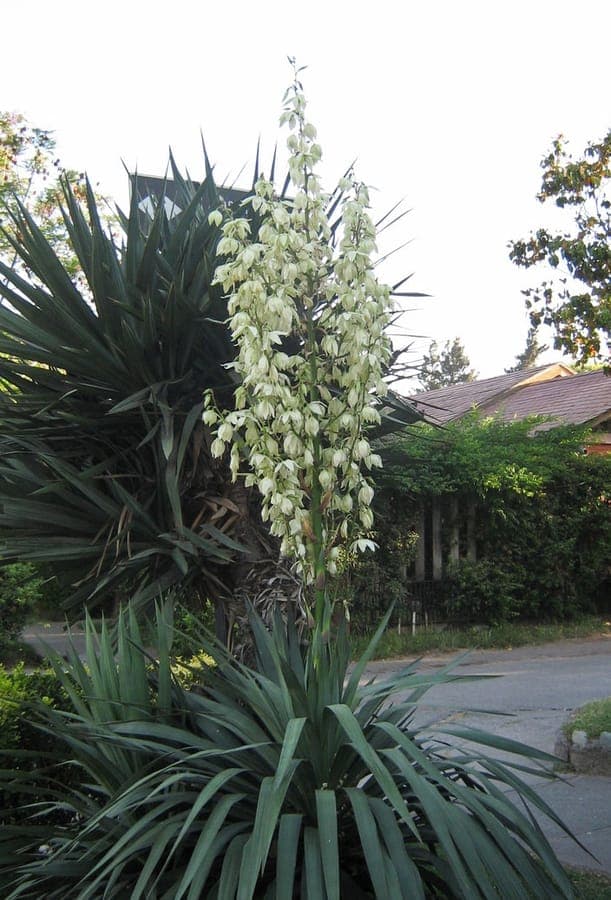
The plant forms a tight rosette of rigid, sword-shaped leaves, 50–70 cm long, with a blue-green hue and sharp, pointed tips. These leaves persist year-round, offering winter structure. In mid-summer, typically June to August, a tall flower spike emerges, rising up to 2 metres. The pendulous, creamy-white, bell-shaped flowers bloom from the bottom up and attract night-flying moths, particularly the yucca moth, which has a mutualistic relationship with the plant.
Flowering usually occurs on mature plants after 3–5 years. Each rosette flowers once and then dies back, but new offsets develop from the base, ensuring continuous growth. Seed pods may form and persist into winter, adding visual interest.
Ideal location
Full sun is essential. Plant in a spot that receives at least 6 hours of direct sunlight daily. South- or southwest-facing walls, slopes, or raised beds work best. Avoid shaded or damp corners - low light leads to weak growth and increases rot risk. Spanish-dagger excels in coastal gardens, xeriscapes, and modern, minimalist designs where clean lines matter.
Be mindful of placement: the leaf tips are extremely sharp. Don't plant near footpaths, play areas, or seating zones where people might brush against it. On gardenworld.app, you can simulate safe placements using the garden planner to avoid hazards while maximizing visual impact.
Soil requirements
Well-drained soil is non-negotiable. Yucca gloriosa hates wet feet. Sandy or gravelly soils are ideal. If your garden has clay, amend it with horticultural grit or create a raised bed with a mix of loam, sand, and perlite. The pH range should be between 5.5 and 7.5. Avoid rich, moisture-retentive soils - they'll spell trouble in winter.
Free design
Want to see Spanish-dagger: complete guide in your garden? Make a free design now.
Watering
Once established, this yucca is drought-tolerant. During the first growing season, water weekly during dry spells. After that, supplemental watering is rarely needed. In prolonged droughts (over 4 weeks without rain), give a deep soak every 10–14 days. Never let the plant sit in soggy soil. Use drip irrigation if possible, targeting the outer edge of the rosette to keep the crown dry.
Pruning
Pruning is minimal. Remove only dead, damaged, or browned leaves with clean, sharp shears. Cut the flower stalk down only after it has fully browned and shed its seeds. Never cut healthy green leaves - this can invite rot and ruin the plant's natural symmetry.
You can divide offsets in spring (April) if the clump becomes too dense. Wear gloves and use a sterilized knife. Replant divisions in well-drained spots, spacing them 60–80 cm apart.
Maintenance calendar
- Jan: Check for frost damage; leave dead leaves as insulation
- Feb: No action
- Mar: Inspect crown for rot; improve drainage if needed
- Apr: Divide offsets; prepare soil for new growth
- May: Monitor for new flower spikes; avoid fertilizing
- Jun: Flowering begins; keep foliage dry
- Jul: Peak bloom; watch for pests like scale
- Aug: Flowers fade; leave stalks for seed
- Sep: Collect seeds or let them disperse naturally
- Oct: Stop watering; keep crown dry
- Nov: Protect base with gravel mulch in wet areas
- Dec: Minimal care; avoid wet mulches
Winter hardiness
Hardy to USDA zone 7. In colder zones, grow in containers and move to a cold greenhouse. In wet winters, even zone 7 plants can rot at the base. Avoid organic mulches like compost or bark - they hold moisture. Instead, use gravel or crushed stone around the base to improve drainage and reflect heat.
Companion plants
Pair with drought-tolerant, textural plants: Echinacea, Sedum 'Matrona', Stachys byzantina, or ornamental grasses like Deschampsia cespitosa. The upright form of Spanish-dagger contrasts beautifully with mounding or feathery plants. Avoid aggressive spreaders or moisture-loving species like hostas or astilbes.
Closing
Yucca gloriosa is a low-fuss, high-impact plant that adds year-round structure and summer drama. With full sun, sharp drainage, and a hands-off approach, it thrives for years. Buy healthy specimens from reputable garden centres, such as those found at major chains or independents with a focus on drought-resistant plants. Look for firm rosettes and no signs of rot at the base. Whether you're designing a coastal retreat or a modern courtyard, Spanish-dagger delivers. For layout inspiration, visit gardenworld.app, where real garden designs showcase how to integrate this bold plant seamlessly.
Want to see Spanish-dagger: complete guide in your garden? Make a free design now.
Upload a photo, pick a style, and get a photorealistic design with plant list in under a minute.
No credit card required


Similar plants
Narrow-leaved dracaena: complete guide
Dracaena angustifolia
Everything about Dracaena angustifolia - the narrow-leaved dracaena: location, care, overwintering and use as a houseplant or patio plant.
Chaparral yucca: complete guide to Hesperoyucca whipplei
Hesperoyucca whipplei
Hesperoyucca whipplei (Our Lord's candle) is a dramatic rosette-forming plant from California that produces a towering flower spike, ideal for dry and gravel gardens.
False lily-of-the-valley: complete guide
Maianthemum dilatatum
Everything about Maianthemum dilatatum, the false lily-of-the-valley. Care, shade location, propagation and garden combinations for this popular shade ground cover.