
William Avery / CC BY-SA 3.0, via Wikimedia Commons
Adam's-needle: complete guide
Yucca flaccida
Want to see Adam's-needle: complete guide in your garden?
1 minute, no credit card
Overview
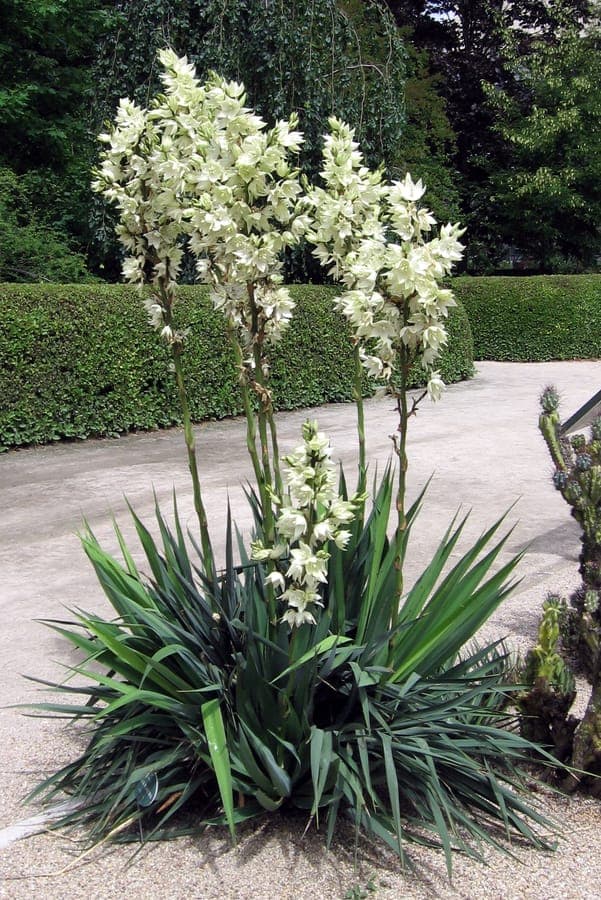
Adam's-needle, or Yucca flaccida, is a standout in any garden where structure and resilience matter. Native to the southeastern United States - from Alabama to Maryland - this perennial brings a bold, almost tropical look without needing tropical conditions. It grows as a clumping subshrub, forming tight rosettes of flexible, gray-green leaves that can reach up to 60 cm in length. Unlike some yuccas, it doesn't form a tall trunk, staying relatively low at 60–80 cm tall, but sends up dramatic flower spikes that tower over surrounding plants.
Hardy in USDA zones 5 through 9, Yucca flaccida handles cold winters and scorching summers with equal ease. It's a fantastic choice for gravel gardens, rockeries, or modern landscapes where low water use is key. On gardenworld.app, you can design a xeriscape layout that highlights the sculptural form of Adam's-needle alongside other drought-tolerant species.
Appearance & bloom cycle
The leaves are the first thing you notice - long, narrow, and slightly drooping, giving the plant its 'flaccida' (flaccid) name. They're a soft blue-green with a fine, almost imperceptible serration along the edges. In early summer, usually June to July, a tall, unbranched flower stalk emerges from the center, shooting up to 1.5 meters. At the top, clusters of creamy-white, bell-shaped flowers open gradually, releasing a sweet evening fragrance that attracts yucca moths - its primary pollinator.
The bloom cycle is irregular; young plants may take 3–5 years to flower. Once established, flowering becomes more predictable, especially in full sun. After blooming, the stalk browns and should be cut back. Seed pods rarely develop in cooler climates, but the plant spreads slowly via underground rhizomes, forming tight colonies over time.
Ideal location
Full sun is non-negotiable. Yucca flaccida needs at least 6–8 hours of direct sunlight daily to thrive and bloom. It performs best in south- or west-facing spots, especially near heat-retaining surfaces like stone walls or paved areas. In cooler zones, a sheltered microclimate can help it survive harsh winters.
It also works well in large containers (minimum 40 cm diameter) for patios or urban gardens. Just ensure the pot has excellent drainage. On gardenworld.app, you can simulate how Adam's-needle fits into a small courtyard or rooftop garden, helping you place it for maximum visual impact.
Soil requirements
This plant despises wet feet. It thrives in sandy, gravelly, or rocky soils with sharp drainage. A pH between 6.0 and 7.5 is ideal. Avoid heavy clay or compacted soils - if you have clay, amend it with coarse sand, perlite, and compost in a 2:1:1 ratio. Raised beds or berms improve drainage and mimic its natural habitat.
In containers, use a cactus or succulent mix with added pumice or grit. Never let the base sit in water - use pots with drainage holes and avoid saucers that trap moisture.
Free design
Want to see Adam's-needle: complete guide in your garden? Make a free design now.
Watering
Once established, Yucca flaccida is extremely drought-tolerant. Water young plants weekly during the first growing season, especially in dry spells. After that, rely on rainfall except during prolonged droughts (3+ weeks without rain). Overwatering is the most common cause of failure - root rot sets in quickly in soggy soil.
In pots, check moisture by inserting a finger 5 cm deep. Water only when dry. During winter, reduce watering to once a month or less if kept in a cool, dry location.
Pruning
Pruning is minimal. Remove dead or damaged leaves at the base with clean, sharp shears. Never cut into healthy leaf tissue - it won't regrow. After flowering, cut the spent flower stalk close to the base, taking care not to damage the central rosette.
Wear gloves when handling - while less spiny than other yuccas, the leaf tips can still be sharp and irritating.
Maintenance calendar
- January: Check for winter damage, remove frozen leaves
- February: No action needed unless severe dieback
- March: Clear old foliage, inspect for new growth
- April: Light feeding with low-nitrogen cactus fertilizer (optional)
- May: Monitor young plants for moisture needs
- June: Flower spike emerging, ensure dry base
- July: Peak bloom, avoid overhead watering
- August: Bloom fading, cut back spent stalk
- September: Stop fertilizing, reduce watering
- October: Divide rhizomes if desired
- November: Leave dead leaves for winter insulation
- December: Protect container plants from freeze-thaw cycles
Winter hardiness
Yucca flaccida survives down to -20°C (USDA zone 5). In colder zones, mulch lightly with dry straw or pine boughs to protect the crown. Avoid wet mulches like bark, which can hold moisture and cause rot. In containers, move pots against a south-facing wall and wrap with burlap or bubble wrap for extra insulation.
Snow cover actually helps by insulating the plant - avoid piling salt-laden snow near it.
Companion plants
Pair Adam's-needle with other sun-loving, dry-soil plants like lavender, sedum, echinacea, and ornamental grasses such as Panicum virgatum. The vertical flower spike contrasts beautifully with mounding forms like Nepeta or low-growing thymes. Avoid moisture-loving plants like ferns or astilbe.
Use gravel, decomposed granite, or crushed stone as mulch to enhance drainage and highlight its architectural form.
Closing
Adam's-needle is a tough, reliable performer that brings year-round interest with minimal effort. Its bold foliage and towering blooms make it a standout in any sunny border. You can find Yucca flaccida at garden centres across the UK and US, and with gardenworld.app, you can visualize how it fits into your garden design - whether you're creating a modern xeriscape or a coastal rockery. Once planted in the right spot, it asks for little and gives back for years.
Want to see Adam's-needle: complete guide in your garden? Make a free design now.
Upload a photo, pick a style, and get a photorealistic design with plant list in under a minute.
No credit card required


Similar plants
Narrow-leaved dracaena: complete guide
Dracaena angustifolia
Everything about Dracaena angustifolia - the narrow-leaved dracaena: location, care, overwintering and use as a houseplant or patio plant.
Chaparral yucca: complete guide to Hesperoyucca whipplei
Hesperoyucca whipplei
Hesperoyucca whipplei (Our Lord's candle) is a dramatic rosette-forming plant from California that produces a towering flower spike, ideal for dry and gravel gardens.
False lily-of-the-valley: complete guide
Maianthemum dilatatum
Everything about Maianthemum dilatatum, the false lily-of-the-valley. Care, shade location, propagation and garden combinations for this popular shade ground cover.