
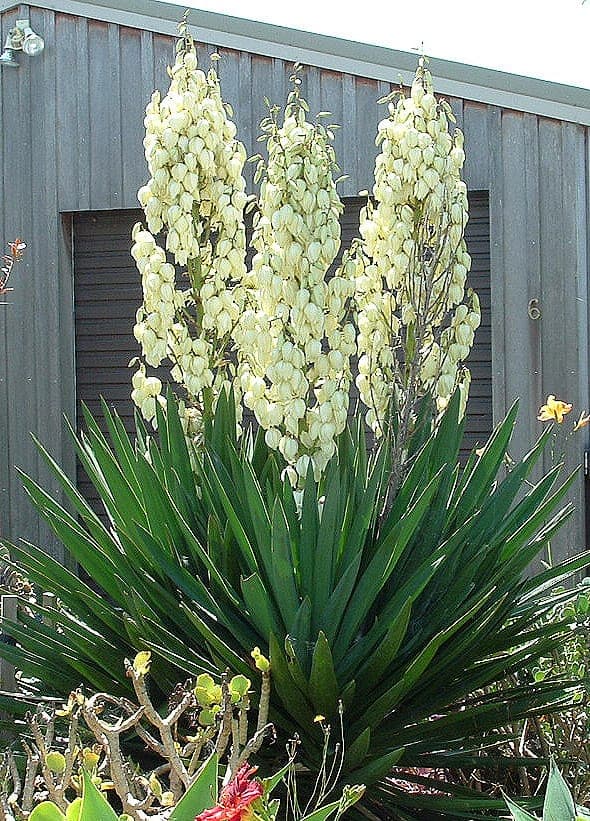
Moriori / Public domain, via Wikimedia Commons
Adam's-needle: complete guide
Yucca filamentosa
Want to see Adam's-needle: complete guide in your garden?
1 minute, no credit card
Overview
Adam's-needle, or Yucca filamentosa, is a standout plant for gardeners who appreciate bold structure and minimal fuss. Native to the southeastern U.S. – states like Alabama, Florida, and Virginia – this member of the Asparagaceae family thrives in hot, dry conditions. It's a subshrub with a clump-forming habit, slowly spreading via underground rhizomes to form colonies over time. In the UK and northern Europe, it grows well in USDA zones 5 to 10, making it surprisingly hardy for such an exotic-looking plant.
What sets it apart is its architectural form: a tight rosette of long, rigid leaves with those signature thread-like filaments curling from the margins. It's not a plant you casually overlook. Whether you're designing a modern gravel garden or a coastal plot with sandy soil, Adam's-needle brings drama without demanding attention.
On gardenworld.app, you can visualise how this plant fits into your layout – whether as a solo specimen or part of a drought-resistant border. Its vertical lines contrast beautifully with mounding perennials or soft grasses.
Appearance & bloom cycle
The leaves of Yucca filamentosa are evergreen, stiff, and blue-green, reaching 50–70 cm in length. The fine, curly white filaments along the leaf edges give the plant its name and add subtle movement in the breeze. These aren't just decorative – they may help reduce water loss or deter herbivores.
In early summer, a tall, woody flower stalk emerges, shooting up to 2.5 meters. It's topped with a panicle of drooping, bell-shaped white flowers, often tinged with purple. Blooming occurs from June to July, and the scent is strong and sweet, especially at night. This is no accident – Adam's-needle relies on the yucca moth (Tegeticula yuccasella) for pollination, a rare example of obligate mutualism in nature. While the moth is absent in Europe, the plant still flowers reliably, though seed set is limited.
After flowering, the main rosette dies, but new offsets form at the base, ensuring the colony persists. The spent flower stalk can be left standing for winter interest or cut back to 10–15 cm above the ground.
Ideal location
Full sun is non-negotiable. Plant Adam's-needle where it gets at least 6–8 hours of direct sunlight daily. In partial shade, growth becomes leggy, flowering is reduced, and the plant is more prone to rot. A south-facing wall or slope works best, especially in cooler regions, as it provides warmth and protection from winter wet.
This plant excels in gravel gardens, rockeries, and coastal landscapes. It's also ideal for modern, minimalist designs where clean lines and texture matter. Pair it with ornamental grasses or silvery foliage plants for contrast. Use gardenworld.app to experiment with plant combinations and spacing before you commit to digging.
Soil requirements
Well-drained soil is essential. Yucca filamentosa hates sitting in wet feet, especially in winter. Avoid heavy clay unless you've amended it with grit, sand, or perlite. Sandy or loamy soils are ideal. The plant tolerates a wide pH range (5.5–7.5) and poor fertility – in fact, too much richness can lead to weak, floppy growth.
For container growing, use a mix of 2 parts potting soil, 1 part perlite, and 1 part coarse sand. Ensure the pot has drainage holes and place a layer of gravel at the bottom.
Free design
Want to see Adam's-needle: complete guide in your garden? Make a free design now.
Watering
Once established, Adam's-needle is extremely drought-tolerant. Water young plants weekly during their first growing season, especially in dry spells. After that, rainfall is usually sufficient. Overwatering is the fastest way to kill this plant – root rot sets in quickly in cold, soggy soil.
In winter, withhold watering entirely unless in a pot and kept in a dry, heated space. Even then, water only sparingly.
Pruning
Pruning is minimal. Remove dead or damaged leaves with sharp, sterilised shears, cutting close to the base. Avoid cutting into healthy tissue – it can lead to rot. The sharp leaf tips are hazardous, so wear gloves and long sleeves when working around the plant.
The flower stalk can be cut down after blooming, but leaving it adds architectural interest through winter. Seed pods may form, though they're rarely viable outside its native range.
Maintenance calendar
- Jan: Check for waterlogged soil. Protect young plants with horticultural fleece if hard frosts are forecast.
- Feb: No action needed. Ensure pots aren't sitting in water.
- Mar: Remove any tattered foliage. Inspect for new offsets.
- Apr: Begin light feeding with diluted cactus fertiliser every 4–6 weeks.
- May: Water young plants weekly in dry weather. Watch for slug damage on new shoots.
- Jun: Flower spikes emerge. Avoid overhead watering.
- Jul: Peak bloom. Enjoy the fragrance and pollinators.
- Aug: No additional water required for mature plants.
- Sep: Stop feeding. Cut back flower stalk if desired.
- Oct: Check drainage. Move potted plants to sheltered spots.
- Nov: Mulch lightly with grit or gravel – avoid organic mulches that retain moisture.
- Dec: Minimal care. Keep dry and frost-protected if in containers.
Winter hardiness
Adam's-needle is hardy to USDA zone 5 (-20°C to -29°C). In zone 7 and above, it usually survives with no protection. In colder or wetter climates, wrap the rosette loosely with horticultural fleece or surround it with a cylinder of wire mesh filled with dry leaves. Ensure air circulation to prevent rot.
Potted plants are more vulnerable – bring them into a cold greenhouse or against a south-facing wall.
Companion plants
Pair with Echinacea, Lavandula, Sedum 'Matrona', and Artemisia. Grasses like Stipa tenuissima add softness. Avoid moisture-loving plants like ferns or hostas. For a bold look, combine with black metal edging or dark stone.
Closing
Adam's-needle isn't for every garden, but for those who value resilience and form, it's a winner. It asks for little and gives back with year-round structure and summer drama.
You'll find Yucca filamentosa at most garden centres from April onwards. Look for healthy, firm rosettes with no signs of basal rot. With the right spot and a bit of patience, it'll thrive for years.
And remember: on gardenworld.app, you can plan your entire planting scheme around this striking specimen – because every great garden needs a little boldness.
Want to see Adam's-needle: complete guide in your garden? Make a free design now.
Upload a photo, pick a style, and get a photorealistic design with plant list in under a minute.
No credit card required


Similar plants
Narrow-leaved dracaena: complete guide
Dracaena angustifolia
Everything about Dracaena angustifolia - the narrow-leaved dracaena: location, care, overwintering and use as a houseplant or patio plant.
Chaparral yucca: complete guide to Hesperoyucca whipplei
Hesperoyucca whipplei
Hesperoyucca whipplei (Our Lord's candle) is a dramatic rosette-forming plant from California that produces a towering flower spike, ideal for dry and gravel gardens.
False lily-of-the-valley: complete guide
Maianthemum dilatatum
Everything about Maianthemum dilatatum, the false lily-of-the-valley. Care, shade location, propagation and garden combinations for this popular shade ground cover.