
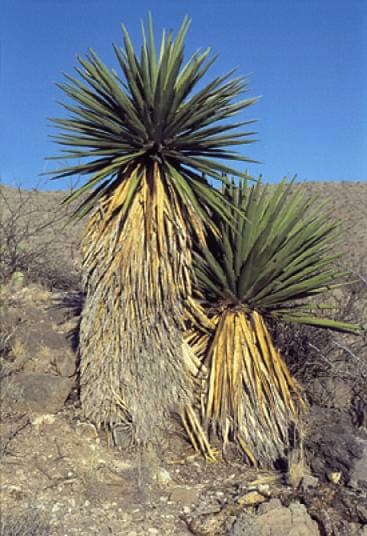
Rebou / CC BY-SA 3.0, via Wikimedia Commons
Yucca Faxoniana: complete guide
Yucca faxoniana
Want to see Yucca Faxoniana: complete guide in your garden?
1 minute, no credit card
Overview
Yucca faxoniana, known as Spanish dagger, Eve's needle, and Faxon yucca, is a monumental desert plant native to New Mexico, Texas, and northern Mexico. This is no subtle beauty - it is a brutally architectural form that radiates dominance and drama. For gardeners seeking true statement plants, Yucca faxoniana is the ultimate choice.
Appearance and Bloom
This massive semi-succulent forms large, compact rosettes of thick, gray-blue leaves reaching 18-60 inches long, sometimes with light edges. The plant grows slowly but impressively - typically 6-13 feet tall and 5-10 feet wide. In May-July, monumental flower spikes emerge 15-16+ feet tall, densely packed with large, pure white, bell-shaped flowers. These spikes attract night-blooming moths, hummingbirds, and other pollinators.
Ideal Location
Yucca faxoniana demands full sun - 8+ hours direct daily light. Position prominently where it dominates the landscape - this is a statement plant. Allow massive clearance - 16+ feet from structures and other plants. Avoid windy sites where heavy leaves might break.
Soil
Extremely well-draining, poor soil is essential. Yucca faxoniana thrives in pure sand, gravel, rocky earth, and highly alkaline soils. NEVER heavy clay or constantly moist soil - both cause irreversible root rot. In poorly drained zones, create raised beds of pure gravel.
Watering
Once established, Yucca faxoniana is extremely drought-tolerant and requires virtually no supplemental water. Water only during establishment. Mature plants tolerate years without irrigation. OVERWATERING is the primary cause of death - ensure soil dries completely between rare waterings.
Free design
Want to see Yucca Faxoniana: complete guide in your garden? Make a free design now.
Pruning
Minimal pruning needed. Remove only dead basal leaves. Flower spikes may be cut after blooming when fully withered. The plant produces young pups at the base that may be carefully separated and grown independently.
Maintenance Calendar
- April-May: Plant inspection
- May-July: Enjoy monumental white spikes
- August-October: Minimal observation
- November-March: Winter dormancy; no water
- Year-round: Remove dead basal leaves
Winter Hardiness
Yucca faxoniana is hardy to USDA zone 6, tolerating temperatures to -10 deg F (-23 deg C). This is remarkable for a southern plant - exceptionally cold-hardy for a Texas native. In wet-winter regions, winter protection may help.
Companion Plants
Pair Yucca faxoniana with:
- Other massive succulents: large Agave species
- Very large desert shrubs: Larrea, Prosopis
- Large stones and boulders for architectural effect
- Gravel and sand as ground mulch
This creates a wild, desert-dominated landscape.
Closing
Yucca faxoniana is for the ultimate drama-seeker. This is no plant for cautious gardeners or small yards. This is a monolith, a statement, a 16-foot architectural scream. In the right setting - a large, extremely dry landscape with full sun and impeccable drainage - this plant delivers decades of unparalleled impact. This is true landscape sculpture. Discover how Yucca faxoniana transforms extreme garden designs at Gardenworld.app.
Want to see Yucca Faxoniana: complete guide in your garden? Make a free design now.
Upload a photo, pick a style, and get a photorealistic design with plant list in under a minute.
No credit card required


Similar plants
Narrow-leaved dracaena: complete guide
Dracaena angustifolia
Everything about Dracaena angustifolia - the narrow-leaved dracaena: location, care, overwintering and use as a houseplant or patio plant.
Chaparral yucca: complete guide to Hesperoyucca whipplei
Hesperoyucca whipplei
Hesperoyucca whipplei (Our Lord's candle) is a dramatic rosette-forming plant from California that produces a towering flower spike, ideal for dry and gravel gardens.
False lily-of-the-valley: complete guide
Maianthemum dilatatum
Everything about Maianthemum dilatatum, the false lily-of-the-valley. Care, shade location, propagation and garden combinations for this popular shade ground cover.