
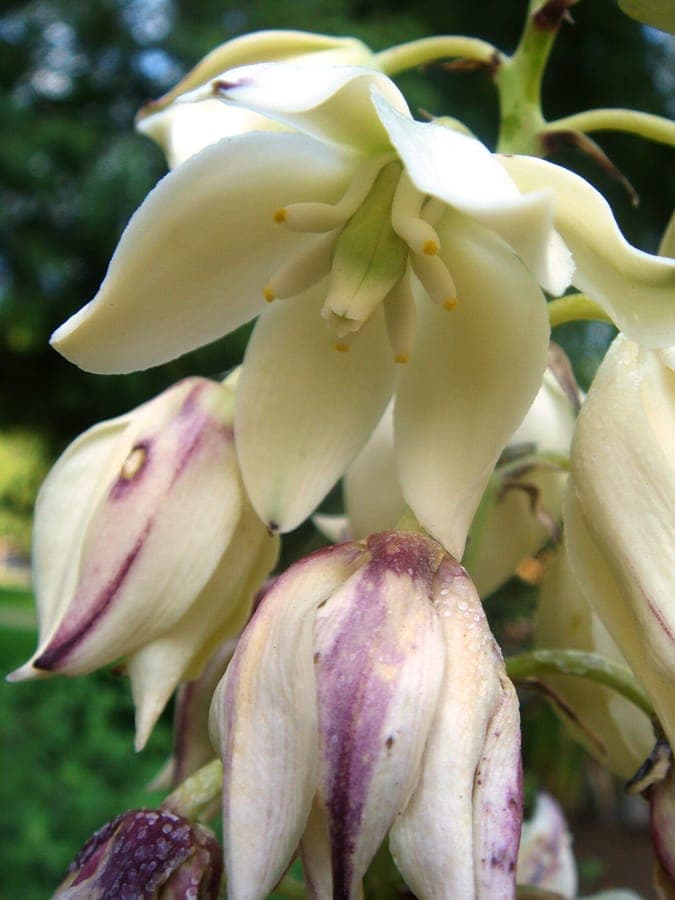
Miwasatoshi / CC BY-SA 4.0, via Wikimedia Commons
Daggerplant: complete guide
Yucca aloifolia
Want to see Daggerplant: complete guide in your garden?
1 minute, no credit card
Overview
Yucca aloifolia, commonly known as Daggerplant, is a bold, architectural plant that brings a touch of the desert to temperate gardens. Despite not being a true palm, its upright form and sword-like foliage make it a favourite in modern and Mediterranean-style landscapes. Native to coastal regions of the southeastern United States and Mexico, it thrives in sandy, well-drained soils and tolerates salt spray, making it perfect for seaside gardens.
In the UK and northern Europe, it's often grown as a container specimen or used as a dramatic focal point in gravel gardens. It grows slowly, reaching 2 to 5 metres in height over many years, and forms a single trunk unless damaged or pruned. Hardy to USDA zone 8 (down to -12°C), it can survive mild winters outdoors with protection.
On gardenworld.app, you can design a drought-tolerant garden layout that highlights the striking silhouette of Yucca aloifolia alongside other sun-loving plants. Its resilience and minimal care needs make it a smart choice for urban courtyards or low-effort borders.
Appearance & bloom cycle
The leaves of Yucca aloifolia are stiff, linear, and sharply pointed - living up to its 'dagger' name. They're deep green, up to 60 cm long, and edged with fine, curly fibres. The foliage grows in a tight rosette from the top of the stem, creating a bold, sculptural look.
From late spring to midsummer - typically June through August - a tall flower spike emerges, reaching up to 2 metres. It's topped with drooping clusters of creamy-white, bell-shaped flowers that emit a sweet, night-time fragrance. These blooms attract moths and other pollinators. After flowering, green, fleshy fruits may form, about 4–5 cm in diameter.
Growth is slow, averaging 10–20 cm per year in ideal conditions. The plant rarely branches unless the growing tip is removed.
Ideal location
Full sun is essential. Yucca aloifolia needs at least 6–8 hours of direct sunlight daily. Choose a south- or southwest-facing spot with good air circulation. In shady or damp areas, the plant becomes weak, leggy, and prone to rot.
If you're growing it in a container, place it on a sunny patio or balcony. In colder regions, move the pot indoors or into a greenhouse over winter. Positioning it near walls or paving helps trap heat, which improves winter survival. On gardenworld.app, you can experiment with different garden zones to see where your Daggerplant will thrive best.
Soil requirements
This yucca is adaptable to various soil types, but excellent drainage is non-negotiable. The ideal pH range is 5–8.5, so it tolerates acidic, neutral, and slightly alkaline soils. Sandy or gritty soils work best. Avoid heavy clay unless amended with coarse sand, perlite, or gravel.
For in-ground planting, raise the bed slightly or mix in 30% grit to improve drainage. In containers, use a cactus or succulent mix with added perlite. Never let the roots sit in water.
Free design
Want to see Daggerplant: complete guide in your garden? Make a free design now.
Watering
Once established, Yucca aloifolia is extremely drought tolerant. Young plants need weekly watering during their first growing season if rainfall is scarce. Water deeply but infrequently to encourage deep root development.
Mature plants rarely need supplemental watering, even in dry summers. Overwatering is the most common cause of failure - it leads to root rot. Water only when the top 5 cm of soil is completely dry. In winter, withhold water entirely unless the plant is in a heated container.
Pruning
Pruning is rarely needed. Remove dead or damaged leaves with clean, sharp shears, cutting close to the stem without damaging the trunk. Avoid cutting healthy foliage - it slows growth and creates entry points for disease.
Topping the plant to control height is possible but risky. It can kill the plant if the wound doesn't heal properly. If you attempt it, do so in late spring and apply a fungicidal sealant.
Maintenance calendar
- January: Check for frost damage; remove loose leaves.
- February: Inspect container plants for dryness.
- March: Begin pest checks; clear winter debris.
- April: Final light pruning; improve soil drainage if needed.
- May: Watch for emerging flower spikes; reduce watering.
- June: Peak bloom; monitor for aphids or scale.
- July: Let flowers fade naturally; avoid trimming.
- August: Fruits may form; remove only when dry.
- September: Stop watering; prepare for dormancy.
- October: Move containers to shelter; protect in-ground plants.
- November: Wrap trunk with hessian; mulch base with dry leaves.
- December: No watering or feeding; dormancy period.
Winter hardiness
Hardy to USDA zones 8–11, Yucca aloifolia struggles with prolonged wet cold. In zone 8, protect the crown with fleece and mulch. In colder zones, grow in containers and overwinter indoors. Avoid wrapping too tightly - moisture trapped against the stem causes rot.
Companion plants
Pair with drought-tolerant perennials like Sedum, Agapanthus, Lavender, or Eryngium. Ornamental grasses such as Stipa tenuissima add soft contrast. Avoid moisture-loving plants like Ferns or Astilbes.
Closing
Yucca aloifolia is a striking, low-effort plant that adds year-round structure to the garden. Its architectural form and occasional blooms make it a standout. Buy healthy specimens from garden centres like B&Q, Wyevale, or local independents. Look for firm leaves and no signs of rot at the base. With the right spot and minimal care, it becomes a long-lived garden feature.
Want to see Daggerplant: complete guide in your garden? Make a free design now.
Upload a photo, pick a style, and get a photorealistic design with plant list in under a minute.
No credit card required


Similar plants
Narrow-leaved dracaena: complete guide
Dracaena angustifolia
Everything about Dracaena angustifolia - the narrow-leaved dracaena: location, care, overwintering and use as a houseplant or patio plant.
Chaparral yucca: complete guide to Hesperoyucca whipplei
Hesperoyucca whipplei
Hesperoyucca whipplei (Our Lord's candle) is a dramatic rosette-forming plant from California that produces a towering flower spike, ideal for dry and gravel gardens.
False lily-of-the-valley: complete guide
Maianthemum dilatatum
Everything about Maianthemum dilatatum, the false lily-of-the-valley. Care, shade location, propagation and garden combinations for this popular shade ground cover.