
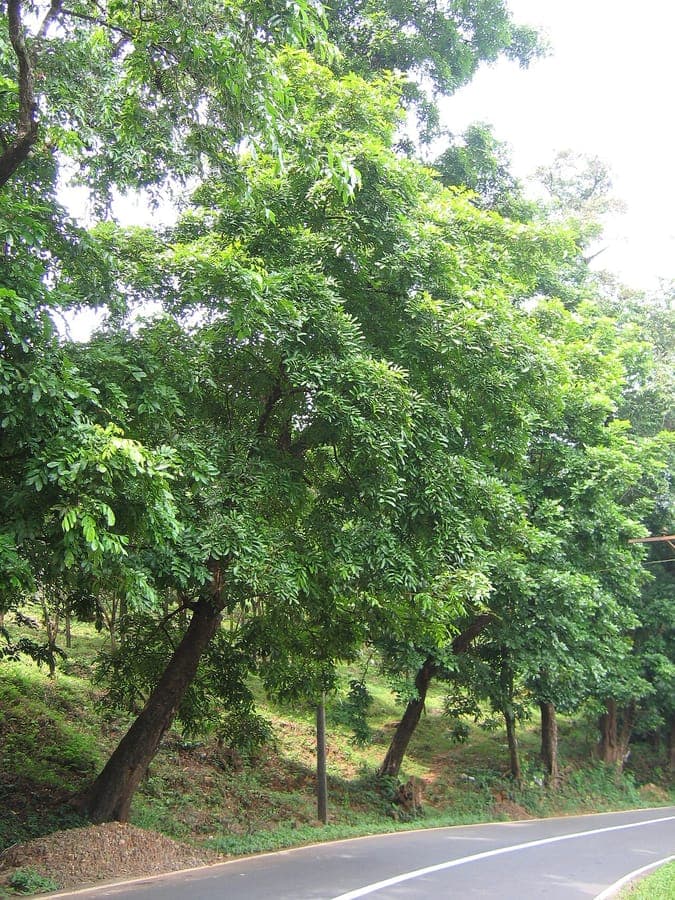
Vinayaraj / CC BY-SA 3.0, via Wikimedia Commons
Xylia xylocarpa: complete guide
Xylia xylocarpa
Want to see Xylia xylocarpa: complete guide in your garden?
1 minute, no credit card
Overview
Xylia xylocarpa, commonly known as Burma ironwood, is a large, woody tree from the Fabaceae family (legume family) native to tropical forests across Asia, from India to Indo-China. This tree is renowned for its exceptionally hard and durable wood, which has been used for centuries in woodworking, construction, and craftsmanship. The tree grows to great heights and forms an imposing presence in the landscape. In countries where it occurs naturally, Burma ironwood has held significant economic and ecological importance throughout history.
Appearance and Bloom
Burma ironwood grows into a large, upright tree with grayish-brown, rough bark that cracks in vertical strips. The leaves are compound, pinnate, and elegant, giving the tree a fine texture despite its enormous size. The tree produces small, yellowish flowers that appear in inflorescences. Following flowering, characteristic hard woody fruits (legume pods) develop that are extremely durable and open slowly. These fruits are very persistent and can remain on the tree for months.
Ideal Location
Burma ironwood grows best in warm, tropical climates with regular rainfall throughout the growing season. The tree prefers full sun and tolerates full sun exposure well. In tropical regions, the tree grows naturally in lowland and hill areas where it is well protected from extreme weather. For cultivation outside the tropical zone, this tree is not suitable due to its extreme temperature sensitivity.
Soil
The tree is flexible regarding soil type, though it grows best in deep, nutrient-rich soils with good drainage. In its natural habitat, it thrives in highly fertile, humus-rich soils. A neutral to slightly acidic pH (around 6.0-7.0) is optimal. The tree tolerates nutrient-poor soils but grows faster and stronger in rich soils.
Free design
Want to see Xylia xylocarpa: complete guide in your garden? Make a free design now.
Watering
Burma ironwood prefers regular water application during its growing season. In tropical regions where it grows naturally, it receives regular rain. Young trees must be watered regularly to develop deep root systems. Once established, adult trees can tolerate considerable drought during short periods, though they thrive better with regular moisture.
Pruning
Burma ironwood requires minimal pruning if growing well. Remove only dead or damaged branches. Since this is a large tree, pruning must be done carefully to maintain the natural form. Young trees can be lightly pruned to encourage a strong, upright form. Heavy pruning can damage the tree and must be avoided.
Maintenance Calendar
Spring: Prepare the tree for the growing season with compost or manure application. Summer: Provide regular watering during drought periods. Monitor for diseases and pests. Autumn: Remove dead branches. Winter: In tropical zones no winter care is needed, but in subtropical zones frost protection is recommended.
Winter Hardiness
Burma ironwood is frost-sensitive and cannot thrive in areas with regular frost. The tree is only suitable for tropical and subtropical zones. In temperate climates, it can only be grown in greenhouses or in very protected microclimates.
Companion Plants
In tropical gardens, Burma ironwood can be paired with other tropical trees such as mango, teak, and other fruit trees. Underplanting with shade-tolerant tropical shrubs and groundcovers creates a natural forest structure.
Closing
Xylia xylocarpa is an impressive tree for tropical and subtropical gardens where climate and space permit. With its strong, durable wood and imposing presence, it offers both aesthetic and practical value. For more plant recommendations and advice on tree cultivation in tropical zones, visit gardenworld.app.
Want to see Xylia xylocarpa: complete guide in your garden? Make a free design now.
Upload a photo, pick a style, and get a photorealistic design with plant list in under a minute.
No credit card required


Similar plants
Tall Silky Lupine: complete guide
Lupinus elatus
Tall silky lupine is a fast-growing Californian perennial with silvery foliage and blue-purple flower spikes, ideal for a prairie-style garden.
Garfield Lupine: complete guide
Lupinus garfieldensis
The Garfield lupine is a rare, fast-growing American perennial for alkaline, dry grassland gardens, with striking blue flower spikes.
Lupinus elegans: complete guide
Lupinus elegans
Lupinus elegans, the elegant lupine, is a spectacular blooming plant from Mexico with blue flower spikes. Care, cultivation and garden use.