
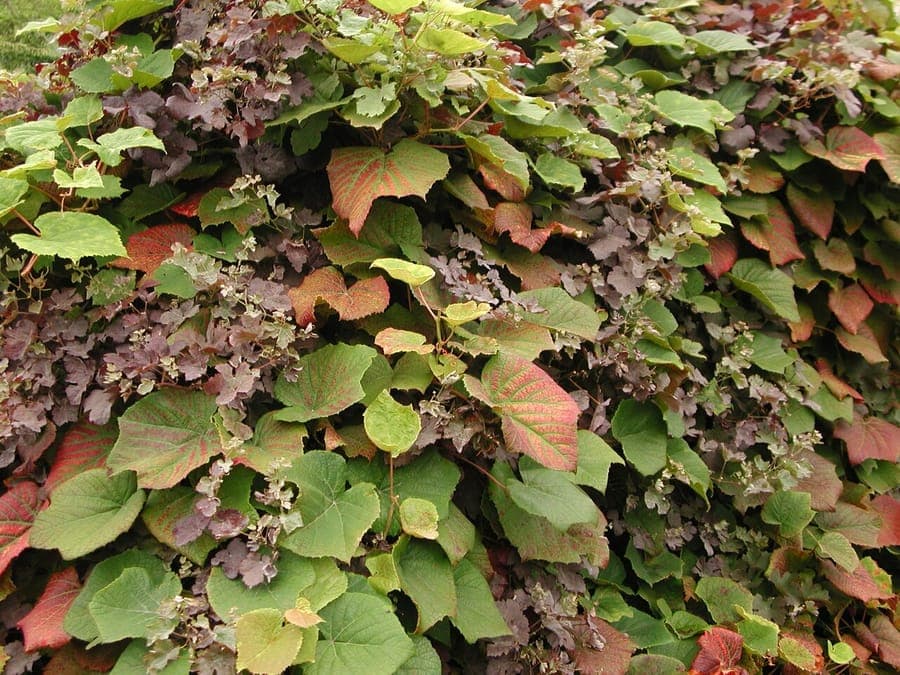
Jamesjhawkins / CC0, via Wikimedia Commons
Vitis coignetiae: complete guide
Vitis coignetiae
Want to see Vitis coignetiae: complete guide in your garden?
1 minute, no credit card
Overview
The Vitis coignetiae, known as the Crimson gloryvine or Japanese grape, is a spectacular climbing plant from Japan, Korea, and Manchuria. This is truly a plant for those who love drama in the garden, as its autumn performance is simply incredible. Large leaves transform in October and November into a fireworks display of red to purple, setting the entire garden ablaze.
This grapevine climbs via tendrils and fastens itself to pergolas, walls, and fences. Since it grows quite vigorously, expect up to three meters per season. This makes it perfect for those wanting rapid coverage of large surfaces.
Appearance and bloom
The Vitis coignetiae stands out primarily for its very large leaves that can reach 25 centimeters wide. The leaves are dark green in summer, thick and rough-textured, with clearly visible veins. They are heart-shaped and grow alternately along the stem.
In spring, inconspicuous greenish-yellow flowers appear in small clusters, but these are truly secondary. The real highlight is autumn when leaves transform in a spectacular red to deep purple display. This typically occurs in October, depending on your region. Small red berries follow, turning black-purple.
Ideal location
The Crimson gloryvine flourishes in full sun to partial shade. For the most colorful autumn display, you need at least six hours of sunlight daily. In full shade, it grows but autumn color is less intense.
Give it substantial support like a pergola, espalier, or sturdy fence. Since it's somewhat moisture-loving, watch for wind exposure. A protected spot without constant wind is ideal. For small gardens, be cautious about growth rate, so pruning is essential.
Soil
The Vitis coignetiae is not fussy about soil type, as long as it's moisture-retentive yet well-draining. It prefers slightly moister conditions than some other climbers. Slightly acidic to neutral pH between 5.5 and 7.0 is perfect.
When planting, work organic matter like compost or decayed leaves into the planting hole. This improves moisture retention. Once established, the plant is very self-sufficient and requires minimal supplementation.
Watering
The Crimson gloryvine loves well-hydrated soil, especially during the first growing season. Water regularly, particularly during dry spells. Check that soil is moist to about 15 centimeters depth without becoming waterlogged.
From the second year onward, you can reduce moisture supply slightly, but this plant is more water-loving than common grapes. In dry summers, supplemental watering really helps, especially during vigorous growth. Ensure drainage always remains good.
Free design
Want to see Vitis coignetiae: complete guide in your garden? Make a free design now.
Pruning
The Vitis coignetiae requires substantial pruning to remain manageable. During winter months (December-February), apply significant cutback. Trim all side shoots back to two to three buds from the main framework.
During summer, you can trim green stems to maintain shape and limit growth. Pruning wounds heal well. Ensure the plant remains well-supported, or it becomes an unruly tangle.
Maintenance calendar
In March, check for winter damage and perform light pruning. This is the time for potential support structure adjustments. From April through September it grows rapidly; check regularly that it doesn't become overgrown.
The highlight is September through November when autumn color displays. Fully enjoy this spectacle! In December and January, perform your thorough winter pruning. Spring brings fresh green growth.
Winter hardiness
The Vitis coignetiae is very hardy to approximately -20 degrees Celsius, sometimes even to -25. This makes it suitable for virtually all European gardens. Extreme frosts can damage young growth, but the plant body survives easily.
During its first winter, you can provide extra protection around the base as leaf mulch. After that, this is unnecessary. The plant grows rapidly and recovers easily from winter damage.
Companion plants
The Crimson gloryvine is so dominant that it best grows alone on its support structure. Below it you can place lower-growing plants like ivy or climbing ivy. Low shrubs also work well, provided they aren't overwhelmed by extending tendrils.
Thread flowers like clematis through the greenery for extra color effect. But ensure these less aggressive species don't get too enclosed. A well-balanced arrangement requires care and regular monitoring.
Closing thoughts
The Vitis coignetiae is truly a showstopper when autumn arrives. For those loving autumn scenes and spectacular garden transformations, this is undoubtedly the right plant. Its growth rate and vigorous performance make it ideal for large surfaces.
Available at nurseries and larger garden centers. Look for healthy, well-developed specimens. Both GardenWorld.app partners and major retailers regularly stock quality examples.
With this guide, you're optimally prepared for cultivating this fascinating climber. Enjoy future autumn glory!
Want to see Vitis coignetiae: complete guide in your garden? Make a free design now.
Upload a photo, pick a style, and get a photorealistic design with plant list in under a minute.
No credit card required


Similar plants
Catbird grape: complete guide
Vitis palmata
Discover the Catbird grape (Vitis palmata), a hardy wild grapevine that draws songbirds. Learn about location, pruning, and year-round care.
Monkshoodvine: complete guide
Ampelopsis aconitifolia
Discover Monkshoodvine. Learn how to care for this plant in your garden.
Vitis girdiana: complete guide to this resilient desert wild grape
Vitis girdiana
Discover Vitis girdiana, the Desert Wild Grape: a resilient native vine from California and Mexico. Perfect for dry, warm gardens and pergola screening.