
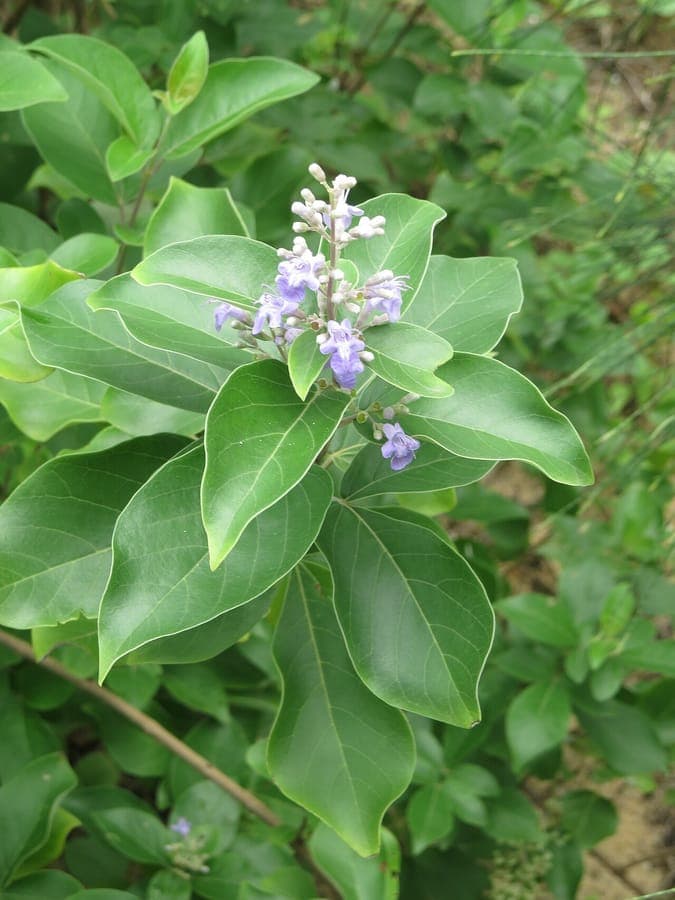
Vinayaraj / CC BY-SA 4.0, via Wikimedia Commons
Vitex trifolia: complete guide
Vitex trifolia
Want to see Vitex trifolia: complete guide in your garden?
1 minute, no credit card
Overview
Vitex trifolia, known as Indian three-leaf vitex, Indian wild pepper, or liligundi, is a fascinating tropical to subtropical shrub from South and Southeast Asia. This plant belongs to the Lamiaceae family (lip flower family) and is famous for its purple flowers, aromatic leaves, and traditional medicinal use. With its elegantly three-lobed foliage and long flowering period, it is a valuable addition to warm gardens.
Appearance and Bloom
Vitex trifolia grows as a medium shrub reaching 2-3 meters in height and width. The leaves are three-lobed (tri-foliate) and finely textured, with fragrant, aromatic surface. In summer (June-October), plants produce delicate, purple to lavender blue flowers in upright spires - a regular, attractive bloom that attracts butterflies and bees.
After flowering, small black berries form containing seeds, providing food for birds.
Ideal Location
Vitex trifolia thrives best on warm, sunny locations with full sun. The plant requires at least 6-8 hours of direct sunlight daily for optimal growth and blooming. In temperate climates, protection from cold winds may be essential. Ideally, place it in a warm, south-facing spot.
Soil
The plant grows in virtually any well-draining soil, from sand to loam. It prefers neutral to slightly acidic pH. It tolerates even poor soils, though richer soil promotes better growth. Ensure adequate drainage to prevent root rot.
Watering
During the growing period, water regularly, especially in young years. Once established, Vitex trifolia is fairly drought-tolerant. In very dry summers, supplemental water can help, but it is usually not critical. Avoid waterlogging in winter.
Free design
Want to see Vitex trifolia: complete guide in your garden? Make a free design now.
Pruning
Vitex trifolia tolerates pruning well and can be trimmed to maintain its shape. Early pruning (March-April) helps create a denser shrub. Dead or weak branches should be removed as needed. The plant can also be shaped for compact formation.
Maintenance Calendar
- Spring: Prune for shaping; water as temperatures rise
- Summer: Water regularly; enjoy blooms; feed
- Autumn: Plant continues growing; minimal maintenance; harvest berries
- Winter: Protect from frost; minimal watering in temperate zones
Winter Hardiness
Vitex trifolia is not winter-hardy in temperate climates. In subtropical zones, it can survive with protection. In tropical zones, it grows as a permanent plant. In temperate zones, it can be treated as an annual container plant or moved to protection in winter.
Companion Plants
Combine with other tropical shrubs such as bougainvillea, lantana, or ixora for an exotic garden landscape. Support with pruning for tree form if desired.
Medicinal and Traditional Use
The leaves of Vitex trifolia have long been used in traditional Asian medicine for various purposes. While interesting, always consult experts before using the plant medicinally.
Closing
Vitex trifolia offers elegant flowers, fragrant foliage, and traditional medicinal value for tropical and subtropical gardeners. With regular watering and good sun, this plant will provide years of blooming and beauty. Consult gardenworld.app for tropical plant guidance.
Want to see Vitex trifolia: complete guide in your garden? Make a free design now.
Upload a photo, pick a style, and get a photorealistic design with plant list in under a minute.
No credit card required


Similar plants
Apple mint (Mentha x villosa): complete guide
Mentha x villosa
Meet apple mint (Mentha x villosa): a fruity-scented kitchen herb with woolly leaves, perfect for tea and mojitos.
Salvia peyronii: complete guide
Salvia peyronii
Discover Salvia peyronii, a rare Lebanese mountain sage. Growing tips, hardiness, and companion planting for a Mediterranean gravel garden.
Bigleaf mint (Mentha x rotundifolia): complete guide
Mentha x rotundifolia
Discover bigleaf mint: cultivation, care tips, and garden uses. Learn how to grow this aromatic herb with soft, hairy leaves.