
Didier Descouens / CC BY-SA 4.0, via Wikimedia Commons
Blue periwinkle: complete guide
Vinca major
Want to see Blue periwinkle: complete guide in your garden?
1 minute, no credit card
Overview
Vinca major, commonly known as blue periwinkle, is a vigorous evergreen perennial that spreads quickly to form a dense carpet in shady garden areas. Native to southern Europe - from France and Italy to the eastern Mediterranean - it's adapted to thrive in challenging spots where few other plants succeed. With its glossy green foliage and vibrant blue flowers, it's a favourite for gardeners looking to brighten up dark corners.
The plant spreads by trailing stems that root at the nodes when they touch soil, making it ideal for stabilising slopes, covering bare patches under trees, or softening the edges of garden paths. It's tough, drought-tolerant once established, and largely pest-free. However, in some regions, particularly in mild coastal climates, it can become invasive. Always monitor its spread, especially near natural areas. On gardenworld.app, you can design a custom layout that uses Vinca major effectively without risking overgrowth.
Appearance & bloom cycle
Blue periwinkle grows 15–30 cm tall but can spread up to 1.5 metres or more in diameter. The leaves are dark green, leathery, oval-shaped, and 3–9 cm long, with a pointed tip. They stay green all year, adding winter interest to the garden.
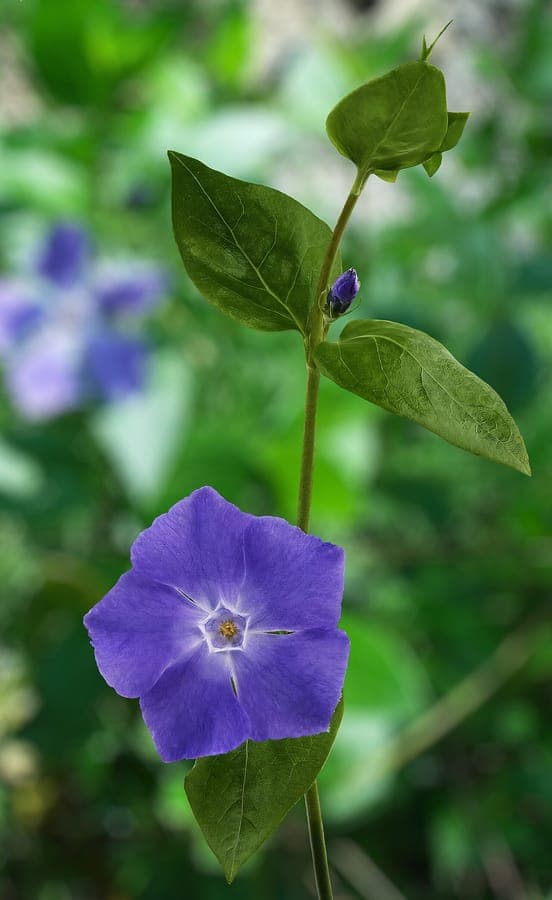
From April to June, the plant produces striking, five-petaled flowers that are bright blue with a deep purple throat. Each bloom measures about 3–4 cm across and appears singly at the leaf axils. In milder winters or protected microclimates, occasional flowers may appear sporadically through autumn and early winter.
While the plant rarely sets seed in cooler climates, it propagates easily through cuttings or layering. Simply press a long stem into moist soil, and it will root within a few weeks.
Ideal location
Blue periwinkle thrives in partial to full shade, making it perfect for areas under deciduous trees, north-facing walls, or woodland gardens. It can tolerate morning sun but struggles in hot afternoon sun, where leaves may scorch or fade.
It's hardy in USDA zones 7b to 10, which means it survives most UK and northern European winters, though in zone 7b, a light winter mulch can help prevent frost damage. In colder zones, it may die back but often rebounds in spring.
Soil requirements
Vinca major is not fussy about soil type. It grows well in loam, sandy, or clay soils, as long as drainage is adequate. The ideal pH range is 5.5 to 7.5 - slightly acidic to slightly alkaline.
Avoid waterlogged conditions, especially in winter, as this can lead to root rot. If planting in heavy clay, amend the soil with grit or compost to improve drainage. A light application of compost in spring is usually sufficient for nutrition - avoid overly rich soils, which encourage leggy growth at the expense of flowering.
Free design
Want to see Blue periwinkle: complete guide in your garden? Make a free design now.
Watering
During the first growing season, water newly planted periwinkle regularly - about once or twice a week, applying 10–15 litres per square metre. This helps the roots establish deeply.
Once established, blue periwinkle is quite drought-tolerant. However, during extended dry spells in summer, especially under trees with high root competition, supplemental watering is beneficial. Water at the base to keep foliage dry and reduce fungal risk.
Pruning
Pruning isn't essential, but it keeps the plant looking fresh and prevents it from becoming straggly. Cut back the entire plant in late winter or early spring (March in the UK) before new growth emerges. Trim stems to 10–15 cm above ground level using sharp secateurs.
If the plant has spread beyond its intended area, use a spade to slice through the outer edges and remove unwanted runners. These cuttings can be used to propagate new plants elsewhere. Regular trimming also helps control its vigour in gardens where it might outcompete more delicate species.
Maintenance calendar
- January: Check for frost damage. Remove any brown or damaged leaves.
- February: Clear debris and old mulch. Prepare for spring pruning.
- March: Prune back old growth. Apply a thin layer of compost.
- April: Blooms begin. Water if soil is dry.
- May: Peak flowering. Monitor for slugs or fungal spots in wet weather.
- June: Flowers fade. Watch for excessive spread.
- July: Water only during prolonged drought.
- August: Minimal care needed.
- September: Divide or transplant if desired.
- October: Mulch with leaf mould or compost.
- November: Leave foliage intact for winter protection.
- December: Inspect for winter hardiness.
Winter hardiness
Blue periwinkle is evergreen and generally stays green through winter in zones 7b and above. However, during harsh freezes below -12°C, foliage may turn brown or die back slightly. This is usually temporary - new growth emerges in spring.
In colder areas, a light mulch of straw or bark chips helps protect the crown. Avoid heavy mulching, which can trap moisture and encourage rot.
Companion plants
Vinca major pairs well with other shade-loving plants like hostas, ferns, hellebores, and epimediums. It also works as an underplanting for shrubs such as rhododendrons or hydrangeas.
Avoid planting it with aggressive ground covers like mint or bishop's weed, which may compete too heavily. Instead, use it to fill gaps in a mixed border or as a green carpet beneath spring-flowering bulbs like daffodils or bluebells.
On gardenworld.app, you can visualise companion planting schemes and check spacing recommendations to avoid overcrowding.
Closing
Blue periwinkle is a reliable, low-maintenance ground cover that brings colour and texture to shady areas. With proper placement and occasional pruning, it stays attractive for years. Available at most garden centres, including trusted retailers like B&Q, Wyevale, and local independents, it's easy to find healthy stock. Look for compact, bushy plants with no signs of disease. Plant in autumn or spring for best results.
Want to see Blue periwinkle: complete guide in your garden? Make a free design now.
Upload a photo, pick a style, and get a photorealistic design with plant list in under a minute.
No credit card required


Similar plants
Asclepias speciosa: complete guide
Asclepias speciosa
Showy milkweed: striking pink-white flowers, fragrant blooms. Essential monarch butterfly host plant.
Plumeria obtusa: complete guide
Plumeria obtusa
Discover the Singapore graveyard flower: an exotic evergreen with mesmerizing white blooms and exquisite fragrance. Expert cultivation, care, and maintenance tips.
Wrightia arborea: complete guide
Wrightia arborea
Wrightia arborea, known as doodhi, is an elegant tree from South Asia with delicate white flowers. Discover how to cultivate this exotic plant.