
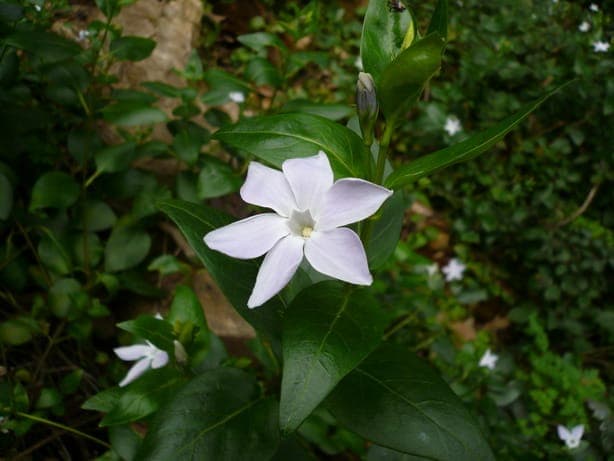
Pere prlpz / CC BY-SA 2.5, via Wikimedia Commons
Intermediate periwinkle: complete guide
Vinca difformis
Want to see Intermediate periwinkle: complete guide in your garden?
1 minute, no credit card
Overview
Vinca difformis, commonly known as intermediate periwinkle, is a quietly resilient ground cover that deserves more attention in UK and European gardens. Native to southern Europe and the western Mediterranean, this evergreen perennial from the Apocynaceae family thrives in woodland settings and under trees where few other plants succeed. It's less aggressive than Vinca major and more refined than Vinca minor, making it perfect for subtle, naturalistic planting schemes.
If you're planning a shady border or underplanting for deciduous trees, Vinca difformis is a smart choice. On gardenworld.app you can design a shade garden layout that highlights this plant's strengths, from early blooms to year-round foliage.
Appearance & bloom cycle
This plant spreads by trailing stems that reach 30–60 cm in length, rooting at the nodes as they go. The leaves are narrow, glossy, and dark green, measuring 3–6 cm long. They form a dense mat that suppresses weeds and retains moisture.
Flowering begins in late winter, typically from February to May, depending on the region. The blooms are a rich sky blue, occasionally with a soft violet hue, and measure about 3.5 cm across. Each flower sits singly at the leaf axils and lasts several days. While not as flamboyant as some spring bulbs, their quiet persistence makes them a welcome sight when little else is in flower.
After blooming, the plant remains lush and green all summer and into winter, only picking up a bronze tint in harsh cold spells.
Ideal location
Intermediate periwinkle grows best in light to moderate shade-think under hazels, beeches, or pines where sunlight filters through the canopy. A light rating of 6 out of 10 is ideal, meaning 3–4 hours of dappled or morning sun.
Avoid deep, dry shade under mature evergreens, as this limits flowering and encourages leggy growth. A sheltered spot, protected from cold winds, will help the plant stay evergreen through winter. South- or east-facing woodland edges work well.
Use gardenworld.app to simulate how light moves across your garden throughout the year and test where Vinca difformis would thrive best.
Soil requirements
Vinca difformis prefers well-drained, humus-rich soil with a neutral to slightly alkaline pH (7.0–7.5). It tolerates clay if it doesn't stay waterlogged and grows well on chalky soils-unlike many acid-loving plants.
If your soil is acidic (below pH 6.5), add a handful of garden lime when planting. Incorporate compost or leaf mould to improve structure and moisture retention. A 5 cm mulch of compost in early spring helps suppress weeds and feed the plant slowly.
Avoid waterlogged spots; poor drainage leads to root rot, especially in winter.
Free design
Want to see Intermediate periwinkle: complete guide in your garden? Make a free design now.
Watering
Once established, Vinca difformis is drought-tolerant and rarely needs watering. Young plants, however, need consistent moisture in their first growing season-about 5 litres per plant once a week during dry spells.
Water at the base to prevent fungal issues. In summer, check soil moisture 5 cm down; if dry, water deeply. Under trees, soil dries faster, so monitor more closely during prolonged dry periods.
Pruning
This plant rarely needs pruning, but if it gets straggly, trim it back in early spring (March) before new growth starts. Cut stems to 10–15 cm above ground level with clean secateurs. This encourages bushier growth and removes any winter-damaged foliage.
Avoid pruning in autumn-old stems insulate the crown during winter. Never cut into old wood without leaves; regrowth may not occur.
Maintenance calendar
- Jan: Check for frost damage. Keep soil well-drained.
- Feb: First flowers appear. Keep mulch clear of stems.
- Mar: Prune if needed. Top up with compost.
- Apr: Peak bloom. Water young plants in dry weather.
- May: Flowers fade. Remove spent blooms if desired.
- Jun: No care needed. Plant remains green and dense.
- Jul: Monitor for drought under trees. Water only if essential.
- Aug: Continue checking moisture in hot, dry spells.
- Sep: Leave undisturbed. Let foliage build up.
- Oct: Apply a light mulch of compost or leaf mould.
- Nov: Ensure good drainage. Avoid compaction.
- Dec: Protect young plants with bracken or twiggy brush in exposed gardens.
Winter hardiness
Vinca difformis is hardy in USDA zones 7–9 (-15°C to -7°C). In the UK and Ireland (zones 8–9), it stays evergreen with no protection. In colder continental regions, foliage may bronze but rarely dies back completely.
It handles wet winters well if the soil drains properly. In exposed sites, a loose mulch helps protect young crowns from freeze-thaw cycles.
Companion plants
Pair Vinca difformis with other shade-tolerant perennials like:
- Helleborus niger
- Pulmonaria officinalis
- Carex sylvatica
- Anemone nemorosa
- Ferns such as Dryopteris filix-mas
It works well beneath open-canopied shrubs like Cornus alba or Prunus lusitanica. Avoid planting with vigorous spreaders like Aegopodium podagraria, which will overwhelm it.
Closing
Vinca difformis is a quietly effective ground cover that brings early colour and year-round structure to shady areas. With minimal care, it forms a dense, weed-suppressing carpet that looks great under trees and along woodland edges. Find it at major garden centres in spring-look for healthy, well-rooted pots at OBI, Hornbach, or Truffaut depending on your region. On gardenworld.app, you can test how this plant fits into your overall garden design, season by season, and plan companion planting with confidence.
Want to see Intermediate periwinkle: complete guide in your garden? Make a free design now.
Upload a photo, pick a style, and get a photorealistic design with plant list in under a minute.
No credit card required


Similar plants
Asclepias speciosa: complete guide
Asclepias speciosa
Showy milkweed: striking pink-white flowers, fragrant blooms. Essential monarch butterfly host plant.
Plumeria obtusa: complete guide
Plumeria obtusa
Discover the Singapore graveyard flower: an exotic evergreen with mesmerizing white blooms and exquisite fragrance. Expert cultivation, care, and maintenance tips.
Wrightia arborea: complete guide
Wrightia arborea
Wrightia arborea, known as doodhi, is an elegant tree from South Asia with delicate white flowers. Discover how to cultivate this exotic plant.