
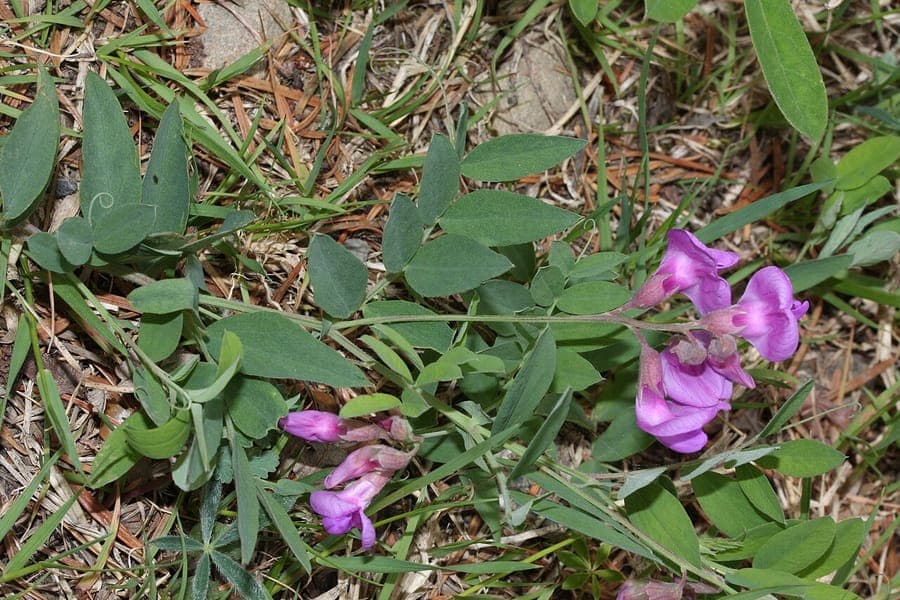
Walter Siegmund (talk) / CC BY-SA 3.0, via Wikimedia Commons
American vetch: complete guide to growing Vicia americana
Vicia americana
Want to see American vetch: complete guide to growing Vicia americana in your garden?
1 minute, no credit card
Overview
Vicia americana, commonly called American vetch, peavine, or buffalo-pea, is a native climbing and scrambling perennial herb in the family Fabaceae. Widely distributed across most of North America from Alaska to Mexico, it grows in prairies, meadows, forest edges, and along stream banks across a tremendous range of climate conditions. In garden settings it is an ecologically valuable choice for naturalistic plantings, wildlife borders, and pollinator strips, offering both ornamental interest and genuine ecological function.
As a member of the legume family, American vetch forms a symbiotic relationship with nitrogen-fixing Rhizobium bacteria in root nodules. This means the plant actively enriches the soil as it grows, making it an excellent companion plant and a natural way to improve fertility in lean garden soils over time. Gardeners exploring plant combinations for a naturalistic front garden can find design inspiration at gardenworld.app, where planting lists are tailored to match style and ecological goals.
The plant goes by numerous folk names reflecting its ecological role. Deer and elk graze it extensively in the wild, which accounts for "deervetch." Bees, bumble bees, and butterflies visit the flowers for nectar, making it a genuine pollinator magnet. The seeds are eaten by various small birds and rodents.
Appearance and bloom cycle
Vicia americana is a scrambling or climbing herb with stems that grow 30 to 90 cm long. It climbs by means of tendrils at the tips of its pinnately compound leaves. Each leaf is made up of eight to fourteen small, elliptic leaflets arranged in pairs, with a branched tendril at the tip that coils around nearby stems, twigs, or supports to anchor the plant.
Flowering occurs from May through August depending on latitude and local climate. The flowers are carried in one-sided racemes of three to nine individual blooms, each one a classic legume flower with a broad upper petal (the standard), two lateral petals (the wings), and a lower keel. Colour ranges from bright rose-purple and lilac-violet to deep blue-violet, occasionally approaching indigo. Each flower is 15 to 20 mm long, showy and richly coloured relative to the plant's size. Bees are the primary pollinators.
After flowering, narrow erect seed pods 2 to 4 cm long develop, each containing two to six seeds. The pods ripen brown and eventually split open, launching seeds some distance from the parent plant.
Ideal location
In its native range, Vicia americana occupies a remarkable variety of habitats: open prairies, woodland edges, moist meadows, riparian banks, and disturbed ground. This versatility translates well to garden conditions. The plant performs best in full sun to light partial shade, which are conditions that also maximise flowering.
For European gardeners, it is particularly well suited to a wildlife hedge border, a meadow-style planting, or a naturalistic front garden strip. It scrambles happily through low shrubs, over wire fences, or along willow twigs and bamboo canes used as informal support. Along a boundary hedge or garden edge it can form a loose flowering curtain that requires minimal management.
Planting in a wildflower meadow context works extremely well. Sow seeds directly into a prepared sunny patch alongside other prairie natives or European wildflowers with similar preferences. The nitrogen-fixing roots improve soil health for neighbouring plants. For full design layouts combining this species with other plants, gardenworld.app provides customised planting plans.
Soil requirements
Vicia americana is undemanding when it comes to soil. It grows across a wide range from poor sandy soils to moderately rich loams, as long as drainage is reasonable. The preferred pH range is 5.9 to 7.2, which covers the vast majority of typical garden soils.
Because the plant fixes its own nitrogen through root nodules, it does not require nitrogen-rich fertilisers. In fact, overly rich, fertilised soils promote leafy growth at the expense of flowers. The leaner the soil, the better the flowering. A deliberately infertile spot - such as a freshly turned, unfertilised bed - is often ideal.
For container growing, use a low-fertility free-draining mix and do not add nitrogen-based fertiliser. The pot should have ample drainage holes to prevent waterlogging.
Free design
Want to see American vetch: complete guide to growing Vicia americana in your garden? Make a free design now.
Watering
Once well established after its first growing season, American vetch is fairly drought tolerant. Its native range includes the dry western prairies as well as moister eastern regions, and the plant's fibrous, relatively deep root system helps it find moisture in lower soil layers during dry spells.
During the first growing season, water regularly to support establishment, approximately once a week if rain does not fall. After that, additional watering is needed only during extended droughts of more than two weeks. Always water at the base of the plant and allow the soil to partially dry between sessions.
Avoid sites with standing water or poor drainage. Like most legumes, American vetch dislikes having permanently wet feet, which can encourage root rot and reduce the effectiveness of nitrogen-fixing nodules.
Pruning
Vicia americana requires minimal active pruning. After flowering, cut back the spent stems if you want to limit seed dispersal, as ripe pods split open and throw seeds some distance from the parent plant. In a naturalistic garden, allowing self-seeding is fine and even desirable for colony establishment. In a more formal border setting you may want to remove the pods before they ripen.
In early spring, the plant can be cut back hard to just above ground level if it has become untidy or overgrown. It will re-sprout strongly from the root crown. In mild coastal climates the plant may remain partly green through winter; in colder areas the top growth dies back and regrows each year.
Maintenance calendar
March-April: Check the plant after winter. Remove dead stems. Apply a thin layer of garden compost around the base if the soil is very poor, but avoid nitrogen-rich feeds.
May-June: Growth begins and flowering starts. Provide support if you want the plant to climb. Water during dry spells.
June-August: Peak flowering period. Water moderately during extended droughts. Check that tendrils are not strangling neighbouring plants you wish to protect.
September-October: Seed pods ripen. Leave some for birds and self-seeding, or collect them for sowing. Foliage begins to yellow.
November-February: Top growth dies back in cold climates. Leave the dead stems for a few weeks as shelter for overwintering insects before clearing.
Winter hardiness
Vicia americana is a robust, cold-hardy plant. Its natural range spans from Alaska and the Yukon through the entire continental United States to the highlands of Mexico, demonstrating a very wide temperature tolerance. It is rated as hardy to USDA zone 3 and withstands temperatures down to approximately -35 degrees Celsius during dormancy.
In European gardens across USDA zones 5 to 8 - covering most of the UK, the Netherlands, Belgium, northern France, and Germany - it overwinters without any protection. After hard winters the above-ground parts die back completely, but the plant re-sprouts reliably from the root crown each spring. In mild winters with little frost it may remain partly evergreen.
No winter mulching, fleece, or other protective measures are needed in most west European gardens.
Companion plants
Vicia americana works beautifully in naturalistic plantings alongside other prairie-inspired or wildlife-friendly plants. Strong companions include:
- Achillea millefolium (common yarrow): similar sun and soil preferences, white or pink flat flower heads provide visual contrast.
- Echinacea purpurea (purple coneflower): tall purple-pink blooms complement the vetch flowers in a bold wildlife border.
- Lupinus polyphyllus (garden lupin): another nitrogen-fixing legume, the two together create a thematic companion planting with shared ecological function.
- Festuca glauca (blue fescue): low ornamental grass that provides structural contrast to the scrambling vetch.
- Geranium pratense (meadow crane's bill): purple-blue flowers in a similar colour palette, both excellent for pollinators.
Avoid planting near delicate, low-growing plants that may be overwhelmed by the vetch's climbing tendrils.
Closing thoughts
Vicia americana is an ecologically rich, charming climbing plant that deserves greater attention in European gardens. It draws bees, bumble bees, and butterflies, supports wildlife, enriches the soil through nitrogen fixation, and blooms prolifically in a vivid rose-purple palette for weeks on end. It requires minimal care and adapts readily to a wide range of garden conditions.
Gardeners looking to incorporate functional wildlife plants into a beautiful, coherent garden design can explore custom front garden plans at gardenworld.app, where planting lists are matched to your chosen style and local conditions. Seek out Vicia americana seeds from specialist wildflower seed suppliers and native plant nurseries, as most mainstream garden centres do not stock it. It is an easy species to establish from seed sown directly in spring.
For further reading on naturalistic garden design and companion planting for pollinators, gardenworld.app offers a growing library of plant guides and inspiration for every garden style.
Want to see American vetch: complete guide to growing Vicia americana in your garden? Make a free design now.
Upload a photo, pick a style, and get a photorealistic design with plant list in under a minute.
10,000+ gardens designed already
No credit card required


Similar plants
Tall Silky Lupine: complete guide
Lupinus elatus
Tall silky lupine is a fast-growing Californian perennial with silvery foliage and blue-purple flower spikes, ideal for a prairie-style garden.
Garfield Lupine: complete guide
Lupinus garfieldensis
The Garfield lupine is a rare, fast-growing American perennial for alkaline, dry grassland gardens, with striking blue flower spikes.
Lupinus elegans: complete guide
Lupinus elegans
Lupinus elegans, the elegant lupine, is a spectacular blooming plant from Mexico with blue flower spikes. Care, cultivation and garden use.