
Jean-Jacques MILAN / CC BY-SA 3.0, via Wikimedia Commons
Leatherleaf viburnum: complete guide
Viburnum rhytidophyllum
Want to see Leatherleaf viburnum: complete guide in your garden?
1 minute, no credit card
Overview
Viburnum rhytidophyllum, commonly known as Leatherleaf viburnum, is a robust, evergreen shrub that brings year-round presence to gardens across temperate zones. Native to central and south-central China, it has earned a solid reputation in European and North American gardens for its toughness, dense growth, and architectural foliage. Mature specimens stand 3 to 4 meters tall with a spread of 2 to 3 meters, making it ideal as a backdrop, informal hedge, or statement shrub in mixed borders. If you're designing a layered garden, gardenworld.app offers visualisation tools that help you place this shrub with precision, avoiding overcrowding.
This plant grows steadily in its first few years, quickly forming a vertical, multi-stemmed form. It's not flashy, but it's dependable-thick, leathery leaves stay on the plant through winter, providing structure when many others go bare. It's not fussy about soil and handles urban conditions well, which makes it a go-to for city gardens and exposed sites.
Appearance & bloom cycle
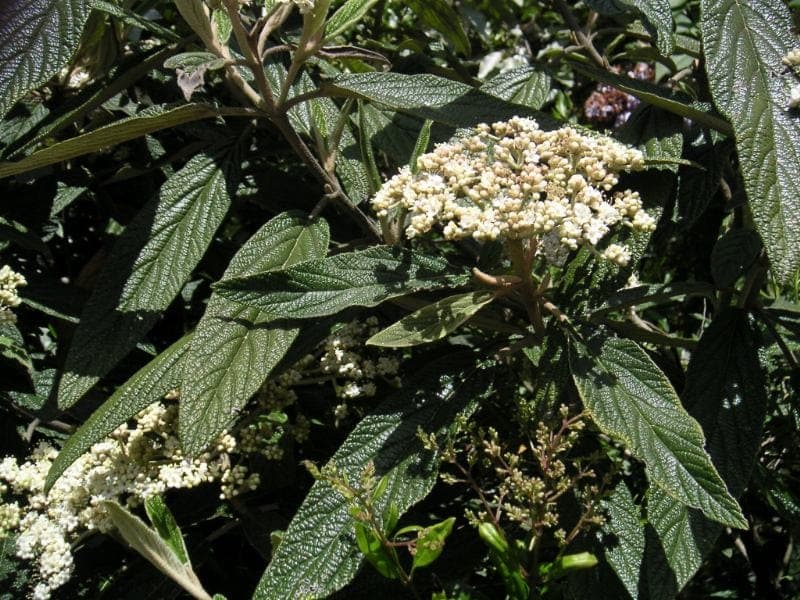
The leaves are 10–15 cm long, dark green and deeply wrinkled on top, with a silvery underside covered in fine hairs. This texture gives the plant its distinctive rugged look. In late spring, from late April to early June, flat clusters of creamy-white flowers appear, about 10–15 cm across. The blooms are lightly fragrant and attract bees and hoverflies, contributing to pollinator support.
After flowering, small round fruits develop, turning from green to dark purple or nearly black by autumn. While not palatable to humans, birds love them, especially thrushes and blackbirds. Watch for subtle colour shifts through the seasons-this plant rewards patient gardeners.
Ideal location
Choose a spot with partial shade to light shade. Full sun is acceptable if the soil stays reliably moist, but in hot, dry summers, leaves may scorch. Deep shade reduces flowering and leads to leggy growth. A north- or east-facing wall or the dappled shade under open-canopy trees works best.
Give this shrub room to grow-minimum 2 meters from other plants or structures. It doesn't like root competition. Use gardenworld.app to map out spacing and growth projections over five to ten years, especially if planting in rows for screening.
Soil requirements
Leatherleaf viburnum adapts to a range of soils but thrives in fertile, well-drained loam or clay-loam with a pH between 5.5 and 7.0. It tolerates heavy clay as long as drainage is adequate. Sandy soils are fine too, but you'll need to water more frequently and mulch to retain moisture. Avoid highly acidic or waterlogged sites.
When planting, dig in organic matter like compost or well-rotted manure to boost fertility and improve soil structure. Avoid planting in compacted or barren urban soil without amending it first.
Free design
Want to see Leatherleaf viburnum: complete guide in your garden? Make a free design now.
Watering
Water deeply once a week during the first 12–18 months after planting, giving 10–15 liters per session. After establishment, it's drought-tolerant but benefits from occasional deep watering during prolonged dry spells. Mulch with wood chips or compost to retain moisture and suppress weeds.
Never let the roots sit in water-poor drainage causes root rot. If planting in containers, ensure the pot has multiple drainage holes.
Pruning
Pruning is rarely needed, but you can shape the shrub lightly after flowering in June or July. Avoid pruning in autumn or winter, as flower buds form the previous season. Cutting too late means losing next year's blooms.
Use clean, sharp tools. Remove only dead, damaged, or crossing branches as maintenance. For hedges, two light trims per year keep it tidy, but it's not required for plant health.
Maintenance calendar
- Jan: Monitor for frost damage, especially on young plants
- Feb: Check stems for dieback; no pruning yet
- Mar: Apply compost around the base to boost spring growth
- Apr: Inspect for emerging buds; keep lawn trimmers away from bark
- May: Peak flowering; enjoy the pollinators
- Jun: Light pruning after bloom; remove any weak shoots
- Jul: Monitor for drought stress; water young plants if needed
- Aug: Replenish mulch; check for pests like aphids
- Sep: Stop pruning; let new growth harden off
- Oct: Rake fallen debris; avoid piling mulch against the trunk
- Nov: Check soil drainage before winter rains
- Dec: Protect young stems with hessian in harsh winters
Winter hardiness
Hardy to USDA zone 7 (down to -17°C). In the UK and Ireland (zone 8), it usually survives without issues, but young plants may suffer from cold, dry winds. Wrap the trunk with hessian or burlap for the first few winters. In prolonged freezes with dry soil, water lightly on a mild day.
Leaves may bronze in extreme cold but generally recover in spring.
Companion plants
Pair with other shade-tolerant, moisture-loving plants: Hydrangea, Rhododendron, Helleborus, or ferns like Dryopteris. For contrast, use silver-leaved plants such as Stachys byzantina or Artemisia. Avoid invasive spreaders like Lysimachia or vigorous groundcovers.
For year-round interest, combine with evergreens like Osmanthus or Skimmia. A mixed border with texture and height variation keeps the eye moving.
Closing
Viburnum rhytidophyllum isn't the flashiest shrub, but it's a long-term performer-low maintenance, wildlife-friendly, and resilient. It handles city grime, coastal winds, and dry spells once established. Buy from trusted garden centres where you can inspect the root ball and stem structure. Look for healthy specimens around 100–150 cm tall. With thoughtful placement and a little patience, this shrub becomes a garden anchor. Use gardenworld.app to explore design options and see how it fits into your overall layout.
Want to see Leatherleaf viburnum: complete guide in your garden? Make a free design now.
Upload a photo, pick a style, and get a photorealistic design with plant list in under a minute.
No credit card required


Similar plants
Squashberry: complete guide
Viburnum edule
Grow mooseberry (Viburnum edule): ultra-hardy North American shrub with fragrant white flowers and red autumn berries. Perfect for boreal gardens. Zone 3.
Witherod: complete guide to this elegant North American shrub
Viburnum cassinoides
Discover Viburnum cassinoides: an elegant North American shrub with white flowers, yellow fall foliage, and blue berries. Perfect for temperate garden zones.
Buddlejaleaf viburnum: complete guide
Viburnum buddleifolium
Elegant evergreen shrub with delicate foliage and white spring flowers. Perfect for sheltered borders in temperate gardens.