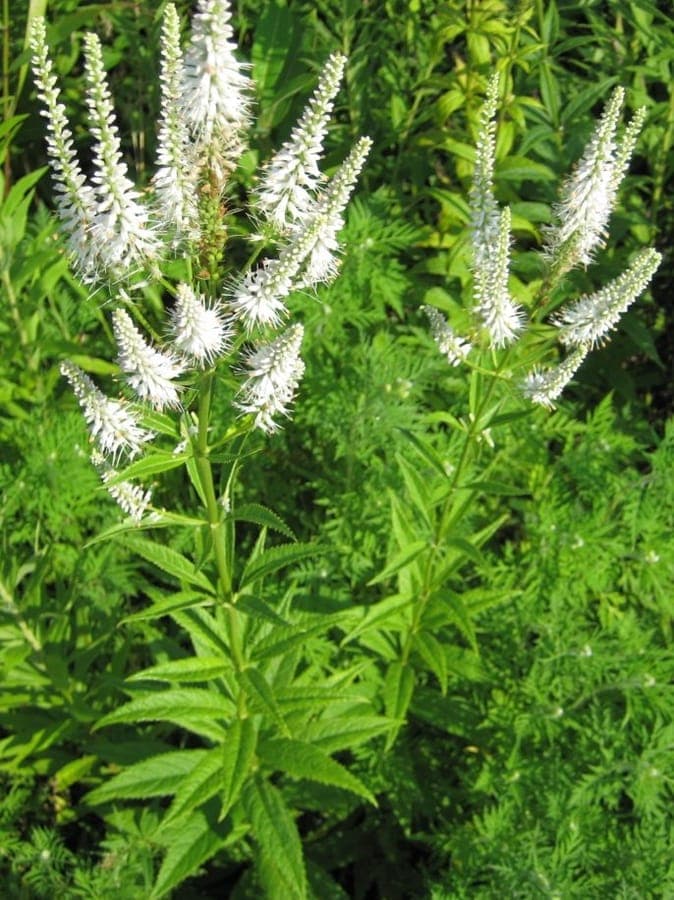
Crazytwoknobs / CC BY 3.0, via Wikimedia Commons
Culver's root: complete guide
Veronicastrum virginicum
Want to see Culver's root: complete guide in your garden?
Full design in HD: €7.99
Look after your Culver's root with the GardenWorld app
Identify plants with your camera and get a care calendar with reminders for this plant.


Overview
Culver's root (Veronicastrum virginicum) is a perennial that stands out in any border for its architecture. Ramrod-straight stems with whorls of narrow leaves carry slender white or lilac spires in summer, rising above the foliage like the arms of a candelabra. The plant is tall but never heavy, adding height to a border without closing it in.
The species is native to eastern and central North America, where it grows in damp meadows, along woodland edges and on open prairies. It belongs to the plantain family (Plantaginaceae) and is related to speedwell (Veronica), which you can see in the flower spikes.
In Europe it became widely known through the naturalistic planting style of designers such as Piet Oudolf, in which perennials and grasses are planted together in large drifts. Veronicastrum grows 1.2 to 1.8 metres tall and around 60 to 80 cm wide. It forms a sturdy clump that slowly widens over the years without spreading aggressively. On gardenworld.app you can have a garden design made that shows how vertical accents like this give a border structure, even in a smaller garden.
There are now quite a few cultivars. 'Fascination' has lilac-pink spires that are sometimes branched or slightly twisted, 'Lavendelturm' is lavender blue, 'Erica' soft pink, 'Album' and 'Diana' pure white, and 'Apollo' has long lilac spikes.
Appearance and bloom cycle
In spring the stems emerge late, often not until April or May. They shoot up quickly and carry whorls of three to seven leaves at regular intervals. The leaves are lance-shaped, 5 to 15 cm long, with finely toothed margins. Even before flowering, the whorls give the stems a handsome, tiered look.
Flowering starts in July and lasts into September. At the top of each stem a central spike of 15 to 25 cm appears, surrounded by a few shorter side spikes, so the whole resembles a candelabra. The spikes are densely packed with tiny tubular flowers whose stamens protrude well beyond the petals, giving them a light, bottlebrush texture. The species itself flowers white to the palest pink. The photo at the top shows exactly that: white, candelabra-shaped spikes above whorls of narrow green leaves.
Bees, bumblebees, hoverflies and butterflies visit the spikes all summer. After flowering, the spikes fade to rusty brown and stay upright. In winter, dusted with frost or a light covering of snow, the seed heads are among the finest silhouettes in the garden.
The root of Veronicastrum virginicum was once used in North America as a powerful purgative and emetic. Fresh plant parts, especially the root, have no place in the kitchen and can cause stomach and gut upset in people and pets if eaten.
Ideal location
Veronicastrum grows best in full sun to light shade. In full sun the stems are sturdiest and flowering is most generous. In more shade the plant tends to be thinner, the stems lean and it flowers less. A spot with at least six hours of sun a day is ideal.
Because of its height it belongs in the middle or back of a border. It looks best in groups of three to five plants, or repeated through the border so that the vertical spikes create a rhythm. Plant 50 to 60 cm apart. Despite its height, it rarely needs staking in a sunny position; only in a very windy or overly shady spot will a few supporting canes help.
Soil requirements
This plant likes fertile, humus-rich soil that does not dry out in summer. In the wild it often grows in damp meadows, and that is reflected in its needs. Clay and loam are excellent, provided water does not lie for long in winter. On light sandy soil, dig in plenty of compost at planting time so the ground holds moisture better.
Soil pH is not critical: slightly acid to slightly alkaline (pH 5.5 to 7.5) is fine. A layer of compost or leaf mould in spring keeps the soil moist and feeds the plant sufficiently. Artificial fertiliser is unnecessary and tends to make the stems floppy.
Free preview
Want to see Culver's root: complete guide in your garden? Make a free preview of your design.
Watering
After planting, water regularly throughout the first season, especially in dry spells: 5 to 10 litres per plant once or twice a week. Once established, Veronicastrum has a deep root system, but it remains a plant that prefers not to dry out. In prolonged drought in July and August the leaves droop, the lower ones turn brown and flowering is shorter.
In hot, dry summers give an occasional thorough soak, ideally in the evening or early morning, watering at the base of the plant. A mulch of compost or bark helps keep moisture in the soil. It can be grown in a large container, but given its height and thirst it does noticeably better in open ground.
Pruning
Veronicastrum needs very little pruning. Leave the faded spikes standing in autumn: they look good in winter and insects overwinter in the hollow stems. Cut all stems down to just above ground level in late February or March, before the new shoots appear.
If you want a slightly shorter, sturdier plant, cut back some of the stems by a third in late May, a technique known as the Chelsea chop. Those stems branch and flower a little later and lower, which extends the flowering season. Every four or five years you can divide older clumps in spring: lift the clump, split it with a sharp spade into pieces with a few buds each and replant.
Maintenance calendar
January to February: Dormant period. Enjoy the winter silhouettes. In late February cut all old stems down to just above ground level.
March to April: Spread compost around the clumps. A good time to plant or divide older clumps. The first shoots appear.
May to June: Rapid growth. Water in dry weather. Optionally cut back some stems in late May to stagger flowering.
July to September: Full flower. Water during heat and drought. Leave spent spikes standing.
October to December: The spikes turn rusty brown and the plant goes dormant. Leave everything standing over winter. The plant calendar on gardenworld.app lists these jobs month by month, tailored to the plants in your own garden.
Winter hardiness
Veronicastrum virginicum is exceptionally hardy and tolerates temperatures down to -30 °C and below. Anywhere in Britain and north-west Europe it needs no winter protection in the ground. The top growth dies back in autumn, but the rootstock overwinters safely underground and reliably shoots again in spring.
The only winter risk is soil that stays wet and airless for long periods, in which the roots can rot. On free-draining ground, even if it holds moisture, this is rarely an issue. The plant is not invasive in Europe: at most it self-seeds occasionally, and otherwise it spreads only slowly from the clump.
Companion plants
Veronicastrum is a key plant in prairie-style naturalistic borders. Pair it with plants that grow in the same moist, fertile soil and flower at the same time. Purple coneflower (Echinacea purpurea) and black-eyed Susan (Rudbeckia fulgida) offer round flower heads that contrast beautifully with the slender spikes. Great burnet (Sanguisorba officinalis) adds small dark red buttons at a similar height.
Border phlox (Phlox paniculata) brings scent and colour in summer, while purple moor grass (Molinia caerulea) or other ornamental grasses lighten the planting and, like Veronicastrum's spikes, stay upright well into winter. For a calm white and blue scheme, combine a white cultivar with blue asters and speedwells.
Final thoughts
Veronicastrum virginicum is one of the best perennials for anyone who wants structure in a border. It is strong, long-lived, almost free of disease and needs little work: a sunny spot, soil that does not dry out and one cut at the end of winter. In return you get months of elegant candelabras full of insects and, in winter, graceful silhouettes that keep the garden interesting through the cold season.
Frequently asked questions about Culver's root
Is Culver's root winter hardy?
Veronicastrum virginicum is exceptionally hardy and tolerates temperatures down to -30 °C and below. Anywhere in Britain and north-west Europe it needs no winter protection in the ground.
When and how do you prune Culver's root?
Veronicastrum needs very little pruning. Leave the faded spikes standing in autumn: they look good in winter and insects overwinter in the hollow stems.
How much water does Culver's root need?
After planting, water regularly throughout the first season, especially in dry spells: 5 to 10 litres per plant once or twice a week. Once established, Veronicastrum has a deep root system, but it remains a plant that prefers not to dry out.
Where does Culver's root grow best?
Veronicastrum grows best in full sun to light shade. In full sun the stems are sturdiest and flowering is most generous.
What soil does Culver's root need?
This plant likes fertile, humus-rich soil that does not dry out in summer. In the wild it often grows in damp meadows, and that is reflected in its needs.

See it in your garden
See Culver's root in your garden
One photo of your garden and a few questions. You see the result in about a minute.
Try it with a photoIdentify this plant in your own garden. Identify a plant
Similar plants
Purple coneflower: complete guide
Echinacea purpurea
Everything about Purple Coneflower (Echinacea purpurea): planting, care, pruning and combinations. Expert tips for a thriving prairie-style garden.
Sanguisorba: complete guide
Sanguisorba officinalis
Discover everything about Sanguisorba officinalis. Learn about its elegant appearance, ideal growing conditions, care and maintenance comprehensively.
Molinia caerulea: complete guide
Molinia caerulea
Molinia caerulea (purple moor grass) is a striking ornamental grass prized for its delicate blue-purple panicles and spectacular autumn color transformation.
