
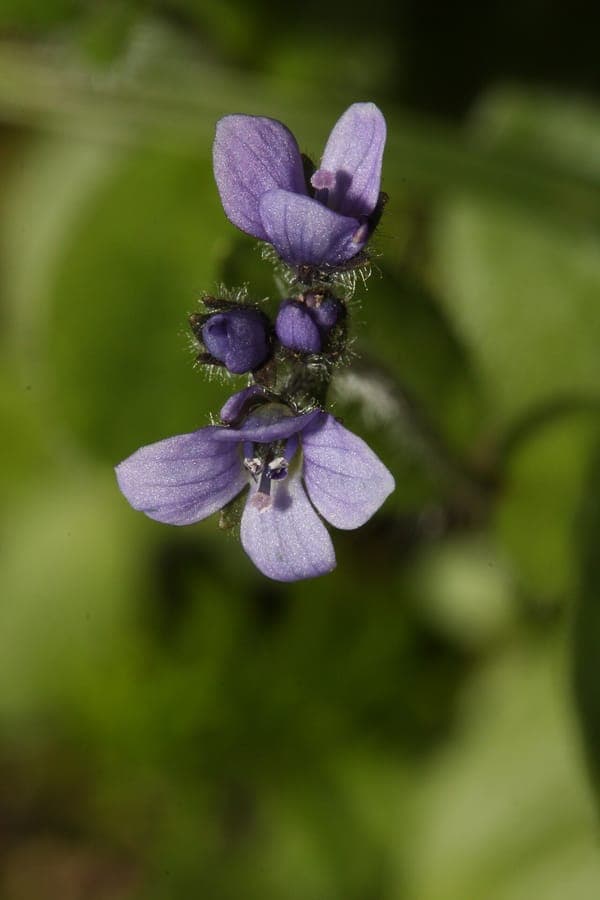
Walter Siegmund (talk) / CC BY-SA 3.0, via Wikimedia Commons
American alpine speedwell: complete guide to growing Veronica wormskjoldii
Veronica wormskjoldii
Want to see American alpine speedwell: complete guide to growing Veronica wormskjoldii in your garden?
1 minute, no credit card
Overview
Veronica wormskjoldii, commonly called American alpine speedwell, is a low-growing rhizomatous perennial in the family Plantaginaceae. Native to the high mountain zones of North America, its range stretches from Alaska and the Aleutian Islands across the Rocky Mountain states to Greenland and the Canadian Arctic territories. In garden settings it brings authentic alpine character to rock gardens, cool shaded borders, and moisture-retentive slopes. Gardeners planning such planting schemes can explore design ideas at gardenworld.app, where photorealistic garden designs show how specialty perennials like this one can be integrated into a coherent landscape.
The species was formally described by Roemer and Schultes in 1817, named in honour of the Danish botanist Morten Wormskjold, who collected plants in Greenland during his expeditions in the early nineteenth century. It is sometimes listed in older references as Veronica alpina subsp. wormskjoldii, but is now accepted as a distinct species in its own right.
In European gardens this plant is less commonly encountered than its relative Veronica spicata, but it deserves wider recognition. Its extreme cold hardiness, compact growth, and modest care requirements make it an excellent choice for gardeners who want alpine authenticity without constant intervention.
Appearance and bloom cycle
Veronica wormskjoldii forms a low, spreading mat of small, oval to elliptic leaves with a fine texture. Leaves are soft green and arranged in opposite pairs along the trailing stems. The plant typically reaches 10 to 25 cm in height depending on soil fertility and climate conditions.
Flowering occurs from June through August, with the precise timing shifting later at higher altitudes or in cooler gardens. The blooms are carried on upright spikes, each bearing a raceme of four to six individual flowers in a vivid blue-violet to blue-purple shade, occasionally with a white centre. Each flower is small, around 5 to 8 mm across, but their colour is intense and stands out sharply against the green foliage. Bees and small butterflies visit regularly during the blooming period.
After flowering, small somewhat flattened seed capsules develop. These are not particularly ornamental, but the neat foliage mat remains attractive throughout the growing season, giving the plant four-season ground cover value even when not in bloom.
Ideal location
In its natural habitat Veronica wormskjoldii grows in alpine meadows, along mountain streams, and on moist rocky plateaus. This tells us exactly what to replicate in the garden: bright light, cool conditions, and consistent moisture without waterlogging.
The plant performs well in full sun to light partial shade. In gardens with hot summers, a spot with some afternoon shade will reduce stress and prevent leaf scorch. In the cooler, moister climates of north-west Europe, a fully sunny position is usually fine.
A rock garden is the most natural setting for this plant. Planting it among stones replicates the cool root zone it enjoys in nature, with the foliage basking in light while the root system remains cool and moist. It also works well as a ground cover on a sloped bank, beside a path in an alpine planting, or at the front of a cool mixed border. For ideas on how to compose rock garden plantings effectively, visit gardenworld.app.
Soil requirements
Veronica wormskjoldii prefers slightly acidic to neutral, free-draining soil with a pH between 6.0 and 7.3. It does not need particularly rich soil and actually performs better in lean to moderately fertile conditions, which suit its mountain origins. Excess fertility promotes leafy growth at the expense of flowering.
Good drainage is the single most important factor. Standing water around the roots is poorly tolerated, especially in winter. If planting in heavy clay soils, improve drainage by incorporating plenty of grit or coarse perlite. A mix of standard potting compost, coarse sand, and fine gravel in equal parts makes an ideal planting medium for rock garden pockets.
Mulching around the plant with a layer of fine gravel helps retain moisture at the surface while keeping the crown dry, exactly mimicking the rocky scree of its native habitat.
Free design
Want to see American alpine speedwell: complete guide to growing Veronica wormskjoldii in your garden? Make a free design now.
Watering
Once established after its first growing season, Veronica wormskjoldii is reasonably drought tolerant, though it naturally benefits from consistent moisture. In its mountain home it experiences regular precipitation from snowmelt and mountain rain, interspersed with dry spells.
During the first growing season after planting, water regularly to help the plant establish its root system. Once per week during dry spells is generally sufficient. Allow the soil to partially dry out between waterings to avoid keeping the roots constantly wet. Water at the base rather than overhead to reduce the risk of mildew on the foliage.
In a well-designed rock garden where excess water drains freely, the plant needs little supplemental irrigation except during prolonged summer droughts of two weeks or more. Use rainwater where possible, as mains water can be too alkaline for the mildly acidic conditions the plant prefers.
Pruning
Veronica wormskjoldii requires minimal pruning. Once the flower spikes have faded, cut them back to the base to keep the plant tidy and potentially encourage a light second flush of bloom later in the season.
In autumn, remove dead or yellowing stems if desired, though leaving the mat through winter causes no harm. The foliage remains reasonably compact even without cutting back. In early spring, around March or April, lightly rake away any winter-damaged leaves to make way for new growth.
The plant spreads gradually by rhizome but is not invasive. If the mat grows wider than desired, simply lift a section and replant it elsewhere or pot it up to share with other gardeners.
Maintenance calendar
March-April: Remove any winter-damaged foliage. Check that drainage is still adequate around the plant. A light topdressing of fine gravel helps suppress weeds and retain surface moisture.
May-June: Growth picks up. Water in dry spells. Watch for slug activity, as young shoots can be damaged.
June-August: Peak flowering period. Deadhead spent spikes to prolong bloom. No fertiliser needed.
September-October: Cut back lightly after the growing season. Assess drainage ahead of winter.
November-February: Dormant period. No special care needed. Ensure the planting area does not become waterlogged during prolonged wet weather.
Winter hardiness
Veronica wormskjoldii is exceptionally cold hardy. Its native range includes some of the most frigid places on the continent, including Greenland, Nunavut, the Yukon, and the high-altitude Rocky Mountain states. It tolerates temperatures well below -30 degrees Celsius and is rated for USDA hardiness zone 2, meaning it handles far harsher winters than most European gardens ever produce.
In UK and north-west European gardens it survives with zero protection. The only genuine winter risk is waterlogging rather than cold. Ensure good drainage, and if growing in a container, keep it in a sheltered spot where rain cannot pool around the roots.
The plant dies back partly over winter. Foliage may brown at the edges, but fresh growth emerges reliably in spring. No fleece, straw, or other winter protection is required.
Companion plants
Veronica wormskjoldii fits naturally with other compact alpines that share its preference for free-draining, lean soil. Good companions include:
- Dryas octopetala (mountain avens): similar height, white flowers, excellent for a shared rocky plateau planting.
- Saxifraga oppositifolia (purple saxifrage): blooms earlier in spring to extend the flowering season before the speedwell begins.
- Phlox subulata (moss phlox): forms a colourful, dense mat that complements the blue-violet tones of the Veronica.
- Thymus serpyllum (wild thyme): aromatic low cover with the same soil preferences.
- Geranium cinereum (grey crane's bill): small pink flowers that contrast well with the blue of the speedwell.
Avoid planting alongside vigorous, spreading ground covers such as Vinca or Pachysandra, which may outcompete the smaller Veronica.
Closing thoughts
Veronica wormskjoldii is a modest but rewarding alpine perennial that repays its placement with a fine display of blue-violet flowers through the summer months. It is easy to maintain, exceptionally cold hardy, and well suited to rock gardens, alpine borders, and cool moist corners of the front garden. Give it well-drained, slightly acidic soil in a cool position, and it will thrive for years with minimal intervention.
For gardeners looking for design inspiration on how to incorporate such specialty plants into a complete garden scheme, gardenworld.app offers photorealistic visualisations of front garden designs. Seek out Veronica wormskjoldii at specialist alpine nurseries and rockery plant suppliers, as most mainstream garden centres carry only the more common speedwell varieties.
Want to see American alpine speedwell: complete guide to growing Veronica wormskjoldii in your garden? Make a free design now.
Upload a photo, pick a style, and get a photorealistic design with plant list in under a minute.
10,000+ gardens designed already
No credit card required


Similar plants
White Beardtongue: complete guide
Penstemon albidus
Discover white beardtongue (Penstemon albidus) - elegant perennial with white to cream flowers. Drought-resistant, perfect for prairie and dry gardens.
Longsepal Beardtongue: complete guide
Penstemon calycosus
Discover longsepal beardtongue (Penstemon calycosus) - beautiful perennial with lilac-blue flowers. For partial shade and moist soil. Ideal for naturalized.
Penstemon cusickii: complete guide
Penstemon cusickii
Discover Cusick's beardtongue, a compact alpine flowering plant with violet-pink blooms. Perfect choice for rock gardens and water-wise landscaping.