
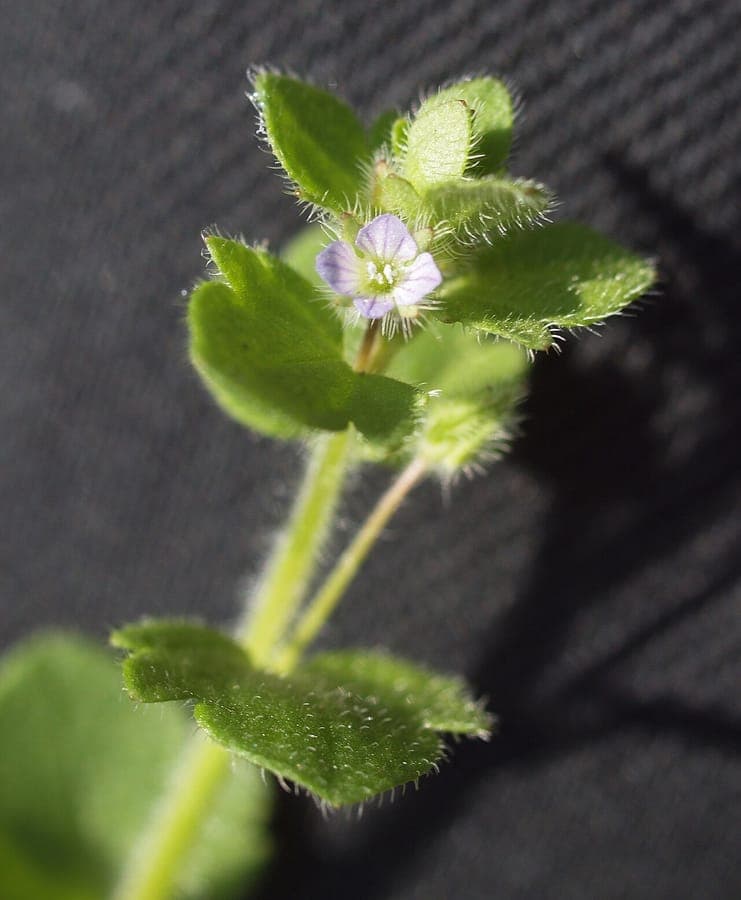
Rainer Burkard / CC BY-SA 3.0, via Wikimedia Commons
False ivy-leaved speedwell: complete guide
Veronica sublobata
Want to see False ivy-leaved speedwell: complete guide in your garden?
1 minute, no credit card
Overview
False ivy-leaved speedwell (Veronica sublobata M.A.Fisch.) is a small, creeping perennial in the plantain family (Plantaginaceae), native to much of central and western Europe. The Austrian botanist M.A. Fischer described it as a distinct species in 1967, separating it from the closely related ivy-leaved speedwell (Veronica hederifolia). The scientific name refers to the slightly lobed leaf shape: 'sublobata' means 'somewhat lobed'. In German it is known as Hain-Ehrenpreis (grove speedwell) or Hecken-Ehrenpreis (hedge speedwell), names that perfectly describe its preferred habitat. Its natural range covers Austria, Belgium, Bulgaria, the Czech Republic, Finland, France, Germany, Poland, Switzerland, and the former Yugoslav states; it has also been introduced in Great Britain and several eastern United States. This is a specialist of shaded, nutrient-rich habitats - woodland margins, hedge banks, and the sheltered floors of mixed deciduous forest. For gardeners looking to populate a shaded corner with authentic European woodland plants, gardenworld.app offers design layouts and planting guides for semi-shaded and fully shaded garden situations.
Appearance and bloom cycle
False ivy-leaved speedwell is a modest, low-growing plant with creeping to slightly ascending stems reaching 10 to 30 cm in length. The stems are finely hairy and branch freely along the ground. The leaves are the most distinctive feature: broadly kidney-shaped to slightly heart-shaped, with a subtly lobed margin that resembles a miniature ivy leaf. The surface is matt and covered in short hairs. The flowers are small but appealing: pale blue to lilac-blue, four-petalled, with two protruding stamens. Individual flowers emerge singly from leaf axils rather than in spikes or racemes, giving the plant a casual, scattered-bloom appearance. The flowering period is remarkably long, from March through to October, with the greatest abundance of flowers in spring and early summer. This extended season makes it valuable for early-emerging insects and small bee species active before most other spring plants are in bloom. After flowering, small, flattened seed capsules develop and ripen.
Ideal location
Unlike most other speedwell species, which prefer open, sunny positions, false ivy-leaved speedwell is specifically adapted to semi-shade and dappled woodland light. It grows naturally along hedgerow banks, at the edges of deciduous woodland, and under the canopy of trees and shrubs where direct sunlight reaches the ground for only a few hours a day. In the garden, a position in semi-shade to light shade is ideal: under a deciduous tree, alongside a north-facing wall, in a shaded border, or at the base of a hedge. Full sun, especially in warm and dry summers, causes leaf scorch and rapidly wilts the plant. Gardeners designing a planting for a shaded or semi-shaded area will find planning tools and species combinations suited to low-light conditions through gardenworld.app.
Soil
False ivy-leaved speedwell has quite different soil requirements from most Mediterranean or alpine Veronica species. The ideal pH range is 7 to 7.5, indicating a preference for neutral to slightly alkaline conditions. The species thrives in rich, humus-laden woodland soil that retains moisture well without becoming waterlogged - the classic forest floor substrate of mixed deciduous woodland. Heavy clay is less suitable unless drainage is improved with grit or coarse sand. A light, airy loam enriched with compost, leaf mould, or well-rotted bark produces the best results. Adding a mulch of leaf mould each autumn mimics the natural leaf-litter accumulation of woodland floors, maintains moisture, and gradually enriches the soil.
Free design
Want to see False ivy-leaved speedwell: complete guide in your garden? Make a free design now.
Watering
This speedwell prefers a relatively high atmospheric humidity and consistently moist soil, in line with its preference for sheltered, humus-rich woodland habitats. During dry spells, particularly in summer, supplementary watering is needed to keep the plant healthy. The foliage wilts quickly in prolonged drought. Water at the base of the plant rather than overhead to avoid promoting fungal disease on the leaves. In semi-shaded positions, the soil dries out less quickly than in full sun, reducing the frequency of watering needed. In pots or containers, check moisture weekly and water before the substrate dries out completely. A layer of leaf mould or composted bark as mulch helps retain soil moisture and reduces watering frequency.
Pruning
False ivy-leaved speedwell requires minimal pruning. Because the plant stays small and flowers modestly, strong intervention is rarely needed. Remove spent stems after the main flush of bloom if you want to limit self-seeding. In early spring, clear away any dead stems and yellowed leaves to allow fresh growth to emerge cleanly. If the plant becomes straggly during the growing season, lightly trim the longest runners to keep growth tidy. Leave the plant undisturbed through autumn and winter, and cut back only in early spring when new growth begins to appear. Avoid cutting back hard in autumn, as the plant uses its foliage to photosynthesize and build reserves for winter survival.
Maintenance calendar
March and April: remove dead material from winter, apply a thin top-dressing of leaf mould or composted bark around the plant. Early May: note that the plant may already be in flower; this is one of the earliest bloomers in a semi-shaded garden. June to August: plant continues to flower; minimal action required. In dry periods, give supplementary water. September: flowering slows; leave seed capsules to ripen if you want natural self-seeding and spread. October and November: no pruning needed; the plant is preparing for dormancy. December and January: the plant overwinters; no active maintenance required. Young plants are available at garden centres in spring.
Winter hardiness
False ivy-leaved speedwell is a robust European plant with good cold tolerance. The species is classified in USDA hardiness zones 5 to 8, tolerating minimum winter temperatures of around -29 to -12 degrees Celsius. In the Netherlands, Belgium, and most of northern France and Germany, it overwinters reliably in the open ground without any protection. Frost alone is not a problem, provided the roots are not sitting in prolonged standing water. On a well-drained, humus-rich soil in a sheltered, semi-shaded position, the plant overwinters without difficulty. After a hard winter the above-ground parts may die back completely, but the plant typically re-sprouts from the root system in early spring.
Companion plants
False ivy-leaved speedwell fits naturally into semi-shaded woodland gardens alongside other European native woodland plants. Good companions include enchanter's nightshade (Circaea lutetiana), lesser celandine (Ficaria verna), bluebell (Hyacinthoides non-scripta), spotted dead-nettle (Lamium maculatum), and Solomon's seal (Polygonatum multiflorum). Ferns such as male fern (Dryopteris filix-mas) and lady fern (Athyrium filix-femina) add structural height without competing directly with this small groundcover. Avoid aggressive spreaders such as ivy (Hedera helix) in large quantities, which would quickly smother the modest false ivy-leaved speedwell.
Closing
False ivy-leaved speedwell is an unassuming but ecologically valuable plant for shaded gardens, hedge banks, and woodland-style borders. Its early start in March, its exceptionally long bloom season through to October, its suitability for native planting schemes, and its worth as a nectar source for early insects all make it a sensible choice for anyone wishing to enrich their garden with authentic European woodland flora. Give it a semi-shaded position, humus-rich and moisture-retentive soil, and minimal care, and it will produce its quiet blue flowers reliably from early spring well into autumn. For more garden design ideas suited to shaded and semi-shaded spaces, visit gardenworld.app.
Want to see False ivy-leaved speedwell: complete guide in your garden? Make a free design now.
Upload a photo, pick a style, and get a photorealistic design with plant list in under a minute.
10,000+ gardens designed already
No credit card required


Similar plants
Spiked Pyrenean speedwell: complete guide
Veronica ponae
Spiked Pyrenean speedwell is a rare mountain perennial with vivid blue flower spikes, native to the Pyrenees, suited to rock gardens and alpine beds.
Ivy-leaf speedwell: complete guide
Veronica hederifolia
Veronica hederifolia is a charming annual plant with lovely blue flowers and ivy-like foliage. Perfect for borders and underplanting. Growing tips and care instructions.
Bird's-eye speedwell: complete guide
Veronica chamaedrys
Explore bird's-eye speedwell (Veronica chamaedrys), a charming native wildflower with sky-blue blooms. Complete guide for natural gardens, meadows, and insect-friendly landscapes.