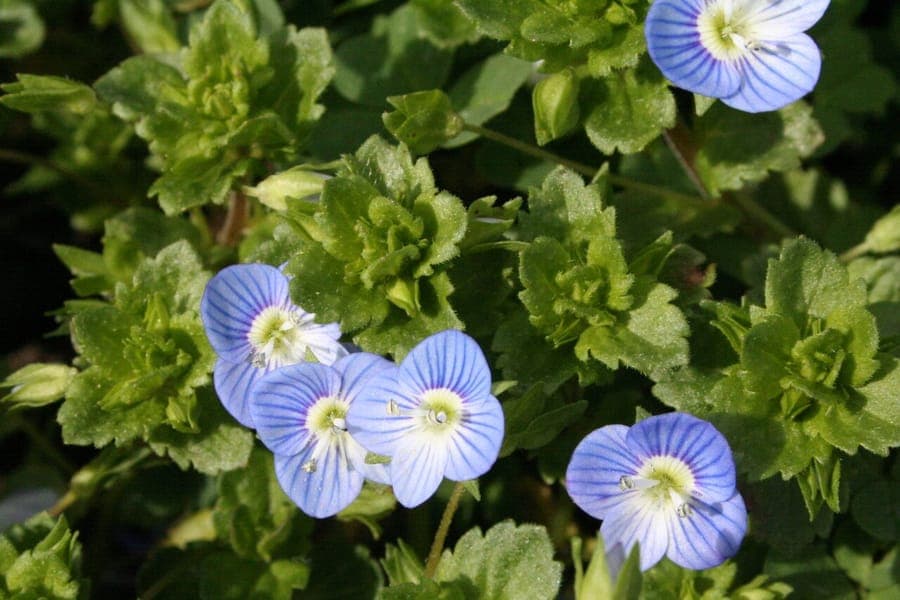
Strobilomyces / CC BY-SA 3.0, via Wikimedia Commons
Persian speedwell: complete guide
Veronica persica
Want to see Persian speedwell: complete guide in your garden?
Full design in HD: €7.99
Look after your Persian speedwell with the GardenWorld app
Identify plants with your camera and get a care calendar with reminders for this plant.


Overview
Persian speedwell (Veronica persica) is a distinctive plant from the Caucasus and northern Iran, known for its frost hardiness and early blue flowers. This plant is unique because it blooms in cold seasons, making it valuable for winter gardens. In garden design, this species serves as a frost-hardy addition to early-season borders and winter bloomers.
Appearance and bloom
Persian speedwell grows as a low, creeping plant with soft, hairy stems. The plant typically reaches 10 to 25 centimeters in height. The leaves are small, oval, and hairy. Most notable are the lovely blue flowers with white and dark blue markings, appearing from very early spring through autumn. In very mild winters, blooming can even occur in January. This makes it one of the earliest bloomers in the garden.
Ideal location
Persian speedwell thrives best in sunny to half-shade locations. The plant flourishes in moist to moderate soils. It works well in early borders, under shrubs, along pathways, and at the edges of water gardens. In warm regions, afternoon shade may be beneficial to avoid excessive heat.
Soil
This plant thrives in well-drained, moist soils. A pH of 6.0 to 7.5 is preferred. The plant grows without issue in sandy loam to moderate clay-based soils. Organic matter improvement helps moisture retention. Excessive drainage or consistently waterlogged soils are not ideal.
Free preview
Want to see Persian speedwell: complete guide in your garden? Make a free preview of your design.
Watering
Always provide regular watering during the growing season. During frost periods, careful watering is required, as excessive ice formation can damage the plant. In milder winters, regular watering can promote growth and bloom.
Pruning
Persian speedwell requires minimal pruning. Remove damaged or dead parts in early spring. After very cold winters, many parts may decline and can be completely removed in spring.
Maintenance calendar
Spring: Inspect for winter damage; add compost. Summer: Monitor moisture use; remove dead parts. Autumn: Prepare for winter; reduce watering. Winter: Protect against extreme frosts with mulch.
Winter hardiness
Persian speedwell is winter hardy to approximately minus 15 degrees Celsius and very suitable for cold, temperate European climates. They can survive extremely cold winters if protected under mulch.
Companion plants
Persian speedwell plants well with other winter bloomers such as snowdrops, winter heather, and other frost-hardy bloomers. Avoid aggressive growers that may overtake it.
Closing
Persian speedwell is a valuable winter-blooming plant for temperate gardens with early color. Available at many European garden centers. Learn more about winter bloomers at gardenworld.app/en and gardenworld.app/nl.
Frequently asked questions about Persian speedwell
Is Persian speedwell winter hardy?
Persian speedwell is winter hardy to approximately minus 15 degrees Celsius and very suitable for cold, temperate European climates. They can survive extremely cold winters if protected under mulch.
When and how do you prune Persian speedwell?
Persian speedwell requires minimal pruning. Remove damaged or dead parts in early spring.
How much water does Persian speedwell need?
Always provide regular watering during the growing season. During frost periods, careful watering is required, as excessive ice formation can damage the plant.
Where does Persian speedwell grow best?
Persian speedwell thrives best in sunny to half-shade locations. The plant flourishes in moist to moderate soils.
What soil does Persian speedwell need?
This plant thrives in well-drained, moist soils. A pH of 6.0 to 7.5 is preferred.

See it in your garden
See Persian speedwell in your garden
One photo of your garden and a few questions. You see the result in about a minute.
Try it with a photoIdentify this plant in your own garden. Identify a plant
Similar plants
Summer snapdragon (Angelonia angustifolia): complete guide
Angelonia angustifolia
Everything about summer snapdragon (Angelonia angustifolia): position, soil, watering, pruning and overwintering this heat-loving summer flower with upright flower spikes.
Rose turtlehead (Chelone obliqua): complete guide
Chelone obliqua
Rose turtlehead (Chelone obliqua) flowers from late August to October with pink blooms shaped like a turtle's head. How to plant, prune and combine this perennial for damp soil.
Disc-leaved hebe: complete guide
Hebe pinguifolia
Everything about Hebe pinguifolia, the blue-grey disc-leaved hebe: position, soil, pruning, winter hardiness and good companions for borders, rockeries and pots.
