
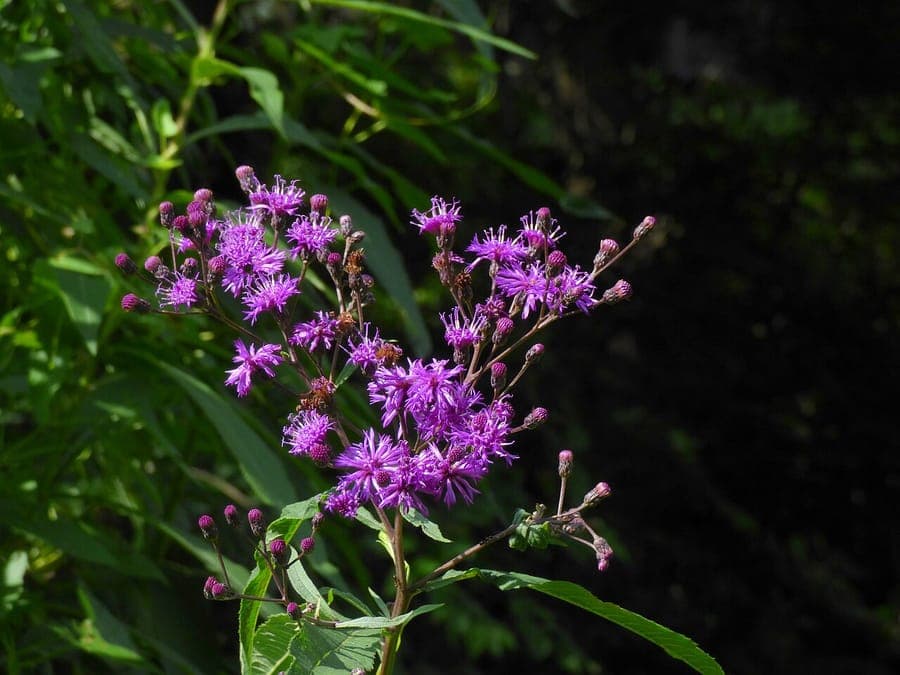
Greg Hume / CC BY-SA 4.0, via Wikimedia Commons
Giant ironweed: complete guide
Vernonia gigantea
Want to see Giant ironweed: complete guide in your garden?
1 minute, no credit card
Overview
Vernonia gigantea, commonly called giant ironweed or tall ironweed, is a striking herbaceous perennial in the aster family (Asteraceae). Native to eastern and central North America - from Ontario, Canada, south to Texas and the Gulf Coast states - it grows naturally along forest edges, in moist meadows, along stream banks, and in open woodland. The common name 'ironweed' refers to the plant's notably tough, wiry stems that persist long after the leaves have fallen.
In garden cultivation, Vernonia gigantea has earned its place as one of the most dramatic late-season perennials available. Its deep purple to violet-red flowers, which appear from August through October, provide a rich colour accent at precisely the moment when most other perennials are past their best. The plant is also highly attractive to butterflies and bees, which flock to it for its abundant nectar.
The genus Vernonia encompasses over 1000 species worldwide, but only a handful have gained traction in European horticulture. The growing popularity of prairie-style and naturalistic planting - inspired by designers such as Piet Oudolf - has driven renewed interest in this genus. On gardenworld.app, Vernonia gigantea can be planned as a bold vertical accent in a large border or prairie-themed front garden design.
The genus is named after William Vernon, a seventeenth-century English botanist who collected extensively in North America. The species was formally described by Trelease in 1891.
Appearance and bloom cycle
Vernonia gigantea is a genuinely tall plant. In good conditions it reaches 150 to 270 cm in height, making it one of the tallest perennials commonly used in gardens. The erect stems are sturdy, branching freely in the upper portion, and seldom require staking when grown in a full-sun position with adequate moisture.
The leaves are lance-shaped to elliptical, 10 to 30 cm long, rough-hairy on the upper surface and slightly softer beneath. They are arranged alternately along the stem and are coarsely toothed. The foliage mass creates a dense, lush green volume through summer.
Flowers appear late in the season - from August to October, depending on location and the season. Individual flowers are small but are borne in large, flat-topped clusters (corymbs) at the tips of all branches. Each flower consists entirely of disc florets (there are no ray florets), which is characteristic of the genus. The colour is intense purple-red to violet, sometimes approaching a deep magenta. The flowers have a faintly sweet, pleasant scent that draws pollinators from a distance.
After flowering, the seeds develop a whitish to grey fluffy pappus that keeps the plant decorative well into autumn and early winter. The stems remain upright throughout winter, providing shelter for overwintering insects.
Ideal location
Vernonia gigantea performs best in a sunny to lightly part-shaded position. In its native range it grows in full light and in the dappled shade at forest margins alike. In the garden, a spot with at least six hours of direct sun daily is ideal; with more shade the plant becomes less rigid and flowers less profusely.
Given its height of well over two metres, it is an outstanding back-of-border plant for large beds. It pairs beautifully with grasses of comparable stature and with lower, mounding perennials that complement its airy upper portion. Its structural quality also makes it suitable as a freestanding specimen in a large garden.
On gardenworld.app you can visualise how a tall border plant like Vernonia gigantea functions as a bold vertical element within a garden design, creating layered depth alongside shorter companions.
In the UK, Vernonia gigantea is available from specialist perennial nurseries and online plant retailers. It is not commonly stocked at mainstream garden centres, but demand is growing as prairie-style planting becomes more mainstream.
Soil
Vernonia gigantea is adaptable to a range of soil types but performs best in moist to moderately moist, reasonably fertile soils. In its native range it is frequently found along riverbanks and in moist meadows, though it also does well in ordinary garden soil without extremes of wetness or drought.
Ideal soil characteristics are:
- Moderately to reasonably fertile
- Moist to moderately moist (but not permanently waterlogged)
- Loamy or silty, though clay soils are also acceptable
- pH 5.5 to 7 (slightly acid to neutral)
On dry, poor soil the plant grows noticeably shorter (to around 100 cm) and flowers less abundantly. On very wet, poorly draining clay, root rot can occur, but periodic drying out is well tolerated.
Incorporate compost into the planting hole to improve water retention. An organic mulch layer 5 to 10 cm deep around the plant helps maintain soil moisture and suppresses weeds.
Free design
Want to see Giant ironweed: complete guide in your garden? Make a free design now.
Watering
Vernonia gigantea is reasonably drought-tolerant once established. However, it grows most vigorously and flowers most abundantly with a consistent water supply. On heavy, moist ground no supplementary watering is needed.
On lighter, free-draining soil during dry summers, supplementary watering is advisable, particularly in July and August when flower buds are setting. Never allow the soil to dry out completely and for extended periods, as this causes premature yellowing and drop of the lower leaves.
In containers, the plant requires significantly more frequent watering than in the open ground. Check soil moisture regularly and water when the upper half of the pot feels dry.
Newly planted specimens in their first year need more intensive watering - weekly during dry spells - to build a strong root system.
Pruning
Vernonia gigantea requires very little maintenance pruning. The main decision is when to cut the stems back: in autumn after flowering or in early spring.
Autumn cutback gives the garden a tidier winter appearance but sacrifices the decorative seed-head display and the overwintering habitat provided by the hollow stems for beneficial insects. Cutting back in late winter or early spring (February to March) is the better ecological choice.
The plant can also be 'pinched' in June - when stems have reached about 90 to 120 cm - to limit final height and encourage more branching. This produces a broader, more compact plant with more flowering stems, but delays blooming by a few weeks.
Division every three to five years keeps the plant vigorous and prevents it from overwhelming its neighbours. Divide the rootstock in early spring using a sharp spade.
Maintenance calendar
January - February: Stems remain upright as overwintering habitat. No action needed.
March: Cut stems to ground level once new shoots are visible at the base. Divide if needed.
April - May: Rapid growth begins. Mulch around the plant. Apply a slow-release balanced fertiliser.
June: Optional - pinch stems at about 100 cm to encourage more branching and limit ultimate height.
July - August: Intensest growth and bud set. Water during dry spells. Apply a potassium-rich feed to support flowering.
August - October: Flowering season. Enjoy. Butterflies and bees are drawn in abundance.
November - December: Leave stems standing for wildlife and winter structure.
Winter hardiness
Vernonia gigantea is an excellent, fully hardy perennial for gardens throughout the UK and northern Europe. Rated for USDA zones 5 to 9, it tolerates cold down to -26 degrees Celsius and survives even the hardest European winters without difficulty.
The above-ground stems die back in autumn, but the roots survive without any protection and the plant re-emerges in spring with remarkable vigour. No winter protection is needed in the UK or the near-continental European climate.
On heavy, wet clay soil a light mulch over the crown can be beneficial in the coldest winters, but this is rarely necessary. The plant's combination of exceptional hardiness and late flowering is one of its greatest assets for northern European gardens. On gardenworld.app you can plan how winter-hardy perennials like Vernonia gigantea give year-round structure to a planting design.
Companion plants
Vernonia gigantea is ideally suited to naturalistic and prairie-style plantings. The most successful combinations include:
- Miscanthus sinensis (Chinese silver grass): comparable height, beautiful textural contrast in autumn tones
- Rudbeckia fulgida (coneflower): yellow-orange flowers as a warm complement to the purple Vernonia
- Eutrochium maculatum (spotted Joe-Pye weed): similar late bloom and equally attractive to pollinators
- Helianthus 'Lemon Queen' (perennial sunflower): yellow flowers, similar vigour
- Sanguisorba officinalis (great burnet): elegant wine-red flowers blooming at the same time
On gardenworld.app you can generate a border design that places Vernonia gigantea as a tall background accent, combined with grasses and mid-height perennials for a richly layered prairie look.
Closing
Vernonia gigantea earns its place in the garden precisely when most other plants are winding down. Its intensely purple flowers in August and September inject drama and life into the border at the moment when both are most needed. Combined with excellent hardiness, long-lived root systems, and minimal care requirements, it is hard to overlook for anyone creating a naturalistic or prairie-themed planting.
Look for it at specialist perennial nurseries or online retailers, as mainstream garden centres rarely stock it. Visit gardenworld.app to see how Vernonia gigantea, alongside other late-season perennials, can transform your border into a colour-rich, wildlife-friendly space that keeps performing well into autumn.
Want to see Giant ironweed: complete guide in your garden? Make a free design now.
Upload a photo, pick a style, and get a photorealistic design with plant list in under a minute.
No credit card required


Similar plants
Spotted Joe-Pye weed: complete guide
Eutrochium maculatum
Everything about spotted Joe-Pye weed (Eutrochium maculatum): cultivation, location, soil requirements and care for this majestic moisture-loving perennial.
Maximilian's sunflower: complete guide
Helianthus maximiliani
Full guide to growing Maximilian's sunflower: site, soil, watering, pruning, and companion planting for this towering late-season prairie perennial.