
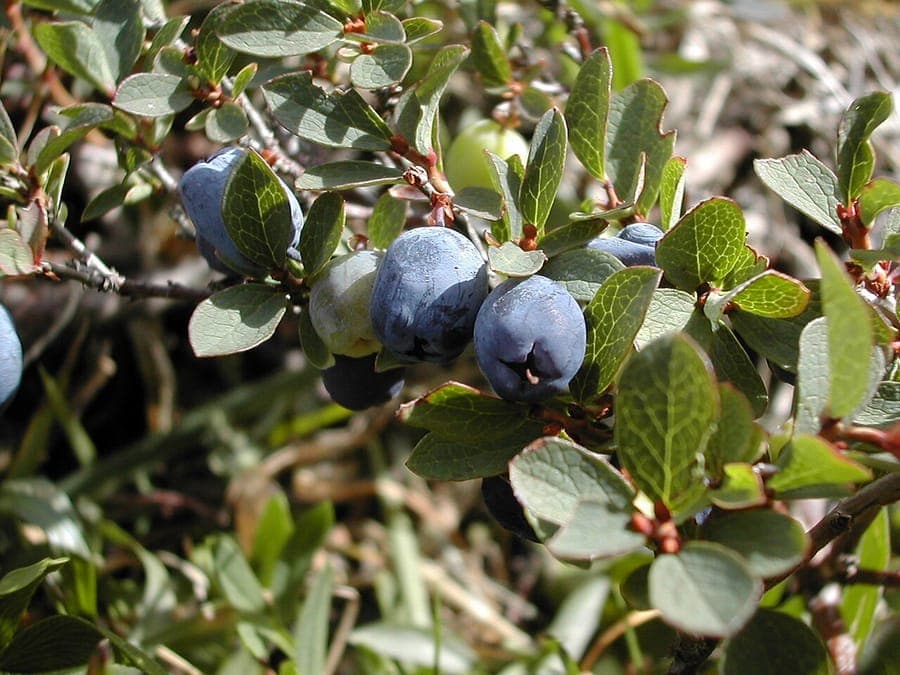
David Gaya / CC BY-SA 2.5, via Wikimedia Commons
Bog blueberry: complete guide
Vaccinium uliginosum
Want to see Bog blueberry: complete guide in your garden?
1 minute, no credit card
Overview
The bog blueberry or northern bilberry (Vaccinium uliginosum) is a small, specialized shrub native to subarctic and temperate regions across the northern hemisphere. This arctic-alpine specialist thrives on wet, acidic moorland and in subarctic regions where conventional fruit crops falter. With persistent evergreen foliage, delicate flowers, and dark blue berries, it delivers both ecological value and culinary interest in marginal climates.
The bog blueberry is exceptionally hardy to -40C and virtually maintenance-free once established. Ideal for arctic and subarctic gardens, alpine slopes, and experimental cold-climate landscapes.
Appearance and bloom
Bog blueberry forms a compact, multi-stemmed shrub typically 0.5-1 meter tall. Leaves are small, obovate, deciduous, turning striking red-purple in autumn. Flowers appear May-June: small, pale pink to white, bell-shaped, subtly attractive.
Fruits ripen to dark blue-black, approximately 1 cm diameter, sweet with subtle tartness. Excellent for jams, sauces, and wildlife food. Harvest extends through October in cold climates.
Ideal location
Bog blueberry thrives in full sun to dappled light in cold climates. In warmer regions, afternoon shade prevents heat stress. This is an open-moorland plant requiring good air circulation and protection from stagnant conditions.
Moist, well-drained but persistently damp sites are optimal. Avoid hot, dry south-facing walls in temperate zones.
Soil
Strongly acidic (pH 4-5.5), moist, humus-rich soil is ideal. Mix 40% peat moss, 40% leaf mold, and 20% coarse sand. The bog blueberry naturally colonizes wet moorland where organic matter accumulates over centuries, creating acidic, nutrient-poor horizons.
In drier gardens, this plant may struggle. Adequate moisture retention through mulching (5 cm organic layer) is essential.
Free design
Want to see Bog blueberry: complete guide in your garden? Make a free design now.
Watering
Moisture is non-negotiable during growing season (May-September). Provide 2.5 cm water weekly minimum; daily misting in hot periods helps. Mulch with compost or leaf mold to stabilize soil moisture.
Avoid waterlogging; bog blueberry grows on damp moorland, not in stagnant pools.
Pruning
Minimal pruning required. This plant grows slowly and natural form is invariably attractive. Remove only visibly dead stems in spring.
Maintenance calendar
March: Inspect winter damage; remove deadwood. April-May: Growth resumes; monitor soil moisture. May-June: Flowering; no intervention needed. July-August: Fruit development; maintain consistent moisture. September-October: Harvest; prepare for dormancy. November-February: Dormancy; moisture maintained.
Winter hardiness
Bog blueberry is exceptionally hardy to -40C, thriving naturally in boreal forests and arctic tundra across northern Europe, Asia, and North America. No winter protection required in any climate zone. Snow provides additional insulation benefit.
Companion plants
Bog blueberry integrates with other arctic specialists: cranberry, bilberry, heather varieties, and arctic mosses. In alpine meadows, it forms living ground cover. Space plants adequately; growth is slow.
Closing
The bog blueberry is a treasured addition to cold-climate gardens and arctic landscapes. Extraordinarily hardy and ecologically vital, it delivers dark blue fruit and traditional sustenance for northern peoples. Perfect for experimental arctic gardening and subarctic food production.
Design arctic gardens using gardenworld.app's specialized tools. Consult gardenworld.app for integration with boreal plant palettes.
Want to see Bog blueberry: complete guide in your garden? Make a free design now.
Upload a photo, pick a style, and get a photorealistic design with plant list in under a minute.
No credit card required


Similar plants
Zenobia pulverulenta: complete guide
Zenobia pulverulenta
Everything about Zenobia pulverulenta (honeycup): siting, acid soil, pruning and the fragrant white bells, in this complete care guide.
Dwarf huckleberry: complete guide
Gaylussacia dumosa
Everything about dwarf huckleberry (Gaylussacia dumosa): acidic soil, partial shade, pruning and care for this compact North American berry shrub.
Drooping leucothoe: complete guide
Leucothoe fontanesiana
Everything about drooping leucothoe (Leucothoe fontanesiana): shade tolerance, soil, watering, pruning, hardiness and companion plants.