
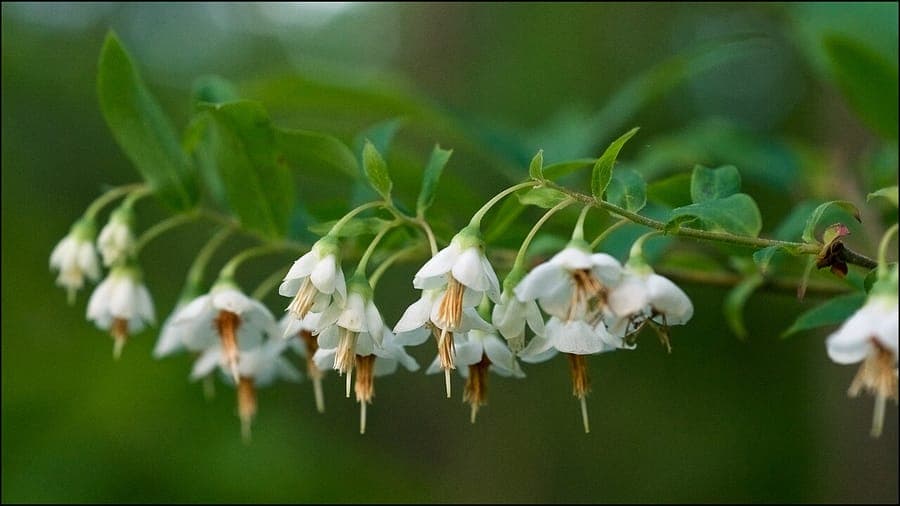
Eric Hunt / CC BY-SA 4.0, via Wikimedia Commons
Vaccinium stamineum: complete guide
Vaccinium stamineum
Want to see Vaccinium stamineum: complete guide in your garden?
1 minute, no credit card
Overview
Vaccinium stamineum, also known as southern gooseberry, deerberry, or squaw huckleberry, is a native deciduous shrub from forest regions of southeastern Canada to Mexico (Guanajuato, Queretaro, San Luis Potosi). This bird-berried shrub is renowned for its edible, flavorful berries and its value for bird feeding.
The plant distinguishes itself through its open, graceful growth habit, whitish to pink flowers, and small red to purple berries that ripen in August-September. It is ideal for bird gardens, natural plantings, and wild food production.
Appearance and Bloom
Vaccinium stamineum forms an open, much-branched shrub 50-150 centimeters tall (rarely to 2 meters). The leaves are simple, reverse-oval to lance-shaped, 1-3 centimeters long, green in summer, yellow-orange to red in autumn. The plant is completely deciduous in winter.
The flowers are small (about 5 millimeters), funnel-shaped, usually white to very pale pink, sometimes with pinkish tints, appearing May-June. They hang in loose clusters along the branches. Flower production is abundant.
The berries are small, round, approximately 6-8 millimeters in diameter, first green then red to dark purple-black when ripe (August-September). They are edible: tart-sweet in flavor, less sweet than blueberries but nutritious. Birds and mammals eagerly enjoy the berries.
Ideal Location
Vaccinium stamineum grows best in full sun to partial shade (4-6 hours direct sun ideal). In very hot regions (25-30C regularly), tolerates 30-40% shade well. The plant places no extreme demands on sunlight.
The plant is suitable for zones 6-10 outdoors; in zone 5 with winter protection. Place in sheltered locations where wind is not too harsh. The plant tolerates wind better than many other berries.
Plant as a specimen, in groups of 3-5 for better fruiting (cross-pollination helps), or in bird gardens where fruits support wildlife feeding.
Soil
Vaccinium stamineum is tolerant of diverse soil types but prefers acidic soil (pH 4.5-6.0). It even grows in moister forest soil but tolerates moderately drier sites better than blueberries. Well-draining soil is preferred, but plant tolerates clay-containing compositions.
Prepared potting mix: 50% peat moss, 30% compost, 20% sand. This provides ideal drainage and pH buffering. In open ground: clay-rich soil is ok as long as site does not have permanent waterlogging.
The plant is tolerant of poor soil: fertilization not essential, though organic supplementation improves growth and fruit production.
Free design
Want to see Vaccinium stamineum: complete guide in your garden? Make a free design now.
Watering
Once established, Vaccinium stamineum tolerates drought moderately well. Water regularly during first growing season (May-September) so soil remains moist but not waterlogged. Water more intensively in dry summers.
In containers: water daily during peak summer, less frequently in spring/fall. In open ground: water 1-2 times weekly during growing period if rainfall less than 25 millimeters per week.
Overwintering: plant becomes dormant in winter; nearly stop watering. Plant tolerates wet winters better than dry summers.
Pruning
Regular pruning maintains open shrub form and ensures better fruit production. Begin pruning once plant is 2-3 years old. Each spring (March), remove dead or damaged branches. Every 2-3 years: remove 15-20% of older branches from the base, stimulating young growth.
After blooming (June): cut thinnest branches back. This stimulates better fruiting next season. Avoid heavy pruning; plant recovers slowly.
Avoid fall pruning: damages fresh flower buds.
Maintenance Calendar
May: plant young shrubs. Lightly fertilize with organic fertilizer. Water regularly. June: blooming in full swing. Prune after blooming: remove thin branches. Water more intensively if dry. July-August: fruit ripens from green to red to purple. Harvest ripe berries. Sow seed from berries. September-October: fall coloring begins. Plant becomes dormant. Reduce watering. November-March: plant dormant. No fertilization or watering. March: apply triennial pruning.
Winter Hardiness
Vaccinium stamineum is winter-hardy to zone 6 (down to -23C). In zone 5, plant with winter protection (frost cloth, snow cover). In zones 7-10 no winter protection needed.
Plant tolerates snow coverage well: even when fully under snow, the plant usually overwinters well. The plant can tolerate low temperatures (down to -30C briefly).
In very warm regions (zone 11+), plant may experience frost shadow stress; plant in partially shadier zone.
Companion Plants
Vaccinium stamineum pairs well with other bird garden plants.
- With other berries: red winterberry, many red-berried plants, Symphoricarpos (snowberries)
- With nectar-attracting plants: cardinal flower, fuchsia
- With native forest plants: thorny hawthorn, wild cherry
From nutrition perspective: mycorrhiza association helps plant absorb nutrients from poor soil.
Conclusion
Vaccinium stamineum is for bird gardeners and nature lovers wanting native forest plants. This is one of the rare shrubs providing both bird food and edible fruit for humans. Ideal for wild food systems and bird treatments.
Plant from young nursery stock in May, water regularly first season. Harvest ripe berries August-September. Use berries raw, in jam, or as bird food. Seed can be saved and sown for new plants.
Plant material available from native bird garden nurseries. GardenWorld.app can create bird garden designs where southern gooseberry takes a central place. This plant provides year-round interest: spring blooms, summer fruit, fall color, winter form.
A true heritage shrub for bird gardens.
Want to see Vaccinium stamineum: complete guide in your garden? Make a free design now.
Upload a photo, pick a style, and get a photorealistic design with plant list in under a minute.
No credit card required


Similar plants
Zenobia pulverulenta: complete guide
Zenobia pulverulenta
Everything about Zenobia pulverulenta (honeycup): siting, acid soil, pruning and the fragrant white bells, in this complete care guide.
Dwarf huckleberry: complete guide
Gaylussacia dumosa
Everything about dwarf huckleberry (Gaylussacia dumosa): acidic soil, partial shade, pruning and care for this compact North American berry shrub.
Drooping leucothoe: complete guide
Leucothoe fontanesiana
Everything about drooping leucothoe (Leucothoe fontanesiana): shade tolerance, soil, watering, pruning, hardiness and companion plants.