
Christian Fischer / CC BY-SA 3.0, via Wikimedia Commons
European cranberry: complete guide
Vaccinium oxycoccos
Want to see European cranberry: complete guide in your garden?
1 minute, no credit card
Overview
The European cranberry or bog cranberry (Vaccinium oxycoccos) is a remarkable, highly specialized plant inhabiting wet, acidic, nutrient-poor wetlands across temperate northern Europe. This creeping, diminutive shrub produces delicate pink flowers and bright red, acidic berries. Indigenous and ecologically vital, it thrives in marginal habitats where cultivation seems impossible, making it invaluable for wetland restoration and boggy garden design.
The bog cranberry is exceptionally hardy and essentially maintenance-free once established in appropriate conditions. Constant moisture is the only requirement for years of reliable fruiting.
Appearance and bloom
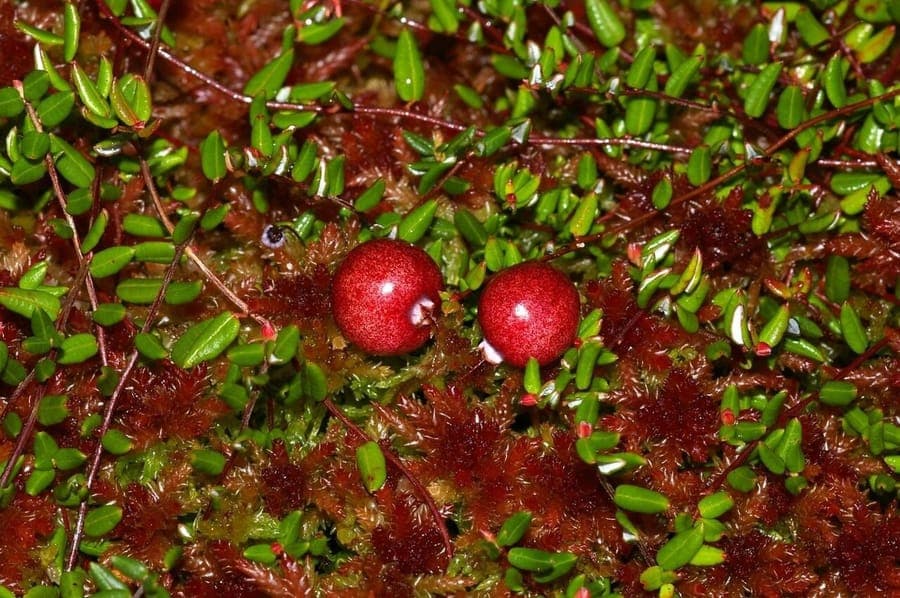
Bog cranberry forms a thin, trailing mat no taller than 30 cm. Leaves are tiny, ovate, evergreen, turning bronze-red in winter. Flowers appear May-June: delicate, bell-shaped, pink-red, subtly beautiful. Fruit develops June-August: bright red spheres, smooth, 0.5-1 cm diameter, extremely tart.
Berries persist on plants into November, valuable for wildlife feeding. Fresh cranberries offer exceptional flavor for sauces, jellies, and traditional preserves.
Ideal location
Bog cranberry thrives in full sun to dappled shade, provided moisture is constant. Wetland margins, bog gardens, marshy hollows, and poorly-drained valley bottoms are ideal. This plant literally welcomes waterlogged conditions; it grows in places most plants cannot tolerate.
Avoid hot, dry south-facing walls. North-facing, shaded, consistently moist sites suit perfectly.
Soil
Strongly acidic (pH 3.5-4.5), nutrient-poor, permanently wet soil is mandatory. Pure sphagnum peat, sand, or sphagnum moss provide the authentic bog substrate. In nature, cranberries colonize ancient peat accumulations where centuries of vegetation create nutrient-poor, acidic horizons.
In typical garden soil: excavate planting pit, line with impermeable membrane, backfill with sphagnum and maintained water table. Constructing an artificial bog bed simplifies establishment dramatically.
Free design
Want to see European cranberry: complete guide in your garden? Make a free design now.
Watering
Constant saturation is not a luxury; it is absolute necessity. Soil must never dry. During dry periods, daily misting or flooding is needed. Better solution: plant in shallow bog bed where water level remains 5-10 cm above substrate year-round.
Raised bog beds with maintained water table prove far simpler than repeated manual watering.
Pruning
Pruning is virtually unnecessary. This plant grows so slowly and compactly that natural form is invariably attractive. Remove only dead stems visible in spring.
Maintenance calendar
March: Inspect winter damage; remove dead wood. April-May: Growth resumes; monitor water level. May-June: Flowering; no intervention needed. July-August: Fruit development; maintain saturation. September-October: Harvest; prepare for dormancy. November-February: Dormancy; maintain moisture year-round.
Winter hardiness
Bog cranberry is exceptionally hardy to -35C, thriving naturally in Scandinavian, Scottish, and subarctic bog systems. No winter protection required in any temperate climate. Snow provides minor insulation benefit.
Companion plants
Bog cranberry integrates with other wetland specialists: round-leaved sundew (Drosera rotundifolia), bog rosemary, heather varieties, and sphagnum moss. In designed wetland contexts, it forms a living carpet amid higher-growing ericaceous plants.
Space companions minimally; cranberry is non-competitive and slow-growing.
Closing
The European bog cranberry is a plant for wetland enthusiasts and ecological gardeners. It delivers native beauty and productivity in marginal habitats unsuitable for conventional cultivation. With permanent moisture, success is virtually assured.
Design comprehensive wetland gardens using gardenworld.app's specialized habitat tools. Consult gardenworld.app for integration strategies with native wetland flora.
Want to see European cranberry: complete guide in your garden? Make a free design now.
Upload a photo, pick a style, and get a photorealistic design with plant list in under a minute.
No credit card required


Similar plants
Zenobia pulverulenta: complete guide
Zenobia pulverulenta
Everything about Zenobia pulverulenta (honeycup): siting, acid soil, pruning and the fragrant white bells, in this complete care guide.
Dwarf huckleberry: complete guide
Gaylussacia dumosa
Everything about dwarf huckleberry (Gaylussacia dumosa): acidic soil, partial shade, pruning and care for this compact North American berry shrub.
Drooping leucothoe: complete guide
Leucothoe fontanesiana
Everything about drooping leucothoe (Leucothoe fontanesiana): shade tolerance, soil, watering, pruning, hardiness and companion plants.