
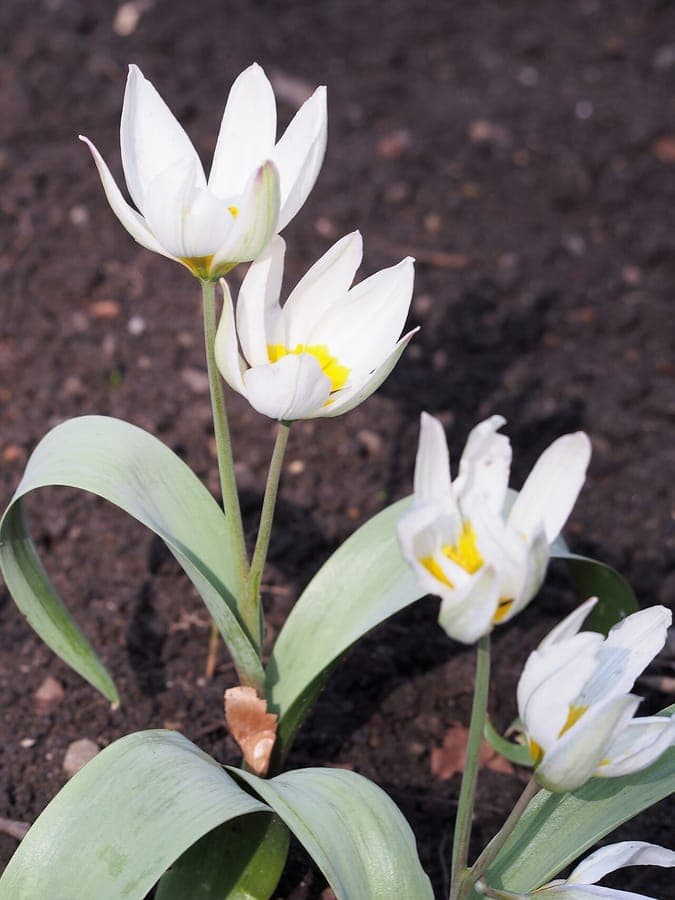
Agnieszka Kwiecień, Nova / CC BY-SA 4.0, via Wikimedia Commons
Two-flowered Tulip (Tulipa biflora): complete guide
Tulipa biflora
Want to see Two-flowered Tulip (Tulipa biflora): complete guide in your garden?
1 minute, no credit card
Overview
Tulipa biflora is a refined, miniature tulip native to Central Asia, from the Crimea to Egypt. This species belongs to the Liliaceae family and distinguishes itself through its fragrant, delicate flowers and compact growth habit. The name "biflora" refers to its ability to produce two or more flowers per stem, which sets it apart from many other tulip species. This tulip is ideal for rock gardens, alpine plantings, and front gardens where its miniature proportions are very welcome.
Appearance and bloom
Tulipa biflora grows only 10-20 cm tall, making it an excellent choice for small gardens and containers. The plant produces two to four gray-green, linear leaves. The flowers are delicate and refined, typically white with yellow interior and red or orange markings at the base. Each flower contains six petals that can be either smooth or wavy. The flowers appear in March-April and emit a pleasant, delicate fragrance. The bloom lasts 3-4 weeks under favorable conditions.
Ideal location
Tulipa biflora thrives best in full sun. At least 6-8 hours of direct sunlight per day is essential for healthy growth and optimal blooms. A south-facing spot is ideal. The plant tolerates full sun even in warm climates better than many other tulips. Avoid shaded locations, as this results in fewer flowers and stem stretching.
Soil
This miniature tulip requires well-draining soil. A mixture of bulb soil, sand, and compost creates the ideal structure. The plant tolerates acidic to neutral soils better (pH 6.0-7.0). Bulb planting in containers requires the use of bulb planting soil mix. Ensure excellent drainage; waterlogging is fatal to tulip bulbs. Add coarse sand as a drainage improver when natural soil structure is poor.
Free design
Want to see Two-flowered Tulip (Tulipa biflora): complete guide in your garden? Make a free design now.
Watering
Tulipa biflora has modest water requirements. Plant the bulbs in autumn and do not water until the first shoots are visible. Once emerged, water carefully when the soil feels dry. During bloom, it needs lightly moist soil, but not stagnation. After bloom and leaf disappearance, reduce watering drastically. Excessive water, especially in summer, causes bulb rot and fungal development. In moderate climates, rainwater is usually sufficient.
Pruning and maintenance
Gently remove withered flowers to keep the plant energized for bulb maintenance. Seed collecting is not necessary for this plant. Leaves should wilt and disappear naturally for nutrient accumulation. No pruning work is required. Remove dead leaves when they are completely brown.
Maintenance calendar
August-October: Bulb planting time. November-February: Cold period; underground root development. March-April: Bloom; water moderately. May: Bloom ends; leaf disappearance begins. June-July: Dormancy; no water until new growth begins.
Winter hardiness
Tulipa biflora is winter-hardy down to -15 to -20 degrees Celsius. The plant requires a cold period during winter (vernalization) for successful blooming. In warm climates, artificial cold treatment (cold storage) may be necessary. Once properly planted, it tolerates freezing without protection.
Companion plants
Tulipa biflora combines well with other alpine and miniature plants: Anemone blanda, Crocus, small daffodil varieties, and other miniature tulips. Alpine phlox, stonecrop, and low-growing sedums form beautiful carpet-like backgrounds. Avoid aggressive growing plants that would overwhelm the delicate tulip.
Closing
Tulipa biflora is a classic favorite for rock gardens and alpine plantings due to its delicate growth, fragrance, and refined flowers. At gardenworld.app, we help you successfully integrate this miniature beauty into your garden. For more advice on miniature bulbs and spring flowers, visit gardenworld.app.
Want to see Two-flowered Tulip (Tulipa biflora): complete guide in your garden? Make a free design now.
Upload a photo, pick a style, and get a photorealistic design with plant list in under a minute.
No credit card required


Similar plants
Reverchon's gagea: complete guide
Gagea reverchonii
Full guide to Gagea reverchonii, Reverchon's gagea: rare Pyrenean bulb with bright yellow spring flowers, soil needs and companion planting.
Leafy gagea: complete guide
Gagea foliosa
Gagea foliosa is a rare Mediterranean bulb with bright yellow star-shaped flowers blooming February to March in well-drained rocky settings.
Tubular gagea: complete guide
Gagea fragifera
Gagea fragifera is a mountain bulb with golden-yellow star flowers blooming May to July on subalpine slopes from Europe to the Himalaya.