
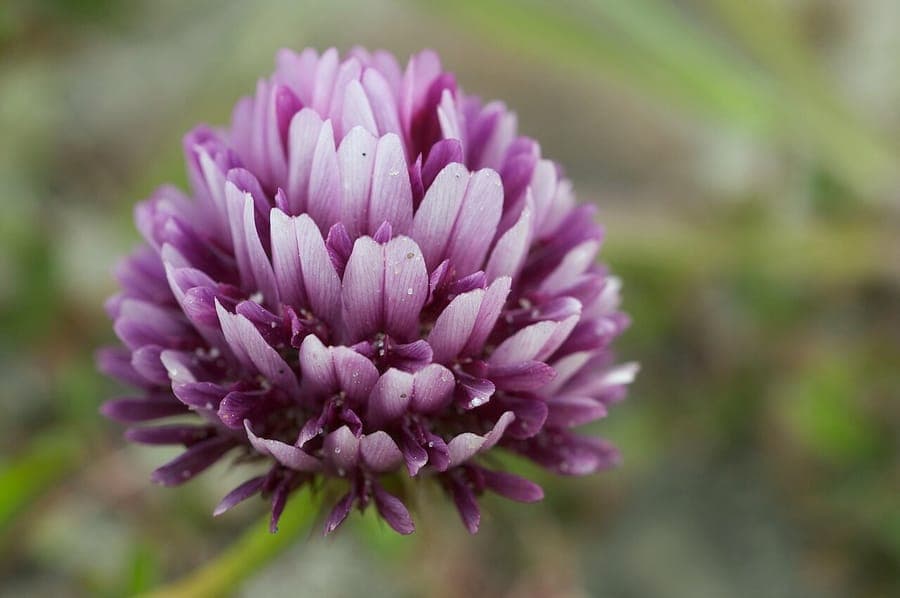
Eric in SF / CC BY-SA 3.0, via Wikimedia Commons
Springbank clover: complete guide for gardeners
Trifolium wormskioldii
Want to see Springbank clover: complete guide for gardeners in your garden?
1 minute, no credit card
Overview
Trifolium wormskioldii, commonly known as springbank clover, cow clover, or seaside clover, is a rhizomatous perennial herb in the legume family (Fabaceae). It is native across the western United States and Mexico, thriving from coastal California northward to Washington State and from sea level up into alpine meadows. Though less familiar in European gardens than common red or white clover, springbank clover is a genuinely useful plant: a low-growing, nitrogen-fixing ground cover with showy flowerheads that draw in bees, bumblebees, and other pollinators.
The species was first described botanically by J.G.C. Lehmann in 1825. Its name honours the Danish explorer Morten Wormskjold, who participated in early 19th-century expeditions along the Pacific coast. In its natural range the plant grows in coastal grasslands, streamsides, wet meadows, and mountain prairies, which tells you a great deal about its tolerance for varied conditions.
For the gardener, springbank clover offers a dual benefit: it acts as a living mulch suppressing weeds through dense mat-forming growth, while simultaneously improving soil fertility through the nitrogen-fixing bacteria housed in root nodules. Gardenworld.app offers design ideas for incorporating low-maintenance wild plants like this one into a front garden redesign.
Appearance and bloom cycle
Springbank clover is a low-growing perennial that spreads via underground rhizomes to form a mat typically 20 to 40 cm in height. The leaves are trifoliate, with smooth to slightly hairy leaflets that have a fresh green colour and fine texture. Some individuals show a faint silvery chevron on the upper surface of each leaflet, a classic clover marking.
The flowers are clustered into rounded heads 1 to 2 cm across. The colour ranges from deep rose to purple-red, sometimes with white or pale markings at the base of the petals. Like all legume flowers, each individual bloom is structured with a banner, two wings, and a keel - the distinctive "pea flower" shape that pollinators learn to exploit quickly.
Flowering occurs from June through August, though plants in mild coastal conditions may begin as early as May. After flowering, small seed pods develop and provide food for seed-eating birds. Even outside the flowering period, the dense, fine-textured foliage gives the plant a tidy, fresh appearance as a ground cover.
The overall growth form is moderate in pace, filling in gradually over two to three seasons to form a reliable mat that competes well against weeds in open ground.
Ideal location
In its natural habitat springbank clover grows in a remarkable range of situations - from coastal dunes and salt marshes to alpine meadows and streamside verges. This versatility carries over into garden settings.
The plant performs best in full sun to light partial shade. In full sun, flowering is most prolific provided the soil does not dry out completely. Partial shade is tolerated but results in fewer flowers and slightly more open growth. Avoid deep shade, where the plant becomes sparse and susceptible to fungal issues.
Good air circulation is helpful. Avoid planting in low-lying pockets where cold air and moisture pool in winter. A gently sloping bed or a raised position with open aspect suits this plant well. In garden settings across Northern Europe, springbank clover can be grown as a reliable perennial in a sheltered spot where drainage is good.
Soil requirements
Trifolium wormskioldii tolerates a wide range of soil types but grows best in well-drained soils that retain moderate moisture. It naturally colonises sandy coastal soils, loams, and even the margins of seasonal wetlands, showing adaptability to both dry and moist conditions.
The ideal pH range is 6.2 to 7.0. Soils more acidic than pH 6 interfere with the nitrogen-fixing Rhizobium bacteria in the root nodules, reducing the plant's ability to thrive without supplemental feeding. If your soil is acid, work in a small amount of garden lime before planting.
As with all legumes, springbank clover fixes atmospheric nitrogen through bacterial symbiosis. This means it needs no extra nitrogen fertiliser - in fact, applying nitrogen-rich feeds is counterproductive, encouraging leafy growth at the expense of flowering. The plant takes care of its own fertility; your job is simply to provide good drainage and an appropriate pH.
Clay soils can be improved by working in coarse sand and garden compost before planting. Sandy soils benefit from the addition of organic matter to improve moisture retention.
Watering
Springbank clover has moderate water needs. During the growing season from April through September, consistent moisture supports healthy growth, but prolonged waterlogging is harmful - the roots of young plants are especially susceptible to rot.
Once established, the plant develops a reasonable degree of drought tolerance. In temperate Northern European climates, supplemental watering is usually only needed during dry spells lasting more than two weeks. When you do water, give a thorough soaking to encourage deep root development. Shallow, frequent watering produces a shallow root system that is more vulnerable to drought stress.
Avoid overhead irrigation in the evening, as wet foliage overnight increases the risk of fungal diseases. Water at the base of the plant in the morning where possible. As the plant dies back in autumn, taper off watering to match the reduced demand.
Free design
Want to see Springbank clover: complete guide for gardeners in your garden? Make a free design now.
Pruning
Springbank clover requires minimal pruning. Once the flowerheads have finished, you can deadhead them to maintain a tidy appearance and to extend the overall flowering period slightly. However, leaving spent heads in place is equally valid - the dried seed pods are decorative and provide food for finches and other seed-eating birds.
At the end of the growing season, in October or November, cut back the above-ground stems to just above soil level. This tidies the plant and encourages strong new growth the following spring. Use clean, sharp secateurs to make clean cuts.
If the plant spreads beyond its intended space through rhizome growth, simply dig out the unwanted sections in spring. The rhizomes are not deeply embedded and lift out easily with a hand fork.
Maintenance calendar
March - April: Check overwintered plants. Remove dead top growth if not already cut back. Add a thin layer of compost around the base. New shoots should appear by mid-April.
May - June: Growth accelerates. Keep on top of weeds while the plant is establishing. Water during dry spells. Watch for any signs of fungal spotting on leaves.
July - August: Peak flowering. Maintain adequate moisture in dry weather. Deadhead if desired to prolong flowering. The dense mat is now at its most effective as a weed suppressor.
September: Flowering winds down. Reduce watering. Leave seed heads for wildlife or remove them to prevent self-seeding.
October - November: Cut back top growth. Apply a light mulch of leaf compost or straw for winter protection.
December - February: Dormant period. No intervention needed. Ensure the site drains freely.
Winter hardiness
In its native range, springbank clover grows in USDA hardiness zones 6 to 9. Across most of Northern and Western Europe, which sits in zones 7 to 9, the plant is fully winter hardy with straightforward care.
The rhizomes survive in the ground even when top growth freezes in severe cold. A light mulch of leaf compost or straw provides extra insurance during unusually harsh winters with temperatures dropping below -12 degrees Celsius. The mulch should be applied loosely rather than packed tightly, to allow air circulation.
Wet winter soils are a greater threat to springbank clover than cold temperatures. If your garden has heavy clay that stays waterlogged in winter, improve drainage before planting or consider growing the plant in a raised bed where water moves freely.
Companion plants
Springbank clover sits happily alongside many other low-growing perennials and ornamental grasses. Good companions include:
- Festuca glauca (blue fescue): shares the preference for sun and well-drained soil, and provides a fine textural contrast with its silver-blue tufts.
- Achillea millefolium (common yarrow): similar habitat preferences, excellent for pollinators, and adds height and a contrasting flower form.
- Aster dumosus (bushy aster): flowers in autumn when the clover has finished, extending the season of interest.
- Prunella vulgaris (selfheal): a native wildflower with complementary height and pollinator value.
- Geranium pratense (meadow cranesbill): adds a splash of blue-violet in early summer and grows happily in similar conditions.
Avoid combining springbank clover with strongly acid-loving plants such as rhododendrons or heathers, as their soil pH requirements conflict.
Closing thoughts
Trifolium wormskioldii may not be the most flamboyant plant in any garden, but it earns its place through usefulness, resilience, and quiet beauty. As a nitrogen-fixing ground cover, a pollinator magnet, and a low-maintenance companion for naturalistic plantings, it delivers genuine value season after season.
For gardens that value biodiversity over bedding plant uniformity, springbank clover is exactly the kind of plant worth seeking out. Visit gardenworld.app to explore how plants like this one can be incorporated into a professional garden design tailored to your specific conditions - from soil type to aspect and local climate.
Springbank clover pairs particularly well with other low-maintenance, wildlife-friendly plants in a naturalistic scheme. It works as a living mulch between taller perennials, knitting the planting together at ground level while the nitrogen it fixes benefits its neighbours. It is also a genuinely good plant for difficult, infertile spots where other ground covers struggle - the leaner the soil, the better it tends to flower.
If you are redesigning a front garden with sustainability in mind, consider replacing conventional bedding strips or tired shrubs with a mix of low perennials anchored by springbank clover. The result is a planting that looks after itself, feeds pollinators, and improves the soil beneath it year after year. For personalised planting recommendations based on your garden's exact conditions, gardenworld.app gives you a starting point that a generic plant catalogue cannot. Quality specialist perennials are increasingly available at good garden centres; ask specifically for native or near-native clover species.
Want to see Springbank clover: complete guide for gardeners in your garden? Make a free design now.
Upload a photo, pick a style, and get a photorealistic design with plant list in under a minute.
10,000+ gardens designed already
No credit card required


Similar plants
Tall Silky Lupine: complete guide
Lupinus elatus
Tall silky lupine is a fast-growing Californian perennial with silvery foliage and blue-purple flower spikes, ideal for a prairie-style garden.
Garfield Lupine: complete guide
Lupinus garfieldensis
The Garfield lupine is a rare, fast-growing American perennial for alkaline, dry grassland gardens, with striking blue flower spikes.
Lupinus elegans: complete guide
Lupinus elegans
Lupinus elegans, the elegant lupine, is a spectacular blooming plant from Mexico with blue flower spikes. Care, cultivation and garden use.