
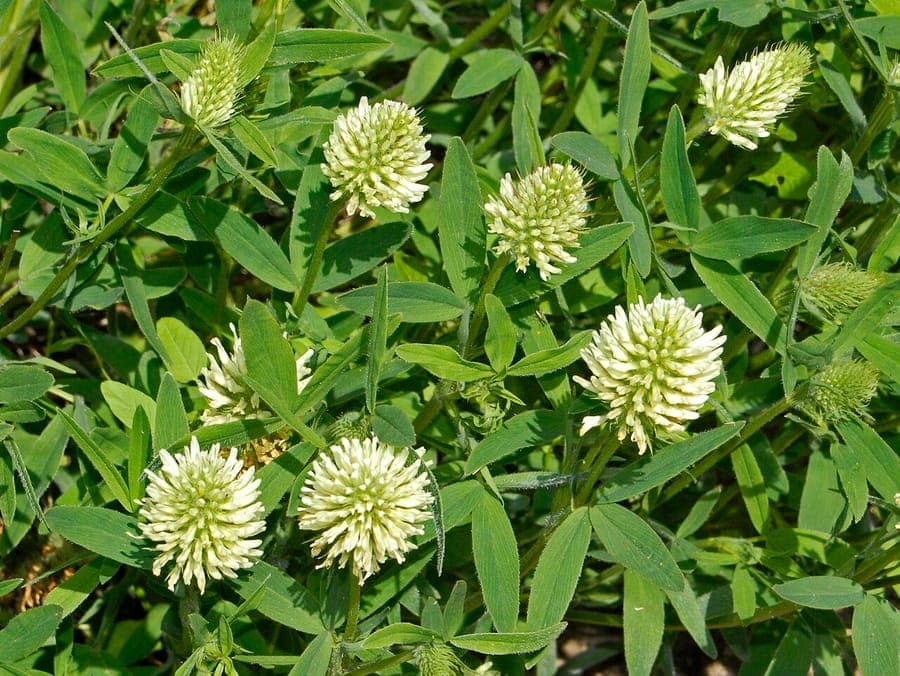
Hectonichus / CC BY-SA 3.0, via Wikimedia Commons
Hungarian Clover: complete guide
Trifolium pannonicum
Want to see Hungarian Clover: complete guide in your garden?
1 minute, no credit card
Overview
Hungarian clover (Trifolium pannonicum), also called Pannonian clover, is an interesting perennial from southeastern European regions ranging from France to Ukraine and Turkey. Belonging to the Fabaceae family, it is valued for its hardiness, drought tolerance, and white flowers. Perfect for steppe-like gardens and sustainable plantings.
Appearance and bloom
The plant grows to 30-50 cm tall with trifoliate, dark-green leaves. The flowers are white to very pale pink, very small and numerous, appearing in compact, densely packed spikes from May to July. The plant has a sturdy growth habit and forms attractive summer blooms. After flowering, characteristic seed development occurs.
Ideal location
Place Hungarian clover on sunny, warm sites with well-draining soil. The plant thrives best in full sun. Perfect for dry slopes, rock gardens, Mediterranean borders, and green roofs. Also suitable as a forage crop in semi-intensive cultivation.
Soil
This plant is very tolerant of many soil types. Well-draining, somewhat dry soils are ideal. The pH can range from 7.5 to 8.0, so it prefers slightly calcareous soils. Lean soils yield more flowers.
Watering
Once established, very drought-tolerant. Regular watering during the first growing season, thereafter minimal water needed. Ideal for dry, hot summers without much maintenance.
Free design
Want to see Hungarian Clover: complete guide in your garden? Make a free design now.
Pruning
Hardly necessary. Remove only spent flowers to encourage more blooming. The plant maintains its natural form well and doesn't need heavy cutting back.
Maintenance calendar
March-April: Growth starts, remove dead material May-July: Enjoy blooms, observe bees and bumblebees August-September: Seed set, allow ripening October-November: Seed falls naturally, winter preparation December-February: Rest period, no maintenance needed
Winter hardiness
Extremely hardy, suitable to zone 4 (-30 degrees Celsius). Hungarian clover is very resistant to cold, frost fluctuations, and snow. Perfect for Central European gardens.
Companion plants
Combine with other drought-tolerant perennials like Artemisia, Stachys, and Salvias. Perfect for xerophyte plantings and steppe gardens.
Closing remarks
Hungarian clover is an underrated plant for those who love sustainable, low-maintenance gardens. Available from specialized seed merchants and sometimes at larger garden centers. On gardenworld.app, you can integrate this type of sturdy perennial into your sustainable garden design.
Want more drought-tolerant perennials? Discuss the design on gardenworld.app and discover more robust plant suggestions!
Want to see Hungarian Clover: complete guide in your garden? Make a free design now.
Upload a photo, pick a style, and get a photorealistic design with plant list in under a minute.
No credit card required


Similar plants
Tall Silky Lupine: complete guide
Lupinus elatus
Tall silky lupine is a fast-growing Californian perennial with silvery foliage and blue-purple flower spikes, ideal for a prairie-style garden.
Garfield Lupine: complete guide
Lupinus garfieldensis
The Garfield lupine is a rare, fast-growing American perennial for alkaline, dry grassland gardens, with striking blue flower spikes.
Lupinus elegans: complete guide
Lupinus elegans
Lupinus elegans, the elegant lupine, is a spectacular blooming plant from Mexico with blue flower spikes. Care, cultivation and garden use.