
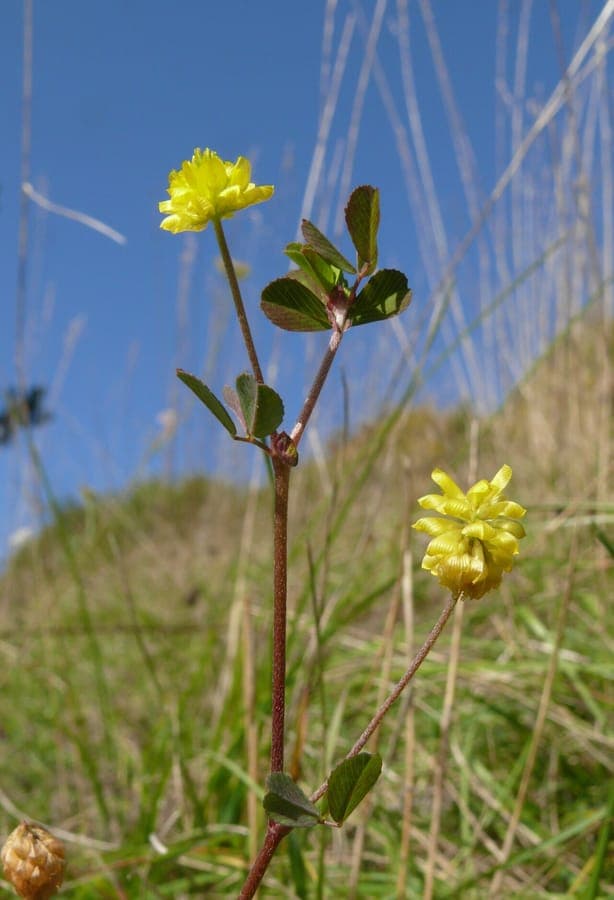
Bernd Haynold / CC BY-SA 3.0, via Wikimedia Commons
Hop Trefoil (Trifolium campestre): complete guide
Trifolium campestre
Want to see Hop Trefoil (Trifolium campestre): complete guide in your garden?
1 minute, no credit card
Overview
Hop trefoil (Trifolium campestre) is an unobtrusive yet charming annual plant from Europe, North Africa, and Iran. The plant appears in grassland, arable land, and fallow areas from May to August with tiny, yellow flower heads. This is a true meadow plant requiring minimal maintenance and naturally spreading through self-seeding.
Hop trefoil reaches only 10-30 cm in height and forms light, open bushes. The plant is particularly suitable for semi-intensive hay meadow plantings, fallow ground, and wild grasslands. Though modest in appearance, hop trefoil significantly contributes to ecological value in gardens and meadows.
Appearance and Bloom
Trifolium campestre has refined, trifoliate leaves with a light, airy appearance. The small, round flower heads are yellow and resemble miniature versions of golden clover. Flowers appear June through September and attract small pollinators.
The plant makes an impression through subtle elegance and mass effect in groups. Each floret is tiny but numerous, creating a lovely yellow tapestry in well-maintained wildflower meadows.
Ideal Location
Hop trefoil grows best in full sun and tolerates dry to moderately moist soils. The plant is highly adaptable and grows in virtually any grassland position. The poorer the soil, the more naturally hop trefoil behaves.
Plant this species in open grasslands, on fallow ground, or as understory in more intensive hay meadow plantings. In gardens, hop trefoil gives a rustic, countryside accent.
Free design
Want to see Hop Trefoil (Trifolium campestre): complete guide in your garden? Make a free design now.
Soil
Hop trefoil thrives in virtually any soil from acidic to alkaline. The plant actually prefers poor rather than rich soils. In nutrient-rich ground, hop trefoil grows poorly and is overwhelmed by stronger competitors.
Soil should be well-draining and may briefly dry out. In wet soils, hop trefoil performs poorly.
Watering
Hop trefoil is particularly drought-tolerant and rarely needs supplemental water once established. In very dry years, extra water can contribute to richer flowering, but is not essential.
Pruning
Hop trefoil requires no pruning. Allow flowers to fade and drop to encourage self-seeding.
Maintenance Calendar
April-May: sow directly into grassland. June-August: bloom, no maintenance needed. August-September: allow seed heads to drop. October-April: dormancy.
Winter Hardiness
Hop trefoil is hardy in the Netherlands, though the plant is annual. Seed easily overwinters in soil and germinates again the following spring.
Companion Plants
Mix hop trefoil with other meadow herbs and grasses: chamomile, dandelion, daisies, and fine grasses. For richer color effects add red clover and white clover.
Conclusion
Hop trefoil is an innocent, ecologically valuable plant that spreads with minimal care. For those wanting to create a natural grassland system, this is indispensable. Find more inspiration at www.gardenworld.app/en.
Discover more natural plant types at www.gardenworld.app/en.
Want to see Hop Trefoil (Trifolium campestre): complete guide in your garden? Make a free design now.
Upload a photo, pick a style, and get a photorealistic design with plant list in under a minute.
No credit card required


Similar plants
Tall Silky Lupine: complete guide
Lupinus elatus
Tall silky lupine is a fast-growing Californian perennial with silvery foliage and blue-purple flower spikes, ideal for a prairie-style garden.
Garfield Lupine: complete guide
Lupinus garfieldensis
The Garfield lupine is a rare, fast-growing American perennial for alkaline, dry grassland gardens, with striking blue flower spikes.
Lupinus elegans: complete guide
Lupinus elegans
Lupinus elegans, the elegant lupine, is a spectacular blooming plant from Mexico with blue flower spikes. Care, cultivation and garden use.