
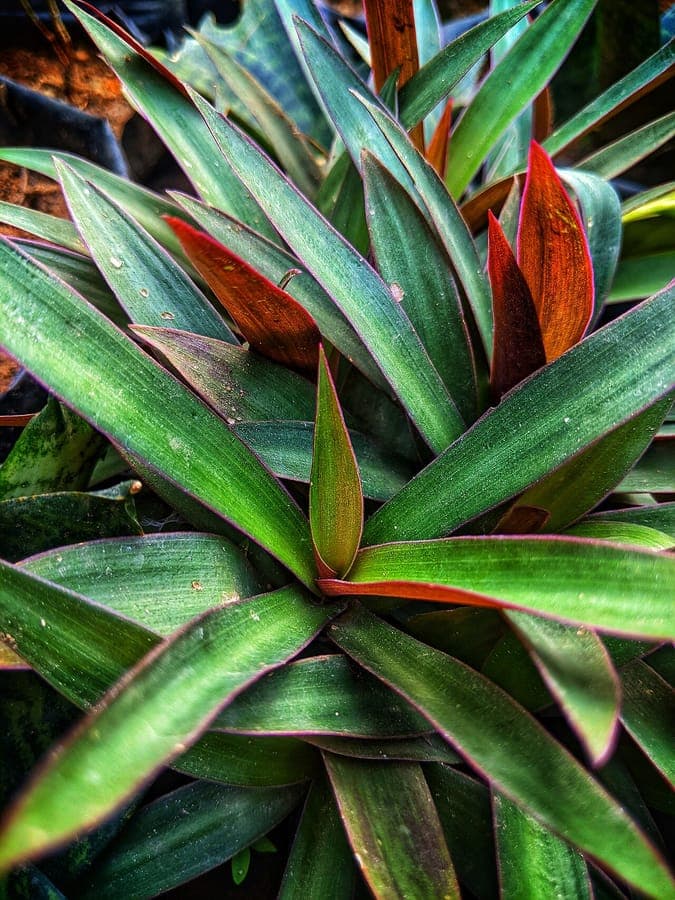
Stephanie cheks / CC BY-SA 4.0, via Wikimedia Commons
Tradescantia spathacea: complete guide
Tradescantia spathacea
Want to see Tradescantia spathacea: complete guide in your garden?
1 minute, no credit card
Overview
Tradescantia spathacea, popularly called Moses-in-the-cradle or boat-lily, is a captivating tropical plant originating from Mexico and Guatemala. It stands out with striking bicolored leaves featuring glossy green tops and deep red to purple undersides. This versatile plant thrives both indoors and outdoors in warm climates.
In its natural habitat within Central American rainforests, it grows in moist, shaded understory areas beneath larger trees and shrubs. This forest-floor preference makes it ideally suited for indoor environments where direct sun exposure is limited.
Appearance and bloom
Tradescantia spathacea develops rosette clusters of elongated leaves in an upright growth pattern. The foliage is glossy green on top while the underside displays characteristic deep red to purple coloring. These striking contrasts make the plant visually compelling.
Small white three-petaled flowers emerge from leaf bracts during the growing season, particularly in warm months. While not showy, these flowers provide pleasant detail. The plant also produces seed pods that add textural interest.
Cultivars with yellow-green or white variegated foliage are also available. Variegated forms prove especially popular among plant collectors and enthusiasts.
Ideal location
Tradescantia spathacea thrives in bright, indirect light. Position it near north- or east-facing windows indoors for optimal diffuse light. Direct afternoon sun can cause leaf scorch and bleaching of the purple undersides.
The plant tolerates shadier locations, though growth slows considerably. In low-light conditions, the vibrant purple underside coloring gradually fades. Adequate indirect light keeps the foliage most colorful.
Maintain temperatures between 18 to 24 degrees Celsius. Tradescantia spathacea dislikes cold and will die at temperatures below 10 degrees. This makes it strictly tropical for cooler regions, requiring protected indoor cultivation.
Soil
Use light, nutrient-rich potting soil based on peat or coco coir. Add 20 to 30 percent perlite or orchid bark for enhanced drainage. Target a slightly acidic to neutral pH around 6.0 to 7.0.
Tradescantia spathacea proves sensitive to waterlogged conditions and root rot. Well-draining potting mix is therefore essential. In humid climates, incorporate additional sand for extra drainage capacity.
Refresh potting soil annually, particularly during the active growing season. This ensures fresh nutrients and relieves compacted soil structure.
Watering
Keep soil evenly moist during the growing season (spring through fall) but never waterlogged. Water when the top centimeter of soil feels dry. Reduce watering significantly during winter dormancy.
Use rainwater or distilled water when possible. Tap water with high mineral content can leave spots on foliage. Ensure pots have drainage holes for excess water removal.
Overwatering represents the most common cause of plant failure. Well-draining potting mix alleviates this risk significantly.
Free design
Want to see Tradescantia spathacea: complete guide in your garden? Make a free design now.
Pruning
Tradescantia spathacea grows relatively slowly and requires minimal pruning. Remove dead or damaged leaves and any weak growth to encourage full expansion.
Pinch a few leaves from shoot tips to encourage bushier development if desired. This stimulates lateral branching and fuller form. However, this plant produces new shoots slowly compared to other Tradescantia species.
Long, bare stems can be carefully cut back to healthy nodes. However, proceed conservatively as this species regenerates more slowly.
Maintenance calendar
Spring (March-May): Begin active growth season. Gradually increase watering. Start monthly fertilization with balanced formula. Refresh potting soil if necessary.
Summer (June-August): Maintain consistent moisture without waterlogging. Fertilize biweekly. Ensure adequate indirect light and good air circulation for cool microclimate.
Fall (September-November): Reduce watering and fertilization. Monitor regularly for pests. Begin preparation for dormancy period.
Winter (December-February): Minimal watering, no fertilization. Provide adequate indirect light. Keep temperatures above 10 degrees.
Winter hardiness
Tradescantia spathacea is not frost hardy and cannot survive outdoors in temperate zones. In tropical and subtropical regions with mild winters, outdoor cultivation is possible.
In Mediterranean climates, move plants indoors before winter arrives. Maintain indoor temperatures above 10 degrees for survival. Even brief frost exposure kills the plant.
Many gardeners treat it as an annual in cold climates, but indoor cultivation allows multi-year growth and development.
Companion plants
Tradescantia spathacea pairs well with other tropical foliage plants sharing similar moisture requirements. Consider Scindapsus pictus, Alocasia species, and other Tradescantia varieties.
For outdoor cultivation in warm climates, combine with shade-tolerant tropical species. Begonias, Fuchsias, and Impatiens create attractive combinations.
Indoors, it thrives on plant shelving with other compact-growing tropical species for layered visual interest.
Conclusion
Tradescantia spathacea offers fascinating visual appeal for warm-climate interiors and protected outdoor spaces. Its striking purple leaf undersides and straightforward care requirements add color and texture to green spaces. Whether you're beginning your plant journey or managing an extensive collection, this Central American beauty deserves space in your home. With proper drainage, indirect light, and careful watering, you'll enjoy years of botanical satisfaction. Available at garden centers everywhere for accessible pricing.
Visit gardenworld.app for additional inspiration on tropical houseplant selection and care techniques.
Want to see Tradescantia spathacea: complete guide in your garden? Make a free design now.
Upload a photo, pick a style, and get a photorealistic design with plant list in under a minute.
No credit card required


Similar plants
Virginia dayflower: complete guide
Commelina virginica
Full guide to Virginia dayflower (Commelina virginica): ideal location, soil, watering, pruning, winter care and companion plants.
Commelina diffusa: complete guide
Commelina diffusa Burm.f.
Commelina diffusa, the climbing dayflower, is an elegant perennial with soft blue flowers that bloom for just a day. This tropical grower thrives in shaded locations and is ideal for hanging baskets, pergolas, and moist garden corners.
Callisia repens: complete guide
Callisia repens
Creeping Inchplant is an elegant trailing plant with delicate foliage, perfect for hanging baskets and groundcover. Learn how to cultivate this popular houseplant successfully.