Michael Wolf / CC BY-SA 3.0, via Wikimedia Commons
Tradescantia sillamontana: growing white velvet
Tradescantia sillamontana
Want to see Tradescantia sillamontana: growing white velvet in your garden?
Full design in HD: €7.99
Look after your Tradescantia sillamontana with the GardenWorld app
Identify plants with your camera and get a care calendar with reminders for this plant.


Overview
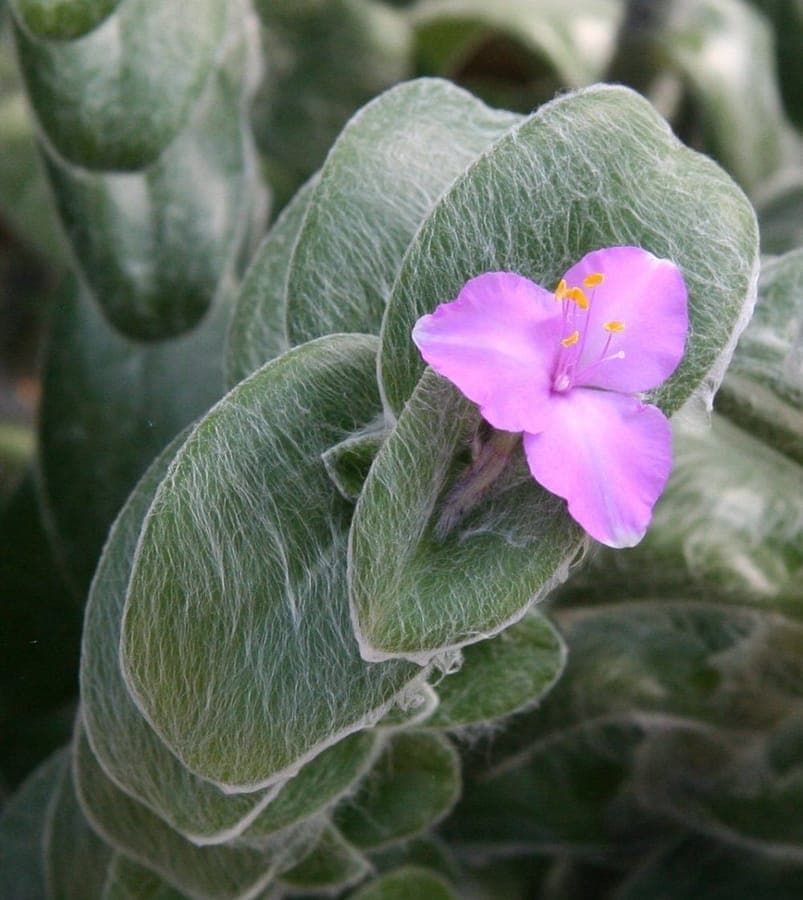
Tradescantia sillamontana is the spiderwort for anyone who thinks they have seen them all. The familiar trailing species with striped or purple leaves usually end up in hanging baskets, but this one grows compact and upright. The leaves are its great feature: they are wrapped in long white hairs, as if someone had draped a woollen cobweb over the plant. That explains its common name, white velvet.
The species comes from north-eastern Mexico, in the state of Nuevo León. Its name refers to the Cerro de la Silla, the saddle-shaped mountain near Monterrey, where it grows among rocks on dry, sunny slopes. That origin explains its character. It tolerates far more sun and drought than other tradescantias, and its slightly fleshy leaves and stems store water. You can treat it more or less as a semi-succulent.
All of this makes Tradescantia sillamontana a rewarding plant for a sunny windowsill, a balcony or a summer patio. If you would like to see how it fits into a bigger scheme, you can have a garden design made on gardenworld.app that also takes your patio pots and containers into account.
Appearance and flowering
The plant forms a loose clump 20 to 40 cm tall. The stems grow upright at first and later arch outwards, so an older plant spills attractively over the edge of its pot. The leaves sit in two ranks along the stem, are oval, roughly 4 to 7 cm long and grey-green, sometimes flushed purple in strong light. The more light it gets, the denser the white hair and the tighter the growth.
From June to September flowers appear at the stem tips. Each has three broad petals in clear pink to magenta and six stamens tipped with yellow anthers, as you can see in the photograph. A single flower lasts just one day, but new ones keep coming for weeks. In winter the plant goes quiet and may let some of its stems die back, then reshoots from the base in spring.
Position and light
Give Tradescantia sillamontana the sunniest spot you have. A south, west or east window works, and a few hours of direct sun a day make the difference between a compact, woolly plant and a lax, green one. In poor light the stems stretch and the leaves lose much of their white coat.
In summer it thrives outdoors. From mid-May, move it to a sunny, sheltered spot. Give it a week in light shade first, because even hairy leaves can scorch if they go straight from a dim room into full sun. A place under an overhang is ideal, since heavy rain flattens the hairy stems and keeps the foliage wet for too long.
Compost and repotting
Use a free-draining mix, for example half multipurpose compost and half cactus compost, or ordinary compost with a generous scoop of perlite or fine grit. A pot with a good drainage hole is essential. Because the plant spreads, it looks good in a wide, shallow pot or bowl.
Repot in March or April as new growth begins. Move a young plant into a slightly larger pot every other year. With an older clump you can divide at the same time: tease the root ball apart gently and pot up each piece with its own roots.
Watering
Let the compost dry out a good way between waterings. During the growing season, from April to September, that usually means once a week, a little more in hot weather, and outdoors in full sun sometimes twice a week. In winter give much less: a small amount every two to three weeks, just enough to stop the roots drying out completely.
Water onto the compost, not over the plant. Water caught among the hairs dries slowly and can cause marks or rot, so misting is unnecessary and best avoided. Dry indoor air does not bother this species at all. Feed once a month during the growing season with half-strength houseplant fertiliser; more than that is not needed and only makes the plant floppy.
Free preview
Want to see Tradescantia sillamontana: growing white velvet in your garden? Make a free preview of your design.
Pruning and propagation
Pruning is simple. In spring, cut long, bare or shrivelled stems back to a few centimetres above the compost, and the plant will quickly reshoot in a compact shape. You can also shorten untidy stems during summer; pinching out the tips makes the plant bushier.
Every piece you cut off is a ready-made cutting. Take a length of 8 to 10 cm, strip the lower leaves and push it into moist cutting compost or stand it in a glass of water. Roots appear within two to three weeks. Plant several cuttings together in one pot for a full result. This is also the easiest way to replace an old, woody plant with a fresh one every few years.
Care calendar
January and February: Winter rest in a bright, cool spot at around 12 to 16 °C. Little water.
March and April: Cut back, repot or divide. Gradually increase watering.
May: From mid-May, harden off and move outdoors to a sunny, sheltered spot.
June to August: Flowering time. Water when the compost is dry and feed monthly. Take cuttings.
September: Flowering tails off. Stop feeding.
October: Bring indoors before nights fall below 8 °C.
November and December: Rest, little water and as much light as possible.
The plant calendar on gardenworld.app shows month by month which jobs are due for your houseplants and patio plants.
Hardiness
In its homeland Tradescantia sillamontana is used to cool, dry winters, and it is tougher than most houseplants. Growers report that the rootstock can come through light frost in dry soil, even though the foliage dies back. In a wet British or northern European winter you should not rely on that. Bring the plant inside before frost and overwinter it bright and cool, ideally between 10 and 16 °C. A warm, dark winter spot produces long, pale stems, which are best cut away in spring.
Toxicity to pets
Spiderworts are not highly poisonous, but the sap can irritate the skin. Redness and itching have been described in cats and dogs that brush against the plant a lot or chew it, especially around the mouth and on the paws. People with sensitive skin can react in the same way, so wear gloves if you are doing a lot of pruning or taking cuttings. Keep the plant out of reach of a cat that likes to nibble leaves, for example on a high shelf or in a hanging pot.
Companion plants
The silvery white foliage sits well with other grey or hairy plants that enjoy the same dry, sunny conditions. Kalanchoe tomentosa also has felted leaves, edged in brown, and echoes the texture nicely. A blue-grey Echeveria elegans or a glossy Crassula ovata adds contrast. If you want to play with spiderworts, place it beside Tradescantia pallida with its purple leaves; together they make a striking colour pairing. Tradescantia zebrina also works, but it wants a little less sun and more water, so give it its own pot.
Final thoughts
Tradescantia sillamontana is a tough, undemanding plant that gives a lot for very little care. Give it plenty of sun, let the compost dry between waterings, keep the leaves dry and cut it back hard in spring. In return you get a woolly, silver clump that carries pink flowers all summer. And because cuttings root so readily, after one season you will have plenty to give away.
Frequently asked questions about Tradescantia sillamontana
Is Tradescantia sillamontana winter hardy?
In its homeland Tradescantia sillamontana is used to cool, dry winters, and it is tougher than most houseplants. Growers report that the rootstock can come through light frost in dry soil, even though the foliage dies back.
When and how do you prune Tradescantia sillamontana?
Pruning is simple. In spring, cut long, bare or shrivelled stems back to a few centimetres above the compost, and the plant will quickly reshoot in a compact shape.
How much water does Tradescantia sillamontana need?
Let the compost dry out a good way between waterings. During the growing season, from April to September, that usually means once a week, a little more in hot weather, and outdoors in full sun sometimes twice a week.

See it in your garden
See Tradescantia sillamontana in your garden
One photo of your garden and a few questions. You see the result in about a minute.
Try it with a photoIdentify this plant in your own garden. Identify a plant
Similar plants
Tradescantia zebrina (Inchplant): complete guide
Tradescantia zebrina
Master Inchplant cultivation: colors, growth habits and stunning displays. Complete care guide for this tropical beauty.
Purple queen: complete guide
Tradescantia pallida
Tradescantia pallida or purple queen is a stunning foliage plant with deep purple leaves. Perfect for indoors and containers. Learn growing and care tips.
Kalanchoe tomentosa: complete guide
Kalanchoe tomentosa Baker
Panda plant (Kalanchoe tomentosa) is a fuzzy-leaved succulent from Madagascar with woolly foliage and purple flowers. Perfect for living rooms, windowsills, and dry zones.
