
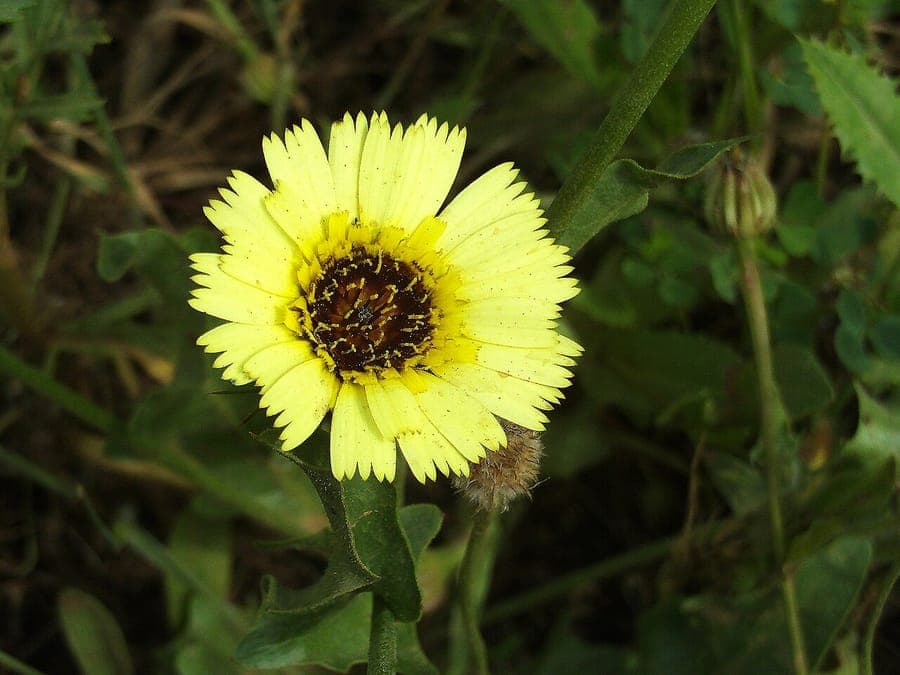
Javier martin / Public domain, via Wikimedia Commons
Tolpis barbata: complete guide
Tolpis barbata
Want to see Tolpis barbata: complete guide in your garden?
1 minute, no credit card
Overview
Tolpis barbata, also known as European umbrella milkwort or yellow hawkweed, is an annual or biennial plant native to the Mediterranean region. This graceful plant with its fine, delicate structure and bright yellow flowers is a staple of Mediterranean and drought-tolerant gardens. With its preference for sunny locations and dry soils, Tolpis barbata is an excellent choice for gardeners wanting to create low-maintenance landscaping.
Appearance and bloom
Tolpis barbata reaches 30-60 cm in height and forms an upright, branching shrubby form. The plant has dark green, linear to lance-shaped leaves that clasp the stems along their length. From May to October, numerous yellow flowers appear that resemble small yellow daisies with black florets. Each flower is approximately 1.5 cm in diameter with both disc and ray florets in the same bright yellow color.
Ideal location
Tolpis barbata blooms best in full sun with at least 6-8 hours of direct sunlight per day. Ensure excellent drainage to prevent overwatering. This plant is ideal for dry climates, coastal gardens, Mediterranean gardens, pergolas, borders and containers.
Soil
Tolpis barbata prefers well-draining, sandy soils. The plant thrives in poor to moderately fertile soils and dislikes heavy, clay-like material. When grown in pots, this plant does fine in standard potting soil with added sand or perlite for better drainage. Neutral to slightly alkaline pH (7-7.5) is ideal.
Free design
Want to see Tolpis barbata: complete guide in your garden? Make a free design now.
Watering
Once established, Tolpis barbata is very drought-tolerant. Water moderately during the growing season, and dry in winter. Overwatering can cause root rot, so ensure the soil dries out between waterings. In rainy areas, minimal additional watering may be needed.
Pruning
Regular deadheading (removal of faded flowers) encourages continued flowering from May to October. Cutting back approximately one-third of the plant after flowering promotes fuller, healthier growth pattern.
Maintenance calendar
- Spring (March-May): Sow seeds directly in the ground or start seedlings indoors. Light feeding at first growth.
- Summer (June-August): Deadhead regularly for continued flowering. Minimal watering.
- Autumn (September-November): Reduce watering. Still blooms until first frost.
- Winter (December-February): Remove plant or pull out. No maintenance needed.
Winter hardiness
Tolpis barbata is not hardy in cold climates. In USDA zones 9-11 it can be grown as an annual or biennial. In cooler zones treat as an annual and reseed each year. The plant feels at home in Mediterranean-like climates with mild winters.
Companion plants
Tolpis barbata combines well with other drought-tolerant Mediterranean plants such as lavender, rosemary, santolina and other yellow summer-flowering plants for a colourful effect.
Closing thoughts
Tolpis barbata is a summer-flowering plant that is easy to grow and requires little maintenance. With sunny location, good drainage and minimal watering, this plant will provide bright yellow flowers from spring to fall. Visit gardenworld.app and gardenworld.app for inspiration.
Want to see Tolpis barbata: complete guide in your garden? Make a free design now.
Upload a photo, pick a style, and get a photorealistic design with plant list in under a minute.
No credit card required


Similar plants
Calendula stellata: complete guide
Calendula stellata
Complete guide to Calendula stellata, the star-flowered marigold from Sicily: location, soil, watering and companion planting tips.
Korean chrysanthemum: complete guide
Chrysanthemum x rubellum
Chrysanthemum x rubellum is a hardy autumn perennial with single pink to copper flowers from August to November. Care and combinations.
Helianthus divaricatus: complete guide
Helianthus divaricatus
Helianthus divaricatus is a North American woodland sunflower with yellow summer blooms, ideal for naturalistic borders and shady edges.