
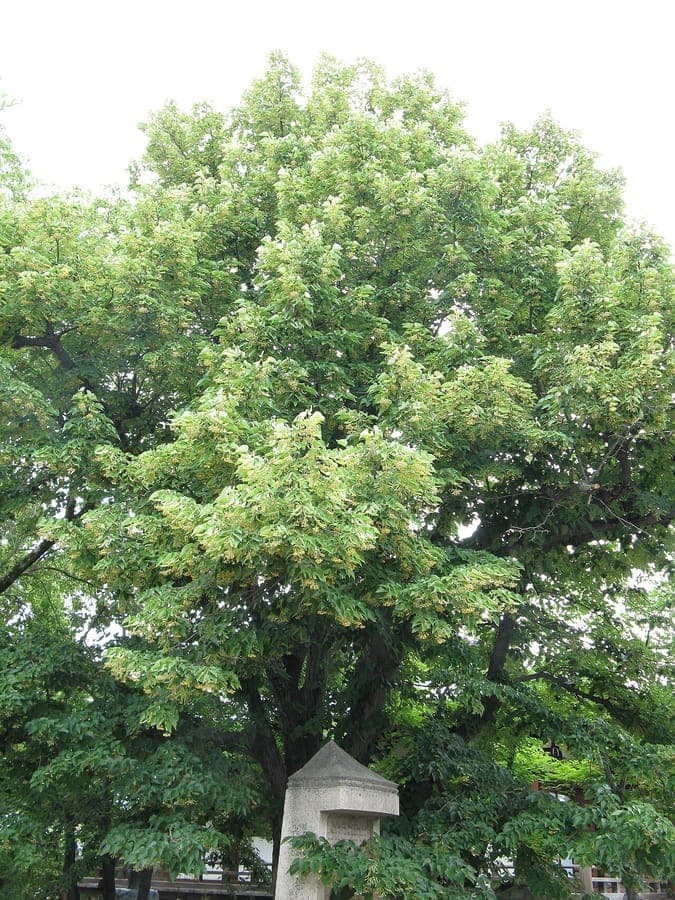
KENPEI / CC BY-SA 3.0, via Wikimedia Commons
Tilia miqueliana: complete guide
Tilia miqueliana
Want to see Tilia miqueliana: complete guide in your garden?
1 minute, no credit card
Overview
Tilia miqueliana is an elegant, frost-hardy tree from the Malvaceae family (now reclassified from Tiliaceae), originating from Southeast China. This tree species is named after botanist Auguste Miquel and reaches 15-20 meters height in its natural habitat. In front yard context, it's a great choice for larger gardens where you seek a classic, fragrant shade tree with interesting foliage.
Tilia miqueliana is distinguished by its large, irregularly serrated leaves and interesting tree form. With its preference for moist soil and full sun, it grows robustly and healthily. The tree is valuable for its shade casting, fragrance during bloom, and ecological value for insects.
Appearance & Bloom
Tilia miqueliana is a medium-sized tree with a broad, rounded crown. The trunk is dark gray with furrowed bark. The leaves are large - up to 12 centimeters long - deep green and irregularly double-serrated. They are heart-shaped at the base with a pointed tip. Fall coloring is nice yellow.
Blooming occurs in May-June with small, yellow flowers in clusters along the leaf side. The fragrance is pleasant and sweet, highly attractive to honeybees. After blooming, small winged nuts form - the characteristic Tilia fruits promoting wind dispersal.
The tree also displays interesting twig structure in winter when leafless.
Ideal Location
Tilia miqueliana grows best in full sun to light partial shade - ideally 6-8 hours of direct sunlight. The tree is flexible and can grow in partial shade, though this may affect tree form.
Choose a location with sufficient space for a mature tree - minimum 8-10 meters distance from buildings. Perfect for large front yard designs where you want plenty of shade. Plant it where passersby can enjoy the fragrance during bloom.
Soil
Tilia miqueliana prefers moist, well-draining soil. The tree grows on varied soil types but prefers neutral to slightly acidic (pH 6-7). The plant is not fussy, but ensures stable growth.
Ensure sufficient depth for roots - minimum 60 centimeters of undisturbed soil. Work ample organic material before planting. Avoid heavy compaction around the plant. The tree grows better in slightly acidic soils than in strongly alkaline ones.
Free design
Want to see Tilia miqueliana: complete guide in your garden? Make a free design now.
Watering
Tilia miqueliana has moderate water needs. In the first year after planting you need regular water until the root system matures. After that, the tree is fairly water-efficient except in severe drought.
In normal rainfall the tree thrives well. In dry periods - especially in early years - water regularly. Water deeply but not daily spraying. Mulch around the tree to improve moisture retention.
Pruning
Tilia miqueliana requires minimal pruning. Remove only dead, diseased, or crossing branches. Prune around May or July after blooming.
The tree naturally forms a beautiful shape and doesn't need drastic cutting back. Avoid heavy pruning - this can damage form and health. Young trees can be lightly trimmed to encourage structure.
Maintenance Calendar
March-April: Plant in full sun to partial shade. Ensure adequate planting hole. Water regularly.
May-June: Enjoy fragrant bloom. Remove spent flowers. Ensure adequate water.
July-August: Tree grows actively. Check watering needs. Light pruning if needed.
September-October: Preparation for fall. Water regularly until first frost.
November-February: Winter dormancy. Minimal maintenance. Check branches for damage.
Winter Hardiness
Tilia miqueliana is winter hardy down to about -15°C in well-draining soil. In northern Europe completely frost-hardy without protection. The tree stems from mountain regions in China, so frost resistance is strong.
In extremely cold winters young branches may be damaged, but the tree recovers easily. Mulch young trees in first winter for extra protection.
Companion Plants
Tilia miqueliana is a specimen tree but can be part of larger planting schemes. Consider:
- Underplanting with shade-tolerant plants such as Hosta, Helleborus
- Taller understory with Sarcococca, Viburnum
- Climbing plants on trunks for extra interest
- Shade-tolerant groundcover around the base
- Other trees at distance for woodland effect
Its large size makes it dominant in composition.
Closing
Tilia miqueliana is a beautiful, fragrant tree for large front yard designs. With its elegant form, interesting leaves, and fragrant blooming, it offers much visual and olfactory value. Perfect for classic front yard designs with tree-shade theme.
Visit specialized tree nurseries for quality trees. Tilia miqueliana fits perfectly with GardenWorld.app's philosophy of sustainable, long-term front yard designs with tree shade.
Discover more large shade trees on GardenWorld.app!
Want to see Tilia miqueliana: complete guide in your garden? Make a free design now.
Upload a photo, pick a style, and get a photorealistic design with plant list in under a minute.
No credit card required


Similar plants
Crimean linden: complete guide
Tilia × euchlora
Crimean linden is an elegant, fast-growing shade tree ideal for large gardens. Discover cultivars, spacing, maintenance tips and winter hardiness.
California flannelbush: complete guide
Fremontodendron californicum
Everything about California flannelbush (Fremontodendron californicum): sunny placement, drainage, pruning and care for this spectacular yellow-flowering shrub.
Hairy rose mallow: complete guide
Hibiscus moscheutos subsp. lasiocarpos
Full growing guide for hairy rose mallow (Hibiscus moscheutos subsp. lasiocarpos): location, soil, watering, winter hardiness and garden design tips.