
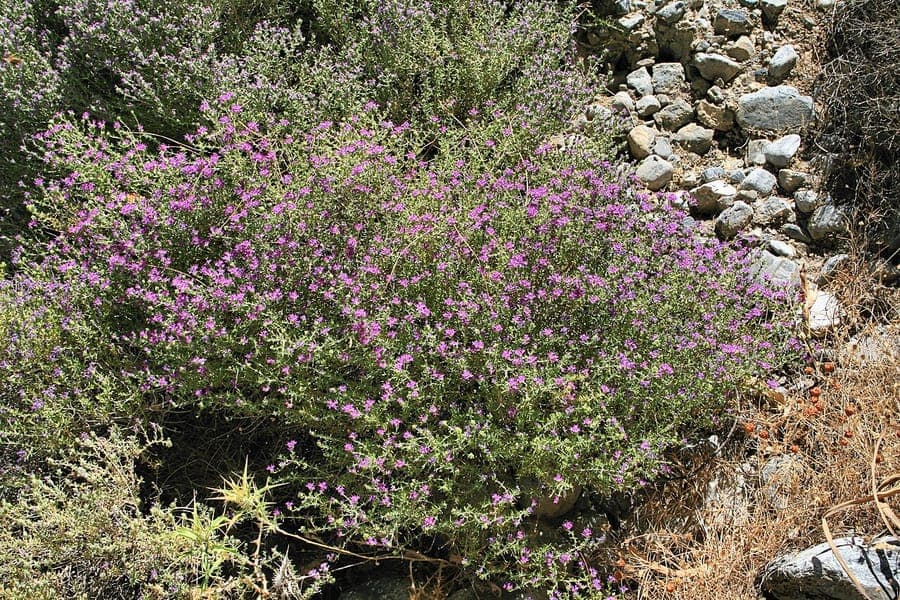
Lapplaender / CC BY-SA 3.0 de, via Wikimedia Commons
Thymbra capitata: complete guide
Thymbra capitata
Want to see Thymbra capitata: complete guide in your garden?
1 minute, no credit card
Overview
Thymbra capitata, commonly known as Mediterranean wild thyme, Conehead thyme or Thym a tetes in French, is a charming aromatic herb from the Lamiaceae family. This Mediterranean shrub grows wild in the hot, dry coasts and slopes of the Mediterranean region, from North Africa to Turkey.
Thymbra capitata is more than ornamental. The plant has been used for centuries for culinary and medicinal purposes in traditional Mediterranean cuisine. With its intoxicating fragrance and beautiful flowers, it's a valuable addition to any garden, especially those with a Mediterranean or dry-climate focus.
Appearance and bloom
Thymbra capitata is a compact, slightly woody dwarf shrub typically growing 15-40 cm tall. The plant has a round, neat growth habit with numerous thin stems. The stems are initially green, later brown to grayish-brown.
The foliage is the real asset of this plant. The leaves are small, linear and very aromatic, with a strong thyme scent when touched. The foliage is green to grayish-green, densely packed on the stems.
Flowers appear from March to October, depending on location and weather. They grow in dense, rounded to oval flower heads atop the stems. The flowers are purple-pink to violet-purple. They are much larger and more conspicuous than many other thyme species, giving the plant high ornamental value. Bees and butterflies adore the flowers.
Ideal location
Thymbra capitata is a sun worshipper. Plant it in full sunlight, receiving at least 6-8 hours of direct sun daily. The more sun, the more aromatic the foliage and the more abundant the flowers.
The plant tolerates light shade but flowers far less abundantly. Always ensure well-ventilated locations without heavy afternoon shade.
Soil
Thymbra capitata is very flexible regarding soil. The plant grows well in poor, lean soils and even accepts very dry situations. The only requirement is good drainage.
Amend the soil with gravel, sand or perlite to improve drainage. The plant tolerates both acidic and alkaline soils. Too much nutrition can lead to less intense fragrance and leaf yellowing.
Free design
Want to see Thymbra capitata: complete guide in your garden? Make a free design now.
Watering
Thymbra capitata is a Mediterranean drought-tolerance champion. Once planted, the plant can survive extended periods without water. Water regularly in the first growing season, but once established, you can reduce watering dramatically.
In very extreme drought, you may give some watering, but this is a plant that clearly prefers dry conditions over wet ones. Overwatering is the most common cause of death.
Pruning
Thymbra capitata responds well to pruning, especially if you prune the plant when young. Trim the plant back to halfway after flowering, usually in April-May for summer pruning, and in October for autumn shaping.
Regular pruning prevents the plant from becoming too old and woody and encourages more compact growth. You can also pick flowers for use in the kitchen.
Maintenance calendar
Winter (November-February): Practically no maintenance required. Plant is fully hardy.
Spring (March-May): Begin regular watering. Enjoy the abundant flowers. Perform first pruning after flowering.
Summer (June-September): Water only in extremely dry periods. Foliage can be used for tea or culinary use.
Fall (October-November): Perform autumn pruning. Water only in very dry periods.
Winter hardiness
Thymbra capitata is very hardy to about -15 to -20C. This makes it suitable for planting in most parts of the Benelux. In very harsh areas, protection with dead leaves can help.
The plant is very frost-resistant, especially if it has well-drained soils. However, moist soils combined with frost can cause problems.
Companion plants
Thymbra capitata combines beautifully with other Mediterranean herbs and drought-tolerant plants. Plant it alongside Rosemary, Lavender, Santolina, or other thyme varieties.
Rock gardens benefit from clustering Thymbra capitata with small groups of the same plant, combined with gray-foliaged plants like Stachys byzantina.
Closing thoughts
Thymbra capitata is an absolute must-have for Mediterranean gardens and for anyone who loves aromatic herbs. With its beautiful flowers, intense fragrance and virtually maintenance-free nature, it's a plant that offers much benefit for minimal effort. Plant it in full sun with well-drained soil and enjoy years of beauty and aroma. Available at Intratuin and Gamma. More information at gardenworld.app.
Want to see Thymbra capitata: complete guide in your garden? Make a free design now.
Upload a photo, pick a style, and get a photorealistic design with plant list in under a minute.
No credit card required


Similar plants
Apple mint (Mentha x villosa): complete guide
Mentha x villosa
Meet apple mint (Mentha x villosa): a fruity-scented kitchen herb with woolly leaves, perfect for tea and mojitos.
Salvia peyronii: complete guide
Salvia peyronii
Discover Salvia peyronii, a rare Lebanese mountain sage. Growing tips, hardiness, and companion planting for a Mediterranean gravel garden.
Bigleaf mint (Mentha x rotundifolia): complete guide
Mentha x rotundifolia
Discover bigleaf mint: cultivation, care tips, and garden uses. Learn how to grow this aromatic herb with soft, hairy leaves.