
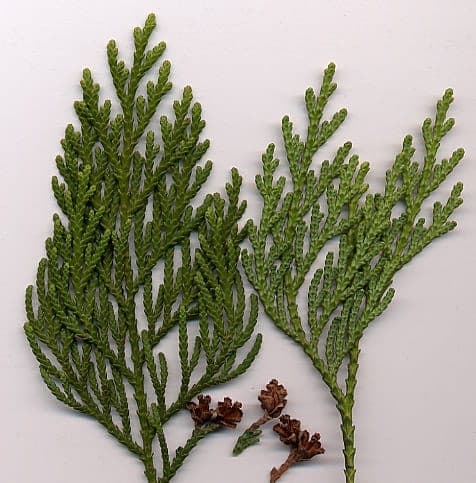
en:User:MPF / CC BY-SA 3.0, via Wikimedia Commons
Japanese arbor-vitae: complete guide
Thuja standishii
Want to see Japanese arbor-vitae: complete guide in your garden?
1 minute, no credit card
Overview
Thuja standishii, commonly known as Japanese arbor-vitae, is a stately evergreen conifer native to the mountain forests of Honshu, Japan. It thrives in temperate climates and brings a refined vertical presence to gardens across USDA hardiness zones 6 to 8. Mature trees reach 10–15 meters in height with a spread of 3–4 meters, growing at a moderate pace of 20–30 cm per year. Its narrow, pyramidal form makes it ideal for hedges, screens, or as a standalone specimen. Unlike some fast-growing Thuja cultivars, standishii maintains good density without becoming leggy, especially when planted in full sun.
Gardeners in the UK and northern Europe appreciate its resilience and year-round presence. On gardenworld.app, you can design a layout that integrates Japanese arbor-vitae seamlessly into formal hedges or woodland edges.
Appearance & bloom cycle
The foliage of Thuja standishii is soft, scale-like, and ranges from bright green in spring to deep emerald in summer. Young growth has a slightly yellowish tinge, adding seasonal contrast. The bark is reddish-brown and peels in thin strips as the tree matures. While not grown for its flowers, the tree produces small, inconspicuous purple male cones in March and April, followed by tiny, woody seed cones (8–10 mm long) that persist through winter. These are not showy but contribute to the plant's natural appeal, especially in quiet garden settings.
Ideal location
Plant Japanese arbor-vitae in full sun to light shade. For densest growth and vibrant color, a spot with at least 6 hours of direct sunlight is ideal. In heavy shade, lower branches may thin out and the plant can become sparse. A sheltered position, away from harsh east or north winds, helps prevent winter desiccation, particularly in exposed gardens. This tree works well in formal hedges, as a windbreak, or as a focal point near patios. Allow at least 2.5 meters of space around the trunk to accommodate root spread and avoid competition with structures.
For layout ideas combining this conifer with shade-tolerant perennials, check gardenworld.app's planting planner.
Soil requirements
Japanese arbor-vitae is adaptable but performs best in moist, well-drained soil. It tolerates a pH range from slightly acidic to neutral (5.5–7.0). Avoid heavy clay soils that retain water, as prolonged saturation leads to root rot. Sandy loams are ideal. At planting, mix in organic matter like compost or well-rotted manure to improve soil structure. Established trees handle short dry spells, but extended droughts may cause browning of leaf tips, especially in young plants.
Free design
Want to see Japanese arbor-vitae: complete guide in your garden? Make a free design now.
Watering
Water thoroughly during the first growing season-about 10–15 liters per plant, twice weekly during dry spells. After establishment (year two), it becomes fairly drought-tolerant. However, during prolonged summer heat, especially in sandy soils, supplemental watering maintains vigor. Mulching around the base with bark or leaf mold helps retain moisture and regulate soil temperature.
Pruning
Pruning isn't essential for health, but it's useful for shaping hedges or maintaining a tidy form. The best time is late spring to early summer (May–June), after the flush of new growth. Avoid pruning in late summer or autumn, as new shoots won't harden before winter. Use sharp, clean shears and never cut into bare wood-Thuja doesn't regenerate well from old wood. For formal hedges, two trims per year (late May and early August) keep the shape tight and dense.
Maintenance calendar
- Jan: Inspect for snow damage or broken branches.
- Feb: Plan pruning; check for pests if grown in sheltered spots.
- Mar: Monitor for early signs of aphids or spider mites.
- Apr: Apply slow-release conifer fertilizer; light trim if needed.
- May: Main hedge trimming; check soil moisture.
- Jun: Apply mulch to conserve water.
- Jul: Water deeply during heatwaves.
- Aug: Second hedge cut; avoid late pruning.
- Sep: Stop all pruning to allow hardening.
- Oct: Clear fallen debris from base.
- Nov: Protect young plants with burlap in cold areas.
- Dec: Check for ice buildup on branches.
Winter hardiness
Hardy in USDA zones 6–8 (-23°C to -12°C), Japanese arbor-vitae handles most UK and northern European winters well. Young plants may suffer from winter burn-browning foliage due to wind and dry air. Wrap vulnerable specimens with horticultural fleece or erect windbreaks. Avoid autumn feeding, as it encourages soft growth that won't survive frost.
Companion plants
Pair Thuja standishii with Fargesia bamboo for texture contrast, or use Carex 'Evergold' and Hosta for soft understory planting. Rhododendrons and Japanese maples (Acer palmatum) enhance the woodland feel. Avoid invasive groundcovers that compete for moisture. For a modern look, combine with ornamental grasses like Hakonechloa macra.
Closing
Thuja standishii is a long-lived, elegant conifer that adds structure and year-round interest. With minimal care and proper placement, it thrives for decades. Choose healthy stock from reputable garden centres like those stocking quality conifers. For design inspiration and precise spacing tools, visit gardenworld.app.
Want to see Japanese arbor-vitae: complete guide in your garden? Make a free design now.
Upload a photo, pick a style, and get a photorealistic design with plant list in under a minute.
No credit card required


Similar plants
Cupressus macnabiana: complete guide
Cupressus macnabiana
The Fragrant Cypress offers elegant growth with fine, aromatic foliage. Perfect for temperate climates and as specimen trees in contemporary gardens.
Cupressus guadalupensis: complete guide
Cupressus guadalupensis
The Guadalupe cypress: an elegant conifer for gardens. Complete cultivation guide for this Mexican cypress. Information about care, location, form and maintenance.
Austrocedrus chilensis: complete guide
Austrocedrus chilensis
Discover Austrocedrus chilensis, the Chilean Cedar ornamental conifer. Elegant specimen with fine foliage and columnar form for permanent structure.