
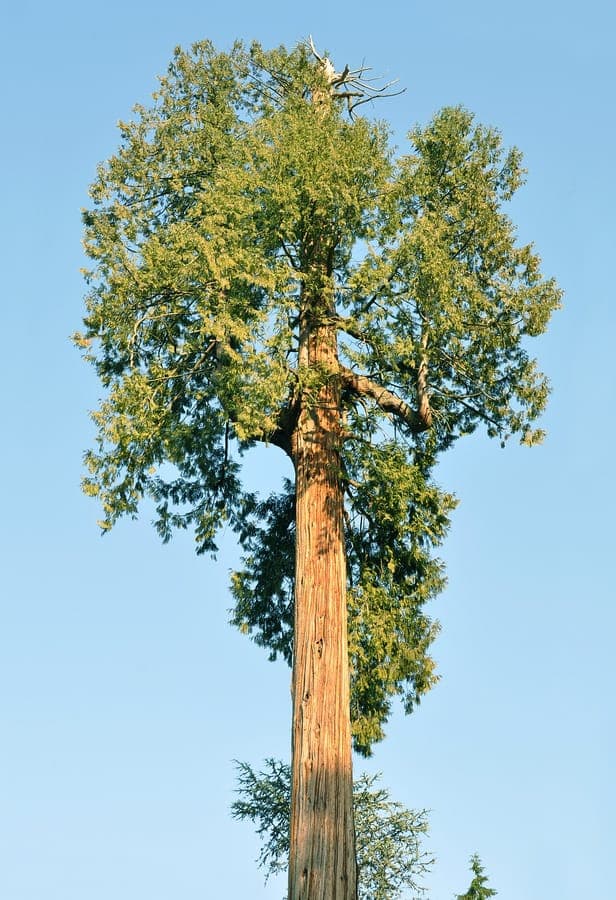
abdallahh from Montréal, Canada / CC BY 2.0, via Wikimedia Commons
British Columbia red cedar: complete guide
Thuja plicata
Want to see British Columbia red cedar: complete guide in your garden?
1 minute, no credit card
Overview
Thuja plicata, known commonly as British Columbia red cedar, is a majestic evergreen tree native to the Pacific Northwest, stretching from Alaska down to northern California. In its natural habitat, it can tower up to 60 meters, but in garden settings across the UK, Europe, and similar temperate zones, it typically reaches 10 to 20 meters tall with a spread of 3 to 5 meters. It's a long-lived, slow but steady grower, gaining 30 to 50 cm annually under ideal conditions. This conifer from the Cupressaceae family is prized for its dense, vertical form, making it a top choice for hedges, windbreaks, and standalone specimen trees.
On gardenworld.app you can visualise how a mature Thuja plicata fits into your garden layout, including projected spread and shade patterns. Its rich green, scale-like foliage creates a lush screen year-round, offering both privacy and noise reduction. While not native to the UK or Western Europe, it adapts well when planted in the right spot.
Appearance & bloom cycle
The British Columbia red cedar has flat, feathery sprays of dark green foliage, with a distinctive white 'X' or 'V' marking on the underside of each branchlet – a helpful ID feature. The bark is fibrous, reddish-brown, and deeply furrowed, giving it a rugged, natural character.
In spring (April to May), small yellowish-brown male and female cones appear. The male cones release pollen, while the female ones mature into ovoid, 8–12 mm-long seed cones that turn brown by autumn. Though not showy, these add texture in winter when most plants are bare. The tree maintains full foliage through winter, showing only minimal shedding of older leaves.
Ideal location
Aim for a site with full sun to light shade – a light rating of 8 out of 10. While it tolerates partial shade, dense foliage and strong growth require at least 6 hours of direct sunlight daily. Avoid deep shade, which leads to thinning and weak growth.
Allow plenty of space: plant at least 3 meters from buildings or other large trees. For hedges, space plants 80 cm to 1.2 meters apart. On gardenworld.app, you can simulate different spacing options and view how the hedge will close in over 3–5 years. Avoid planting in confined areas or near underground utilities, as the root system spreads widely.
Soil requirements
Thuja plicata thrives in moist, well-drained soils with a pH between 5.1 and 7.1. It handles clay, loam, and sandy soils, provided they don't become waterlogged. In heavy clay, amend with grit or compost to improve drainage. On dry sandy soils, mulch heavily and irrigate regularly during establishment.
Avoid highly alkaline or calcareous soils – these can cause chlorosis (yellowing leaves). A 5 cm layer of organic mulch helps retain moisture and suppress weeds. Don't pile mulch against the trunk to prevent rot.
Free design
Want to see British Columbia red cedar: complete guide in your garden? Make a free design now.
Watering
During the first two to three growing seasons, consistent watering is essential. Give each young tree 10–15 liters once a week during dry spells. Use a soaker hose or irrigation spike to deliver water deep into the root zone. Avoid frequent shallow sprinkling.
Once established, the tree is moderately drought-tolerant but benefits from deep watering during prolonged dry periods, especially in summer. Overwatering or poor drainage leads to root rot – a common issue in compacted or clay-heavy sites.
Pruning
This thuja doesn't require regular pruning, but it responds well to shaping. Prune in June or early July, after the spring growth flush. Avoid late autumn or winter cuts, as new growth may not harden off before frost.
Use sharp, sterilised shears. Never cut back into bare, non-leafy wood – Thuja plicata won't regenerate from old wood. Limit pruning to one-third of the new season's growth. For hedges, a light trim twice a year (June and August) keeps them dense and tidy.
Maintenance calendar
- Jan: Inspect for storm or snow damage
- Feb: Clear debris; no pruning
- Mar: Plant new trees if soil isn't frozen
- Apr: Begin watering during dry spells
- May: Monitor for pests (e.g. spider mites) and fungal issues
- Jun: First light pruning; check soil moisture
- Jul: Second trim if needed; water deeply in heat
- Aug: No pruning; irrigate during drought
- Sep: Top up mulch layer
- Oct: Leave fallen cones and leaf litter for wildlife
- Nov: Check for root rot in wet soils
- Dec: Protect young trees from winter wind with burlap
Winter hardiness
Thuja plicata is hardy in USDA zones 5 to 8, tolerating temperatures down to -20°C. It performs well in the UK (zone 8) and most of Western Europe. Young trees may suffer from winter desiccation, especially in exposed, sunny spots. Shield them with burlap or windbreak fabric.
Mulch the root zone in late autumn to insulate roots. Water during dry winter spells when the ground isn't frozen – this prevents moisture loss from wind and sun.
Companion plants
Pair with other conifers like yew (Taxus baccata) or Norway spruce (Picea abies) for layered evergreen structure. Beneath the canopy, plant shade-tolerant perennials: Heuchera, Bergenia, Hosta, or Helleborus. For seasonal colour, add spring bulbs like Eranthis hyemalis or Chionodoxa.
Avoid invasive ground covers like periwinkle (Vinca minor) that may compete for water. Stick to low-maintenance, non-spreading plants that won't interfere with root development.
Closing
The British Columbia red cedar is a reliable, elegant tree for larger gardens and landscapes. With room to grow and proper care, it becomes a living fixture that lasts decades. It's not suited for small urban plots, but in spacious settings, it delivers unmatched presence and function.
Buy healthy specimens from reputable garden centres or nurseries like B&Q, Wyevale, or local independents. Look for plants with even green foliage and no signs of dieback. Planning with gardenworld.app ensures your Thuja plicata has space to thrive without future conflicts.
Want to see British Columbia red cedar: complete guide in your garden? Make a free design now.
Upload a photo, pick a style, and get a photorealistic design with plant list in under a minute.
No credit card required


Similar plants
Cupressus macnabiana: complete guide
Cupressus macnabiana
The Fragrant Cypress offers elegant growth with fine, aromatic foliage. Perfect for temperate climates and as specimen trees in contemporary gardens.
Cupressus guadalupensis: complete guide
Cupressus guadalupensis
The Guadalupe cypress: an elegant conifer for gardens. Complete cultivation guide for this Mexican cypress. Information about care, location, form and maintenance.
Austrocedrus chilensis: complete guide
Austrocedrus chilensis
Discover Austrocedrus chilensis, the Chilean Cedar ornamental conifer. Elegant specimen with fine foliage and columnar form for permanent structure.