
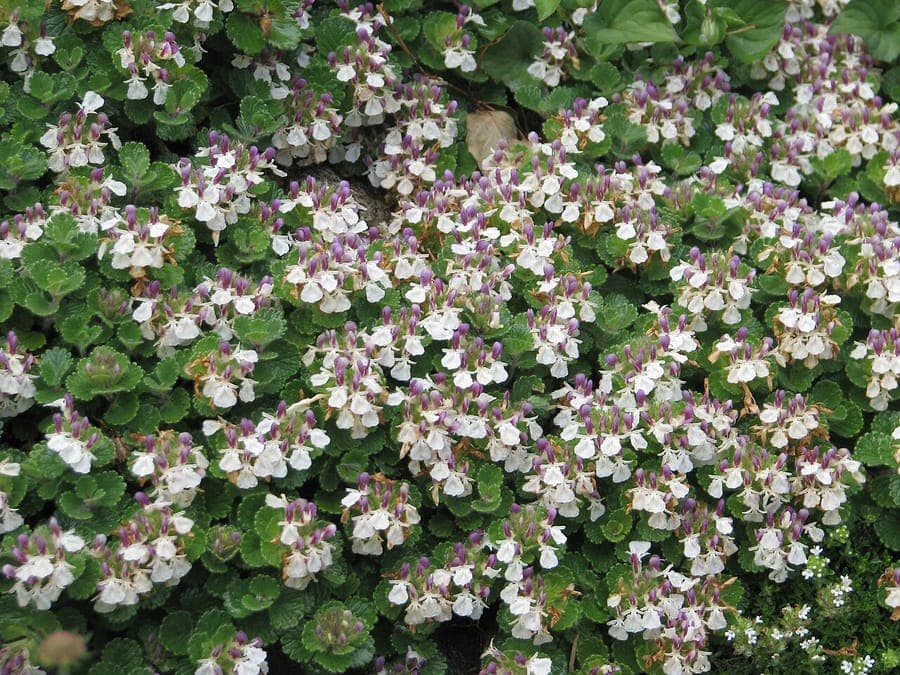
peganum from Small Dole, England / CC BY-SA 2.0, via Wikimedia Commons
Pyrenean Germander: Complete Guide to This Alpine Gem
Teucrium pyrenaicum
Want to see Pyrenean Germander: Complete Guide to This Alpine Gem in your garden?
1 minute, no credit card
Overview
The Pyrenean germander (Teucrium pyrenaicum) is a charming, low-growing dwarf shrub from the mountain regions of France and Spain. This plant is a favorite among alpine gardeners because of its robustness, purple flowers, and minimal maintenance demands.
The plant forms dense, cushion-like mats perfectly suited for rocky outcrops, alpine troughs, and dry stone gardens. In its natural habitat, Teucrium pyrenaicum grows on limestone rocks at 1500-2500 meters elevation, where it withstands extreme weather conditions.
Appearance and Bloom
The Pyrenean germander is an extreme dwarf - typically no taller than 15-25 centimeters, spreading to 30-40 centimeters wide. The plant forms compact, cushion-shaped masses of small, grey-green foliage.
Flowers appear from July through September in lovely purple shades on short, thick flower spikes. These small flower heads (tubular flowers with two lips) are attractive to pollinators, particularly bees. After blooming, small seed capsules form.
The foliage remains yellow-grey and decorative even in winter, extending seasonal interest.
Ideal Location
The Pyrenean germander thrives in bright, sunny locations with excellent drainage. 6+ hours of direct sunlight daily is ideal. In very hot climates, the plant tolerates light afternoon shade (15% shade).
Plant in raised beds, rock gardens, or steep slopes where excess water cannot pool. The plant fails in low, wet spots.
Protection from strong wind is unnecessary - the plant is extremely wind-resistant due to its low growth habit and compact form.
Soil
The Pyrenean germander prefers very well-draining, limy (alkaline) soil. This is the key to success. Work sand, perlite, and gravel into the top 30 centimeters.
Heavy clay is unsuitable without significant amendment. For rock gardens: use specialized alpine potting mix (50% sand/gravel, 50% garden loam/compost).
A pH of 7.0-8.5 is ideal. Very acidic soils (pH below 6.0) can be problematic.
Watering
Once established (after 1-2 seasons), the Pyrenean germander is highly drought-tolerant. During the first year, water regularly (weekly, light spraying) to aid establishment.
In the established phase, minimal extra watering is needed - water only in extreme drought (3+ weeks without rainfall).
Overwatering is the greatest threat. Ensure drainage is always perfect. Better underwatered than overwatered.
Free design
Want to see Pyrenean Germander: Complete Guide to This Alpine Gem in your garden? Make a free design now.
Pruning
Minimal to no pruning is needed. The plant grows naturally into an attractive shape. Remove only spent flower heads after blooming (deadheading) to promote extended flowering.
In spring, very light pruning may be used to maintain shape, but often unnecessary.
If the plant becomes larger and shaggy, summer pruning (August) can help, though full rejuvenation pruning is not recommended.
Maintenance Calendar
Spring (March-May): Very light pruning possible, no fertilization needed (alpine plants thrive in poor soils).
Summer (June-August): Enjoy the blooming period, deadheading to promote extended flowering.
Autumn (September-October): Blooming decreases, plant prepares for winter.
Winter (November-February): Complete rest, no watering (snow/rain suffices), no pruning or feeding.
Winter Hardiness
The Pyrenean germander is fully hardy to USDA 5 (-29 degrees Celsius), though USDA 6-7 (-23 to -18 degrees) is typical. In most of Northern Europe, winter hardiness is no concern.
Full rain/snow protection is unnecessary. The plant tolerates wet winters well, as long as drainage remains perfect.
Snow as an insulating blanket is actually beneficial.
Companion Plants
The Pyrenean germander combines beautifully with other alpine dwarfs:
- Draba - similar growth preference
- Sempervivum (houseleek) - rocky form
- Phlox subulata - complementary purple flower color
- Saxifraga - alpine texture
- Silver artemisia (Artemisia schmidtiana) - grey-silver contrast
Conclusion
The Pyrenean germander is an unbeaten choice for alpine and dry stone gardens. With its purple summer flowers, compact form, and exceptional hardiness, this plant adds genuine mountain charm to any garden.
Specialist alpine nurseries stock this plant regularly. Gardenworld.app helps you integrate this mint-sized jewel into your garden plan. Plant in groups of 3-5 for maximum effect, surrounded by other drought-tolerant dwarf species.
The Pyrenean germander: small in stature, great in character.
Want to see Pyrenean Germander: Complete Guide to This Alpine Gem in your garden? Make a free design now.
Upload a photo, pick a style, and get a photorealistic design with plant list in under a minute.
No credit card required


Similar plants
Apple mint (Mentha x villosa): complete guide
Mentha x villosa
Meet apple mint (Mentha x villosa): a fruity-scented kitchen herb with woolly leaves, perfect for tea and mojitos.
Salvia peyronii: complete guide
Salvia peyronii
Discover Salvia peyronii, a rare Lebanese mountain sage. Growing tips, hardiness, and companion planting for a Mediterranean gravel garden.
Bigleaf mint (Mentha x rotundifolia): complete guide
Mentha x rotundifolia
Discover bigleaf mint: cultivation, care tips, and garden uses. Learn how to grow this aromatic herb with soft, hairy leaves.