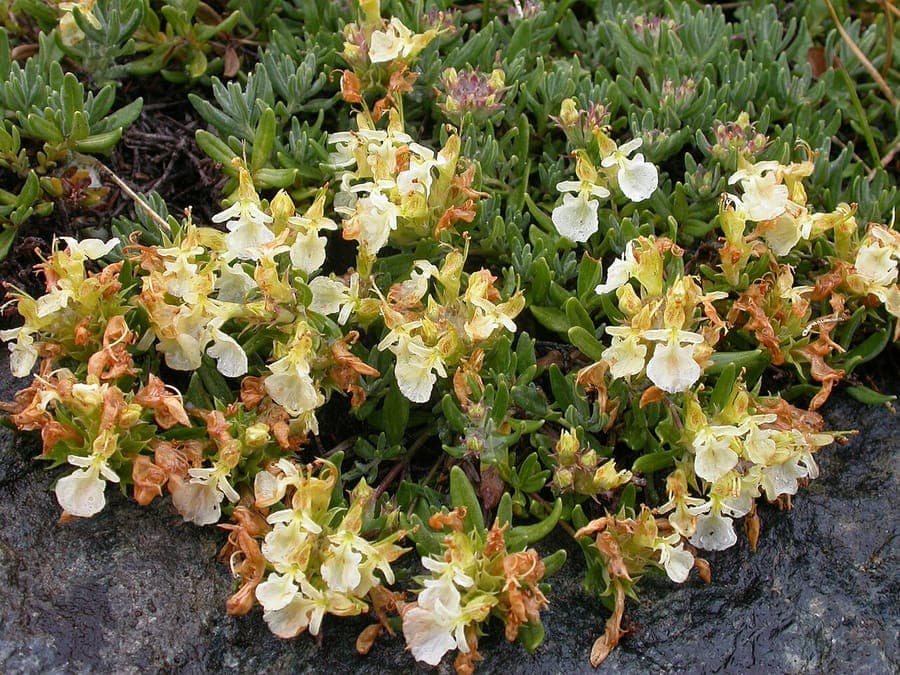
No machine-readable author provided. Thommybe assumed (based on copyright claims). / CC BY-SA 3.0, via Wikimedia Commons
Mountain germander: complete guide
Teucrium montanum
Want to see Mountain germander: complete guide in your garden?
Full design in HD: €7.99
Look after your Mountain germander with the GardenWorld app
Identify plants with your camera and get a care calendar with reminders for this plant.


Overview
Mountain germander (Teucrium montanum) is a compact, alpine plant from the Lamiaceae family that is native to the mountain regions of Central and South Europe. This evergreen dwarf shrub is ideal for rock gardens and alpine landscapes.
Appearance and bloom
Mountain germander grows as a dense, low shrub, usually 10-20 cm high with broad spreading. The leaves are small, linear and hairy, with a grey-green appearance. The flowers are white to light pink and appear in short, dense spikes from May to August. The plant creates an impressive flower display and attracts bees.
Ideal location
Mountain germander grows optimally in very sunny, warm positioned spots. The plant is sensitive to shade and thrives poorly in partial shade. In rock gardens and alpine gardens very suitable. Ensure good drainage and ventilation.
Soil type
The plant grows well in draining, stony soils. Mountain germander prefers lean to moderately fertile soil with good drainage. A pH of 7.5-9.0 (slightly alkaline) is optimal. Heavy clay and waterlogging should be avoided.
Free preview
Want to see Mountain germander: complete guide in your garden? Make a free preview of your design.
Watering
Once established Mountain germander is very drought-resistant. Water moderately during the first year. After that limited watering needed, only in long dry spells. Excessive moisture can be harmful. The plant tolerates frost-dry periods well.
Pruning
Pruning stimulates compact form. After flowering, light cutting back helps maintain density. In spring hardened stems can be shortened. Minimal winter maintenance needed.
Maintenance calendar
Water moderately in growing season. After flowering light cutting back. No fertilizer needed. In autumn light cleaning.
Winter hardiness
Mountain germander is very winter hardy, down to -25 degrees Celsius. However sensitive to wet winters. Ensure excellent drainage to prevent frost damage. In very damp climates protection may be needed.
Companion plants
Mountain germander grows beautifully with alpine lavender, saxifraga, stylus and alpine juniper. Also together with iberis, low lavender and other mountain herbs.
Conclusion
Mountain germander is a valuable plant for rockery and alpine gardens. The white-pink flowers provide summer color. Perfect for dry, sunny mountains. Discover more: gardenworld.app/en
Frequently asked questions about Mountain germander
Is Mountain germander winter hardy?
Mountain germander is very winter hardy, down to -25 degrees Celsius. However sensitive to wet winters.
When and how do you prune Mountain germander?
Pruning stimulates compact form. After flowering, light cutting back helps maintain density.
How much water does Mountain germander need?
Once established Mountain germander is very drought-resistant. Water moderately during the first year.
Where does Mountain germander grow best?
Mountain germander grows optimally in very sunny, warm positioned spots. The plant is sensitive to shade and thrives poorly in partial shade.
What soil does Mountain germander need?
The plant grows well in draining, stony soils. Mountain germander prefers lean to moderately fertile soil with good drainage.

See it in your garden
See Mountain germander in your garden
One photo of your garden and a few questions. You see the result in about a minute.
Try it with a photoIdentify this plant in your own garden. Identify a plant
Similar plants
Agastache rupestris: sunset hyssop for hot, dry borders
Agastache rupestris
Growing Agastache rupestris, sunset hyssop: salmon-orange flowers from July to October, aniseed foliage, drainage, pruning and getting it through a wet winter.
Beautyberry (Callicarpa bodinieri): complete guide
Callicarpa bodinieri
Everything about beautyberry (Callicarpa bodinieri) and 'Profusion': position, soil, pruning and hardiness for the shrub with vivid violet berries in autumn and winter.
Bluebeard (Caryopteris × clandonensis): complete guide
Caryopteris × clandonensis
Everything about bluebeard (Caryopteris × clandonensis): sunny position, well-drained soil, spring pruning and hardiness for this late summer, bee-friendly shrub.
