
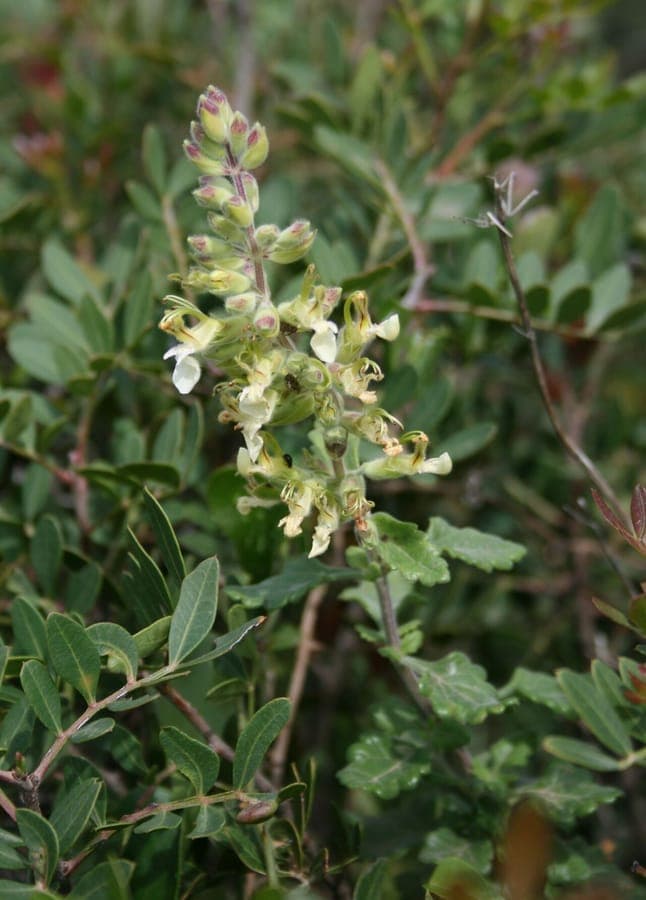
Franz Xaver / CC BY-SA 3.0, via Wikimedia Commons
Teucrium flavum: complete guide
Teucrium flavum
Want to see Teucrium flavum: complete guide in your garden?
1 minute, no credit card
Teucrium flavum, known as yellow germander, is a characteristic Mediterranean shrub from the Lamiaceae family. This plant distinguishes itself through its bright yellow flowers and fine, grey-green foliage originating from the Mediterranean region.
Overview and Appearance Yellow germander is a compact, low-growing shrub usually reaching 30 to 60 centimeters in height. The plant forms a dense, angular growth pattern with fine, greyish-green leaves that are aromatic. Characteristic yellow flowers appear at branch tips and are small but striking. These blooms attract bees and butterflies.
Geographic Distribution Teucrium flavum naturally occurs throughout the Mediterranean region, particularly in Spain, Italy, Greece and Turkey. It grows in dry, sometimes rocky habitats, along slopes and in scrubland vegetation. The plant is adapted to the hot, dry Mediterranean climate.
Flowers and Bloom Time Small yellow flowers, approximately 1 centimeter across, appear in spike-like clusters at stem tips. Flowering typically runs from May through October, making this a long-blooming plant. Flowers attract pollinators including butterflies and honeybees.
Growth Requirements and Location Teucrium flavum thrives optimally on very sunny, warm locations. At least six to eight hours of direct daily sunlight is desirable. This is a plant for full sun garden positions.
Soil Requirements Yellow germander prefers well-draining, even dry soil. Heavy clay soils should be avoided. Supplementing with sand or fine gravel improves drainage. The plant tolerates poor, nutrient-poor soils well.
Watering Needs Once established, Teucrium flavum displays excellent drought tolerance. Regular water during the growing season helps, but once established the plant tolerates long periods without supplemental water. Avoid waterlogging.
Pruning and Shaping Prune in early spring before new growth appears to maintain shape. Remove dead or damaged branches. Light pruning after flowering encourages more compact growth.
Maintenance Calendar February-March: Perform pruning tasks. April-May: Growth accelerates and flowering begins. June-October: Flowering in full. November-January: Winter rest with minimal tasks.
Winter Hardiness Teucrium flavum is not very winter hardy and does not tolerate much cold. In cold regions it must be protected from frost or kept indoors as a container plant. In the UK it cannot overwinter outdoors without protection.
Shade and Drought Tolerance Although preferring sunlight, it tolerates some partial shade. Drought tolerance is one of the plant's strengths.
Companion Plants Combine yellow germander with other Mediterranean plants such as Lavandula, Rosmarinus and Santolina. Silver-foliaged plants like Artemisia make fine contrast plants. Ornamental grasses like Festuca can grow beneath for added dimension.
Pests and Diseases The plant is generally very resistant to diseases and pests. In very humid conditions, fungal problems can occur, especially if the plant is not well-ventilated.
Use in Garden Design Yellow germander is excellent for xeriscapes, Mediterranean gardens and dry slopes. Use in groups for maximum visual impact. The plant also makes an attractive container specimen.
Aroma and Herbs The leaves are aromatic with a characteristic herbaceous scent. In some Mediterranean cultures, leaves are used for tea-making.
Conclusion Teucrium flavum is a charming Mediterranean plant that demands sunlight and dry soils. With minimal care it provides years of yellow flowering. Find this plant at specialist nurseries and Mediterranean plant centers.
Want to see Teucrium flavum: complete guide in your garden? Make a free design now.
Upload a photo, pick a style, and get a photorealistic design with plant list in under a minute.
No credit card required


Similar plants
Apple mint (Mentha x villosa): complete guide
Mentha x villosa
Meet apple mint (Mentha x villosa): a fruity-scented kitchen herb with woolly leaves, perfect for tea and mojitos.
Salvia peyronii: complete guide
Salvia peyronii
Discover Salvia peyronii, a rare Lebanese mountain sage. Growing tips, hardiness, and companion planting for a Mediterranean gravel garden.
Bigleaf mint (Mentha x rotundifolia): complete guide
Mentha x rotundifolia
Discover bigleaf mint: cultivation, care tips, and garden uses. Learn how to grow this aromatic herb with soft, hairy leaves.