
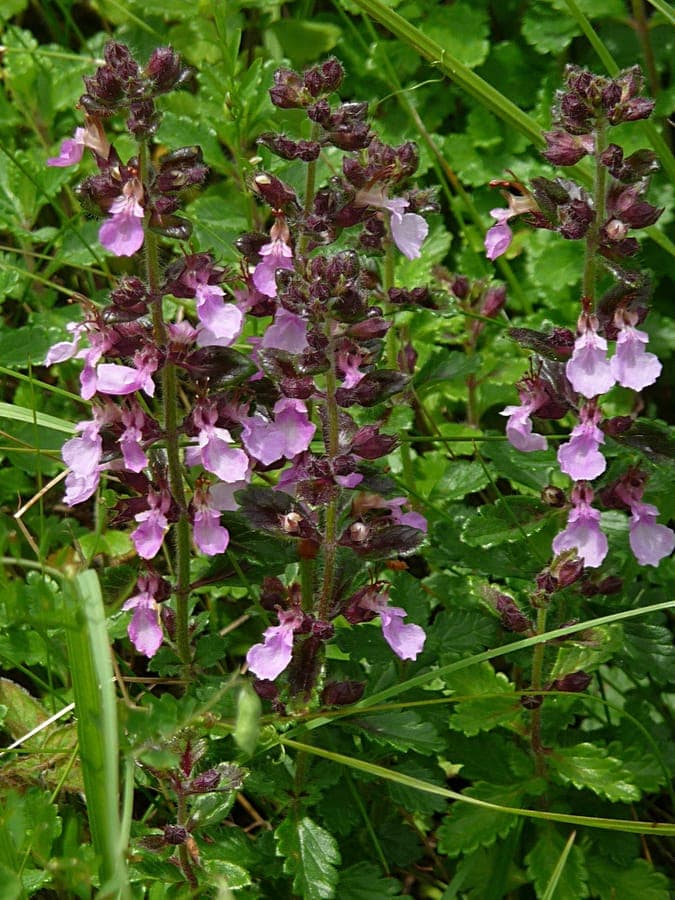
Konrad Lackerbeck / CC0, via Wikimedia Commons
Wall germander: complete guide
Teucrium chamaedrys
Want to see Wall germander: complete guide in your garden?
1 minute, no credit card
Overview
Wall germander (Teucrium chamaedrys) is a strong, low-growing plant from the Lamiaceae family that originally comes from Southeast Europe and the Mediterranean region. This evergreen groundcover is a classic garden plant with charming purple flowers and dense growth pattern.
Appearance and bloom
Wall germander grows as a compact shrub, usually 15-30 cm high with spreading lateral growth. The leaves are small, linear and glossy green, giving the plant a fine structure. Purple to pink flowers appear from July to October and form semi-long spikes. Each flower is about 1 cm long and very attractive to bees and butterflies.
Ideal location
Wall germander grows optimally in warm, fully sunny spots. The plant thrives in partial shade as well, although flowering production decreases. Ensure good air circulation to prevent fungi. Perfect for pergolas, walls and borders front.
Soil type
The plant grows well in many soils, but prefers well-draining, moderately fertile soils. Wall germander is very frost-sensitive and tolerates poor, dry soils. A pH of 6.5-8.0 is optimal. Avoid heavy clay soils and waterlogging.
Free design
Want to see Wall germander: complete guide in your garden? Make a free design now.
Watering
Once established Wall germander is very drought-resistant. Water regularly during the first year. After that, watering can be drastically reduced. Excessive moisture can cause root rot. In dry summers targeted watering helps.
Pruning
Pruning stimulates compact growth. In early spring prune about a third of the height. After flowering, faded material can be removed. In autumn light cleaning pruning helps maintain shape.
Maintenance calendar
In the growing season periodic inspection. After flowering removal of dead flowers. In spring and autumn targeted maintenance pruning. No fertilizer needed.
Winter hardiness
Wall germander is evergreen but not fully hardy in very cold areas (below -10 degrees Celsius). In temperate zones very reliable. In cold winters leaves can be damaged but plant recovers.
Companion plants
Wall germander combines well with lavender, sage, white geranium and low roses. Also together with stylish silvery foliage and dry shrubs. Ideal for gravel gardens.
Conclusion
Wall germander is an elegant, reliable plant for Mediterranean and contemporary gardens. It creates beautiful borders and attracts pollinators. Perfect choice for dry, sunny locations. Discover more: gardenworld.app/en
Want to see Wall germander: complete guide in your garden? Make a free design now.
Upload a photo, pick a style, and get a photorealistic design with plant list in under a minute.
No credit card required


Similar plants
Apple mint (Mentha x villosa): complete guide
Mentha x villosa
Meet apple mint (Mentha x villosa): a fruity-scented kitchen herb with woolly leaves, perfect for tea and mojitos.
Salvia peyronii: complete guide
Salvia peyronii
Discover Salvia peyronii, a rare Lebanese mountain sage. Growing tips, hardiness, and companion planting for a Mediterranean gravel garden.
Bigleaf mint (Mentha x rotundifolia): complete guide
Mentha x rotundifolia
Discover bigleaf mint: cultivation, care tips, and garden uses. Learn how to grow this aromatic herb with soft, hairy leaves.