
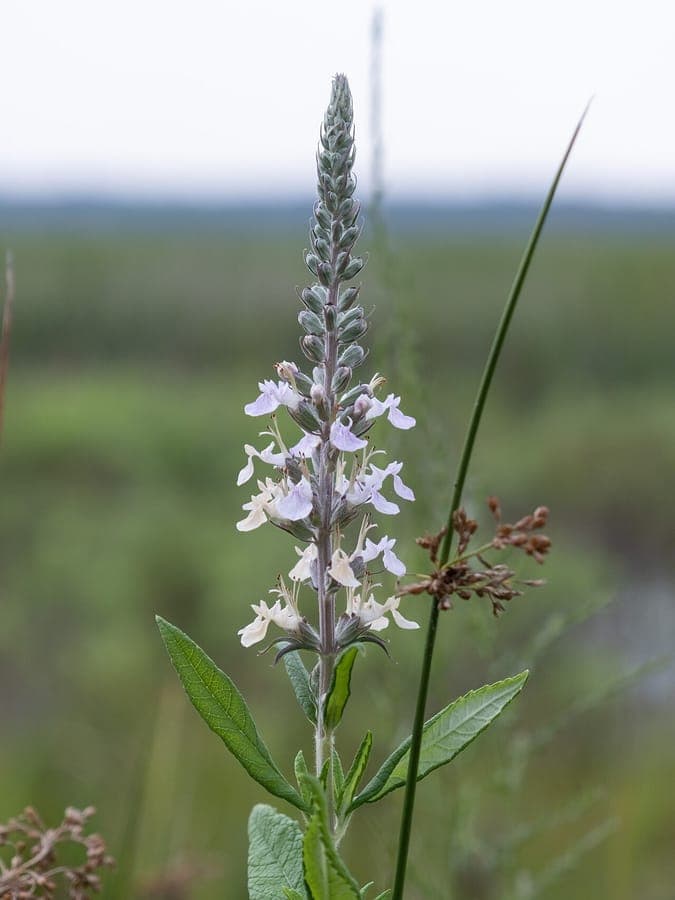
[https://www.inaturalist.org/users/alex_abair Alex Abair} / CC BY 4.0, via Wikimedia Commons
American germander: complete guide
Teucrium canadense
Want to see American germander: complete guide in your garden?
1 minute, no credit card
Overview
Teucrium canadense, known as American germander, Canada germander, or wood sage, is a vigorous native perennial in the mint family (Lamiaceae) with a remarkably wide natural range across North America. It occurs from southern Canada through the eastern United States, across the Midwest, into the Southwest and south to Mexico and Cuba. In the wild it favours moist to wet habitats: river banks, marshes, wet meadows, and the shaded edges of riparian woodlands.
The genus Teucrium contains around 300 species worldwide, with the Mediterranean region as the centre of diversity, but Teucrium canadense is the dominant North American representative. In French it is known as Germandrée du Canada. The plant attracts considerable interest from gardeners because of its long-lasting spikes of lavender to pink-purple flowers that bloom through summer and are especially attractive to bumblebees, sweat bees, and butterflies.
For gardeners with wet corners, pond margins, or rain gardens, American germander is a practical and beautiful solution. It thrives precisely where many other perennials fail. On gardenworld.app you can find ideas for designing garden spaces around moisture-loving plants that remain attractive throughout the growing season.
Appearance and bloom cycle
American germander grows as an upright perennial typically reaching 40 to 90 cm tall, occasionally to 120 cm in ideal conditions. The stems are square in cross-section - a reliable characteristic of the mint family - and covered in fine grey-white hairs that give the entire plant a slightly silvery, grey-green appearance. This attractive foliage tone contrasts beautifully with the flower colour.
The leaves are lance-shaped to oval, with clearly toothed margins, and slightly paler on the underside. The foliage colour is classified as grey, which gives the plant year-round interest even before and after flowering. The texture is medium: not coarse, not delicate.
The flowers are small, two-lipped blooms densely clustered into slender terminal spikes. Their colour ranges from pale lavender to deeper pink-purple, occasionally with a paler throat. Flowering runs from June through August, sometimes extending into September. This extended bloom period - two to three months of colour - makes it exceptionally valuable in the garden. The flowers are rich in nectar and attract a constant stream of pollinators throughout the summer.
After flowering, small brown nutlets develop. Seeds are persistent and the plant also spreads vegetatively by rhizomes, making it moderately aggressive in ideal conditions.
Ideal location
American germander is naturally suited to moist and wet habitats. In the wild it is found along river banks, in alder and willow carrs, on wet hayfields, and on the damp fringes of riparian forests. It tolerates temporary flooding and performs well in wet, poorly drained areas where many plants would rot.
In the garden it is ideal for a pond margin, a rain garden, a bog garden, or the damp low-lying areas of a yard that drain slowly after rain. It also performs adequately in a conventional border with consistent moisture, but it will be smaller and less floriferous in drier conditions.
For light, it is highly adaptable: it flowers most abundantly in full sun, but tolerates partial shade and even relatively deep shade under open tree canopies. A sunny, moist position is optimal. In hot, dry summers, afternoon shade helps reduce water stress and maintains the plant's best appearance.
Soil requirements
This germander prefers moist to wet, moderately fertile soil. It grows across a remarkably wide range of soil types: sandy loam, clay, silt, and even moderately acidic peaty soils. The pH tolerance spans 4.5 to 8.0, making it broadly adaptable.
Good water retention is the most important soil quality. In dry, sandy soils it remains smaller and blooms less freely. In rich, moist loam or clay it reaches its full potential size and flower production. There is no need for heavy fertilisation: an annual mulch of garden compost or a light spring feed is entirely sufficient.
In a wet garden or pond margin you rarely need to amend the soil at all - this plant works with what is naturally present.
Free design
Want to see American germander: complete guide in your garden? Make a free design now.
Watering
American germander is not drought-tolerant and genuinely needs consistent moisture to perform well. At a pond edge or in a rain garden, natural moisture levels are usually sufficient. In a conventional border that dries out in summer, weekly deep watering is necessary. During hot, dry spells, allow the soil to dry out only minimally at the surface before watering again.
For freshly planted specimens, water daily for the first two to three weeks while the roots establish. After that, twice-weekly watering in normal summer conditions is usually adequate, with daily watering during heat waves.
A 5 to 7 cm layer of mulch around the plant significantly reduces watering requirements by holding moisture in the soil, moderating root temperature, and suppressing weeds that compete for water.
Pruning
American germander benefits from an annual hard cut-back in early spring (March to April): cut the stems back to 10 to 15 cm above the ground. This encourages fresh, compact regrowth and prevents the plant from becoming woody and overly tall.
During the growing season, removing spent flower spikes can trigger a second, lighter flowering flush. If you want to allow some seed set for natural self-seeding or to provide seed for birds, leave a proportion of the spikes intact.
The plant spreads by underground rhizomes and can become quite expansive over time. Dig out unwanted edge runners each spring to keep the clump in bounds. Alternatively, install a root barrier around the planting area at time of planting.
Maintenance calendar
January to February: Plant is dormant. No action needed. Old stems can be left as winter structure if desired.
March to April: Cut back to 10 to 15 cm. Work in compost around the base. Divide overcrowded clumps every three to four years at this time.
May: Strong new growth appears. Remove edge runners if needed. Monitor moisture levels.
June to August: Main flowering period. Enjoy the pollinator-rich spikes. Remove spent spikes to extend flowering. Water during dry spells.
September to October: Flowering winds down. Cut back optionally or leave stems for winter structure.
November to December: Plant retreats to its rhizomes. Apply mulch over the root zone before hard frosts.
Winter hardiness
American germander is reliably winter-hardy across most of western Europe. It is rated for USDA hardiness zones 4 to 9, corresponding to minimum temperatures of -34 to -7 degrees Celsius. In the Netherlands, Belgium, Germany, and the United Kingdom it winters without any protection.
In exceptionally cold winters, a light mulch over the root zone provides insurance. In practice this is rarely needed in maritime western European climates. New shoots emerge reliably from the underground rhizomes each spring, even after a hard winter. Importantly, the plant tolerates the combination of cold and wet soil that kills many other garden perennials - making it genuinely dependable in problem wet spots.
Companion plants
American germander is an excellent companion for other moisture-loving and native plants. At a pond margin it pairs beautifully with purple loosestrife (Lythrum salicaria), marsh marigold (Caltha palustris), arrowhead (Sagittaria), and yellow iris (Iris pseudacorus). In a wet border, Joe Pye weed (Eutrochium/Eupatorium), swamp milkweed (Asclepias incarnata), and cardinal flower (Lobelia cardinalis) make striking companions.
In lightly shaded, moist positions, ferns such as Dryopteris filix-mas and sedges like Carex pendula complement the fine-textured germander well. On sunnier wet sites, Culver's root (Veronicastrum virginicum) and sneezeweed (Helenium) are excellent neighbours that share its preference for reliable moisture.
Garden centres typically stock a good range of moisture-loving plants to build a diverse, wildlife-rich planting around this species.
Closing thoughts
American germander is one of the most adaptable and useful perennials for wet and moisture-rich garden situations. Its long summer bloom of pink-purple flowers, its outstanding value for pollinators, and its ability to thrive in conditions that defeat many other plants make it a genuine asset in any garden with a pond, wet border, or rain garden.
Visit gardenworld.app to discover how to transform wet and damp garden areas into colourful, wildlife-friendly spaces that remain beautiful and productive throughout the entire growing season.
Want to see American germander: complete guide in your garden? Make a free design now.
Upload a photo, pick a style, and get a photorealistic design with plant list in under a minute.
10,000+ gardens designed already
No credit card required


Similar plants
Apple mint (Mentha x villosa): complete guide
Mentha x villosa
Meet apple mint (Mentha x villosa): a fruity-scented kitchen herb with woolly leaves, perfect for tea and mojitos.
Salvia peyronii: complete guide
Salvia peyronii
Discover Salvia peyronii, a rare Lebanese mountain sage. Growing tips, hardiness, and companion planting for a Mediterranean gravel garden.
Bigleaf mint (Mentha x rotundifolia): complete guide
Mentha x rotundifolia
Discover bigleaf mint: cultivation, care tips, and garden uses. Learn how to grow this aromatic herb with soft, hairy leaves.