
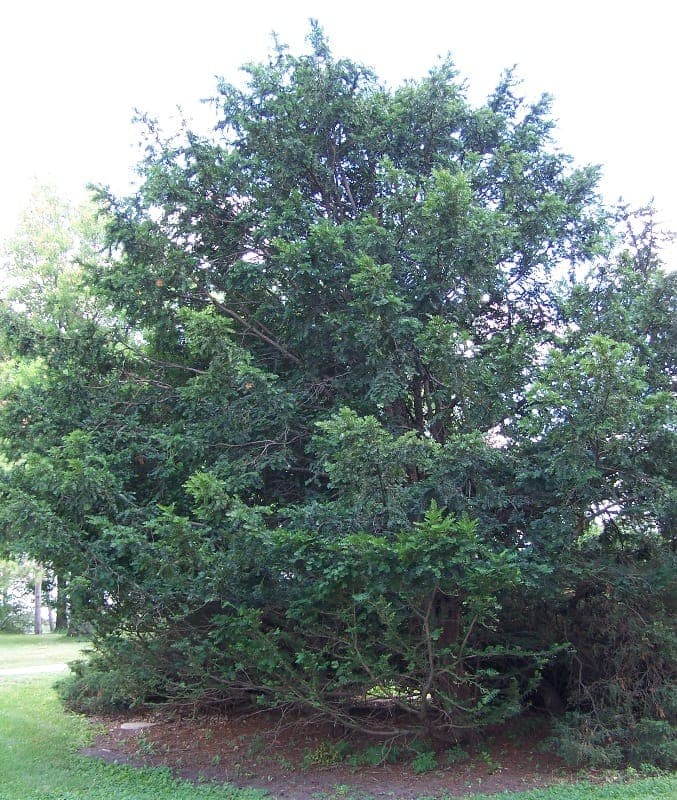
Bruce Marlin / CC BY-SA 3.0, via Wikimedia Commons
Taxus chinensis: complete guide
Taxus chinensis
Want to see Taxus chinensis: complete guide in your garden?
1 minute, no credit card
Overview
Taxus chinensis, commonly known as the Chinese yew, is a frost-hardy conifer widely used in formal and contemporary garden designs. This species originates from mountainous regions of China and Tibet, where it develops into an elegant ornamental shrub. With its refined needle structure and compact, dense growth habit, this plant offers year-round visual interest and value to any garden.
The Chinese yew is renowned for its extremely slow growth rate, making it ideal for formal topiary, hedging, and sculptural pruning projects. Compared to the common English yew (Taxus baccata), this species features slightly broader needles and a more open growth pattern.
Appearance & Bloom
The leaves of Taxus chinensis are linear and flattened, approximately 15-20 mm long, with a characteristic dark green color on the upper surface and lighter green on the underside. The needles remain green throughout the year, providing structural interest even during winter months.
Flowers are small and inconspicuous, yellow-green in color, and appear during spring. Female plants produce distinctive red, fleshy berries called arils, which are highly toxic. These red berries create striking visual contrast against the dark green foliage.
Ideal Location
Taxus chinensis thrives in full light to partial shade conditions. Although this plant is tolerant and can survive in deep shade, it reaches its full potential with at least a few hours of direct sunlight daily. The plant responds well to both open sites and understory positions beneath larger trees.
Ensure adequate air circulation around the plant to prevent prolonged moisture retention on the needles. This helps prevent fungal diseases and pest infestations.
Soil
Taxus chinensis is not particular about soil type and grows well in sandy, clay, and loamy soils. The critical factor is good drainage. Waterlogging is a serious problem for this species and can quickly cause root rot. Amend heavy soils with well-conditioned compost to improve drainage.
The plant prefers neutral to slightly acidic soil with a pH range between 6.5 and 7.5. Ensure adequate organic matter in the soil for moisture retention during drier seasons.
Watering
Once established, Taxus chinensis is a fairly drought-tolerant plant. During the first growing season after planting, regular watering is essential, especially during dry periods. Water deeply and evenly to keep soil moderately moist but not waterlogged.
In established situations, supplemental water is needed only during prolonged droughts. The plant requires less water than many other ornamental conifers. Overwatering can lead to root rot and is far more problematic than underwatering.
Free design
Want to see Taxus chinensis: complete guide in your garden? Make a free design now.
Pruning
The slow growth of Taxus chinensis makes it an excellent candidate for formal pruning work. Light pruning can be done throughout the growing season, removing dead or diseased wood and refining the shape. For more aggressive pruning in topiary projects, conduct this work during early summer or late spring.
The plant responds well to hard pruning and will reshoot from dormant buds, useful for rejuvenating older specimens. Always use sharp pruning tools to make clean cuts and prevent infection.
Maintenance Calendar
Spring: Check for winter damage. Apply a layer of compost around the plant to improve soil organic matter. Begin light pruning work.
Summer: Shape pruning can continue. Ensure the plant receives adequate water during dry spells.
Fall: No special activities required; the plant prepares for dormancy.
Winter: Protect young plants from snow damage in heavy snow regions by wrapping with burlap. Water during dry periods outside the frost season.
Winter Hardiness
Taxus chinensis is extremely hardy to zone 6 (-20 degrees Celsius), making it suitable for most of Europe. In temperate climates, the plant experiences no serious frost damage. In severe winters, needles may show some desiccation from frost drying, but the plant typically recovers without lasting harm.
In areas with extremely heavy snowfall, the weight of snow on branches can cause distortion. Loosely bind young plants to prevent damage.
Companion Plants
Taxus chinensis combines well with other shade-tolerant plants and ornamental conifers. Try combining it with shrubs such as Ilex (holly), Aucuba, and Osmanthus. For contrast, pair it with foliage plants of different structures, such as ferns.
In more formal garden schemes, Chinese yew works excellently in grouped arrangements for symmetrical effects. It also forms a perfect backdrop for flowering plants with more color.
Closing Thoughts
Taxus chinensis is a valuable addition to gardens where structure and formality are desired. With its slow growth, hardiness, and tolerance for various growing conditions, it can ornament your garden for decades with minimal maintenance. For topiary enthusiasts, this is undoubtedly one of the finest choices available.
Ready to add this impressive conifer to your garden? Visit your local tree nursery for healthy, well-formed specimens. On gardenworld.app, discover inspiration for integrating this plant into a cohesive garden design. Don't forget to explore gardenworld.app for more information on other hardy conifers and ornamental plants.
Want to see Taxus chinensis: complete guide in your garden? Make a free design now.
Upload a photo, pick a style, and get a photorealistic design with plant list in under a minute.
No credit card required


Similar plants
Florida Torreya: Complete Guide to This Endangered Evergreen
Torreya taxifolia
Discover the Florida torreya (Torreya taxifolia), an endangered, elegant evergreen. Learn about care, habitat, and conservation importance.
Chinese Nutmeg Tree: complete guide
Torreya grandis
Learn everything about Torreya grandis, the Chinese nutmeg tree. Discover cultivation methods, care, and special characteristics of this rare tree.
Japanese nutmeg tree: complete guide
Torreya nucifera
Discover the Japanese nutmeg tree (Torreya nucifera). A rare conifer with elegant growth and interesting fruits. Perfect garden addition.